Structured Data Extraction From Unstructured Web Content for Entities
Four pipeline stages turn messy HTML into reliable entity records for AI systems.

Structured data extraction from unstructured web content is an engineering discipline. Reliable entity records depend on four distinct stages, namely retrieval, cleaning and context shaping, schema enforcement, and validation. Treating those stages as separate responsibilities is what turns a brittle extraction script into a production pipeline whose output can support LLMs, retrieval-augmented generation, and agents.
Why web entity data is structurally unextractable by default
Company profiles, product data, people records, and financial events are published in HTML designed for human browsers. The available information’s presentation creates a format mismatch that is a foundational obstacle to dependable entity extraction. Freshness adds another constraint because web entity data changes by the hour. Model training data cannot take the place of live retrieval when the record keeps changing.
That distinction divides extraction tools into two segments, namely document AI and OCR platforms for static files, and web-scraping and AI-pipeline APIs for live URLs. The former handle PDFs, forms, invoices, and scanned images, returning fields and confidence scores. The latter retrieve web content and produce JSON or Markdown for machine consumption. Choosing across those segments creates a fundamental mismatch between the tool and the task. Because both the source format and the freshness requirement are structural, solving the problem requires distinct pipeline stages.
The four stages that turn raw HTML into a machine-ready entity record
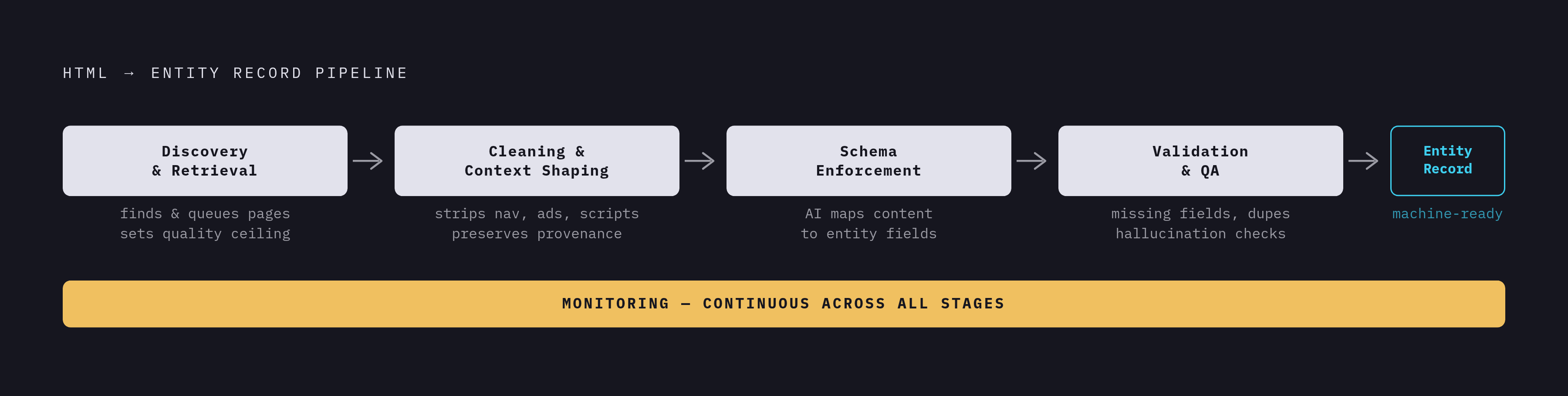
Discovery and retrieval establish which pages enter the pipeline. This stage finds and queues content while accounting for pagination and category structure. Its output sets the quality ceiling for everything that follows because an extraction model cannot recover records that were never retrieved. Cleaning and context shaping then turn that retrieved material into usable context. They remove navigation, ads, scripts, and footers before those elements consume model capacity or obscure entity content.
Schema enforcement maps the cleaned content into a defined output structure. At this stage, an AI agent produces the entity fields that downstream systems will use. Validation and QA then test those records for missing fields, out-of-range values, and duplicates. Separating field production from checking matters because a record can look complete while still being wrong. The pipeline needs both the ability to produce an answer and a way to test whether that answer meets its requirements.
These stages run in sequence, but monitoring spans the whole process. A site change can undermine extraction accuracy after an otherwise sound pipeline has been deployed. Monitoring must continue while the pipeline runs, beyond the final step of implementation. This decomposition also locates failures more precisely. Missing source content, noisy context, poor field mapping, and unchecked records are different problems, even when they produce the same disappointing result downstream.
What retrieval quality determines before extraction begins
Retrieval design determines which failures an extraction model will inherit. Teams that jump directly to an LLM call can ship a pipeline before discovering that its inputs are incomplete. A simple HTTP fetcher may miss content rendered by client-side scripts, while incomplete handling of pagination or category structure can leave records undiscovered. These failures can be silent because receiving a page is not the same as receiving the required entity content.
Traditional SERP APIs route queries through proxy networks and return short text snippets. Those snippets are insufficient when an entity task requires the complete body of a record. AI-native retrieval layers instead combine capabilities such as semantic reranking, real-time crawling, and boilerplate removal to produce structured Markdown.
Retrieval must also account for the conditions under which pages can be accessed. Anti-bot defenses tuned to AI-related crawling make proxy management, CAPTCHA handling, and rate-limiting retrieval responsibilities. Hybrid search uses both BM25 keyword matching and vector similarity to balance precision and recall, which directly affects which entity records the pipeline sees.
Why context shaping before the LLM is an engineering discipline, not a preprocessing nicety
Cleaning is the middle stage that teams often skip when moving from a raw fetch to an LLM call. That shortcut sends navigation, ads, scripts, and footers into the same context as the entity information. At pipeline scale, the token cost of this noise can dwarf the cost of the useful content. The model must also work through material it does not need, which makes it harder to extract fields consistently.
Context-aware filtering retains the evidence needed for extraction while removing content that does not serve the task. Choosing the output format is part of the same work because the token cost changes with the format. Across millions of calls, that choice compounds into the pipeline’s cost structure. A format that is convenient at one boundary may still be expensive as input to the next model call.
Chunking also controls what the model receives and in what state. Splitting large documents into smaller chunks can improve retrieval precision, but the boundaries determine which entity content travels together. Reranking after initial retrieval then orders that content by relevance before extraction. Omitting them leaves context quality to the order and structure of the raw source.
Provenance must survive these transformations. Preserving a source citation for each content fragment keeps the resulting entity records verifiable. If cleaning strips those connections, later stages cannot reconstruct them from the cleaned text alone. Context shaping therefore has two linked duties, which are isolating useful evidence and preserving its origin. Cheaper context is valuable only if it remains sufficient and traceable.
Schema enforcement: how structured outputs and entity extraction actually differ
One commentator characterizes structured extraction from unstructured text as the single most commercially valuable application of LLMs. Yet schema extraction and entity extraction are related operations with different failure modes. In schema extraction, the developer defines the output structure and the model fills it. In entity extraction, the model identifies people, organizations, prices, and dates without every field being enumerated in advance.
OpenAI’s Structured Outputs lets a developer supply a JSON Schema and receive output in that exact format. This makes the result usable without further parsing, but format compliance does not establish that the extracted values are correct. Producing high-quality schemas is often harder than supporting them, particularly for complex structures. PARSE addresses this problem by refining schemas for model consumption and adding reflection-based validation. Its improvements on SWDE and SGD concern extraction accuracy rather than the mere availability of structured output.
Entity extraction offers more flexibility, but that flexibility shifts responsibility for inferring structure to the model. Without field constraints, records can become inconsistent. WebLists found poor recall from state-of-the-art web agents on structured extraction tasks, while a record-and-replay system using CSS selectors reached 66%. That result is a tool-selection reality check rather than an argument against LLMs. Schema design and extraction method determine coverage, and a deterministic approach can outperform an agent on a constrained task.
Scale introduces limits beyond field definitions. General LLM agents cap output at tens of thousands of tokens per call, so larger datasets typically require a programmatic loop. Table parsing adds a limit because the meaning of prices and financial statements depends on how rows and columns relate to each other. Flattening a table into prose loses those relationships and can corrupt the resulting record. Even a well-formed schema cannot restore the structure of evidence lost before extraction.
Validation and why silent extraction failures are the costliest production bug
A pipeline that throws an exception is easier to fix than one that keeps populating a database with subtly wrong entity records. Silent errors go unnoticed because the output looks usable. Missing attributes, invalid values, and duplicates can pass downstream until they corrupt the reasoning context at the point of use. By then, the failure is separated from the stage that caused it. Validation closes that gap by making record quality an explicit pipeline responsibility.
Automated checks must test for required fields, value ranges, types, and duplicates. A missing key attribute can quietly defeat a downstream task even when the rest of the record is sound. A price returned as a string or a future date assigned to a historical record presents a different failure that field-presence checks alone will miss. Duplicate captures of the same entity inflate the dataset and bias retrieval. These checks address distinct defects rather than interchangeable definitions of correctness.
Schema validation still cannot establish whether a value is supported by its source. LLM output can be fluent and confident while being factually wrong, unsupported by retrieved context, or internally inconsistent. Citation forcing requires a link from each extracted fact to the source evidence that supports it. Grounding substantially reduces hallucination, but a model can still misuse or ignore correctly retrieved context. That is a faithfulness failure, which makes source-based checking a second validation pass following type and schema checks.
Validation must also remain active after deployment. A target site’s layout change can invalidate extraction logic without stopping the pipeline. Monitoring extends validation into ongoing pipeline health, catching changes in accuracy before a later data-quality review. This operational discipline is what prevents an infrequent extraction error from becoming persistent data corruption.
What the full pipeline requires from its retrieval infrastructure
The four-stage design only holds if the retrieval infrastructure can support it under production conditions. Unpredictable latency, shallow content, and broken provenance propagate through otherwise well-designed stages. The extraction stage needs the complete body of a record to produce reliable fields. A retrieval layer that supplies less transfers an unsolved evidence problem to the model.
Good results at low volume do not establish that a system can sustain thousands of concurrent entity extraction requests with predictable latency. Context-engineered, boilerplate-stripped content at the retrieval boundary removes expensive work that would otherwise fall to cleaning. The cleaning responsibility still exists, but it can be fulfilled before raw content reaches the application’s model call.
Every entity record needs a traceable source, while third-party services that retain data or strip citations weaken control over that path. Unmanaged infrastructure can also introduce unclear data residency and weak control over inputs at the point where web content enters the system. These are linked architectural concerns because the same retrieval path determines content quality, performance, and data handling. Owning that path end-to-end makes those properties controllable.
The enterprise risk surface that production entity pipelines must account for
Entity pipelines ingest live, untrusted web content and feed it into systems that make decisions. That makes them more demanding than pipelines built only for analytics, with greater sensitivity to data quality, silent failures, and provenance gaps. At retrieval, agents must treat page text as untrusted input and keep it separate from instructions governing their actions. Prompt injection exploits precisely that boundary. A page retrieved for evidence must not gain authority over the agent reading it.
Cleaning has a related security duty because removing noise does not make a source trustworthy. A malicious page can still be retrieved, shaped into readable content, and cited as authoritative. Adversarial-input awareness must be part of relevance filtering from the start. At the extraction layer, training data poisoning is a threat when pipelines operate at volume against public web content. Model extraction through repeated API queries is a separate threat in which adversaries seek to clone an exposed model’s behaviour.
Multi-vendor supply chains can leave security teams unable to verify which tools process ingested content or where it is physically stored. Shadow AI makes this harder to track when tools run on corporate infrastructure without enterprise-managed licenses or oversight. Teams may then be unable to tell what classified information passes through retrieval layers. Infrastructure selection is consequently a compliance decision as much as a performance decision.
These risks require deliberate design because they arise from the pipeline’s normal work. The architecture must have untrusted-input boundaries, evidence that can be traced to its source, and control over how data is processed built in from the start. Enterprise teams should not have to choose between retrieval speed and data ownership. That tradeoff is a sign of infrastructure that was not designed for AI consumption from the start.