Static Knowledge Bases vs. Live Web Retrieval in RAG
Static indexes fail on fast-changing facts; live retrieval solves that problem.
A retrieval-augmented generation system does not usually fail by making things up. It fails by answering confidently, citing a source, and getting the fact wrong, because that source was accurate when indexed but has since changed. The pipeline gives no warning when this happens. Vector similarity scores look fine. Retrieval latency looks fine.
The pattern is predictable: a team builds the system, demos it successfully, ships it, and two weeks later it confidently cites something that changed the previous Tuesday. That is an inherent property of how the retriever and the embedding model work. It is the architecture doing what it was built to do, just against data that is no longer true.
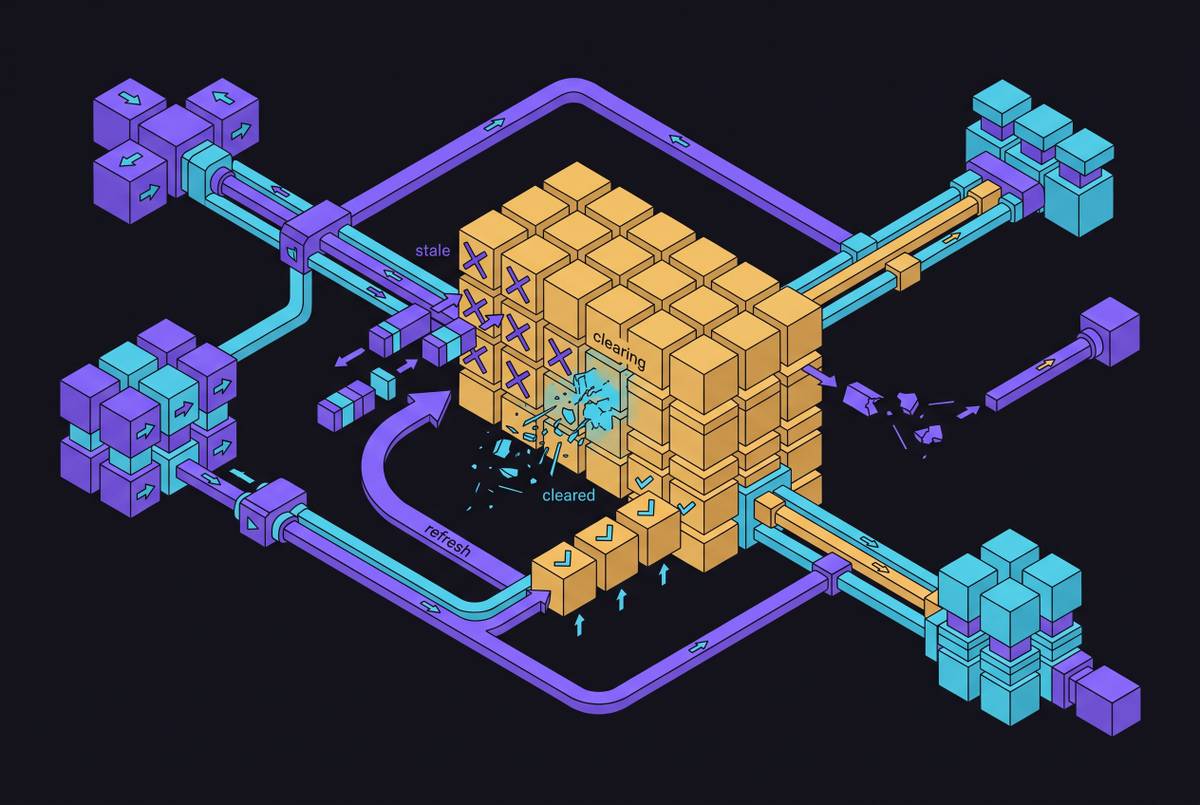
There are two separate mechanisms behind this, and they call for different fixes. The first is a coverage gap: a page that did not exist when the index was built simply is not retrievable, no matter how good the retriever is, because there is nothing there to retrieve. The second is a drift gap: the page was indexed, but its content has since changed, so the embedding still points at a version that no longer exists live. More frequent re-indexing narrows both gaps but closes neither. A nightly crawl still misses same-day changes, and no crawl schedule can index a question spanning sources outside the corpus. The staleness window shrinks. It does not disappear.
What static knowledge bases are well-suited for
None of this makes static retrieval a bad architecture; it is simply suited to a specific kind of corpus. Static RAG performs well when the underlying material changes slowly: HR policy manuals, product documentation, regulatory filings that get amended on a known cycle, internal research archives, company wikis. In those domains, an index built last month is still an accurate reflection of this month's reality, and that is the entire premise the architecture depends on.
Enterprises need this retrieval for a reason that has nothing to do with freshness. Most operate in specialized domains with vocabulary, shorthand, and compliance requirements a general-purpose language model was never trained to understand. A properly built RAG pipeline lets that system pull in internal documents, research papers, product manuals, or regulatory filings and reason over them directly, rather than guessing at company-specific terms. Adoption among enterprise AI systems rose from 31% to 51% year over year, per Nimbleway, a shift toward RAG as default, which explains why the architecture has moved past the experimental stage.
Four properties tend to mark a domain as a good fit for a vector store. Change frequency should be weekly or slower, because anything faster outruns a reasonable re-index schedule. Access control matters too: proprietary data that cannot leave the enterprise boundary belongs in an internally managed store, not on the open web. Terminology specificity counts as well, since domain vocabulary often needs curated chunking and embedding tuned to how the organization actually talks about its own work. And audit requirements matter for regulated industries, where every answer needs a traceable path back to a versioned internal source. Where all four line up, static retrieval is not a compromise but the correct answer. The failure described earlier is never the architecture itself, but its application to a corpus that moves faster than the index can keep up.
Where static retrieval breaks down and live retrieval becomes necessary
The same architecture starts to fail once the questions change shape. Three categories of query break the classic pipeline regardless of how well it was built. Time-indexed questions, things like current prices, active regulations, breaking news, or a competitor's latest move, change on a schedule no index can match. Post-ingest questions ask about events after the last crawl, so no document exists in the corpus for the retriever to find. Open-web questions point to authoritative sources entirely outside the enterprise's corpus, on sites the pipeline was never built to touch.
This pressure comes from concrete developments, not theory. Gartner's 2025 projection, cited by joinmassive, expected enterprise applications built around task-specific AI agents to grow sharply by end of 2026, up from a small minority the year before. Agents that book things, price things, or check regulatory status cannot run on a snapshot from last month. The demand for live answers is scaling faster than any static index can be re-crawled to match.
Live-web retrieval solves this by inverting the whole sequence. Instead of pre-fetching pages and hoping the right one is already indexed, the system discovers and fetches sources at query time. The cost model flips too: instead of continuously crawling the entire web to catch every update, the system fetches only the handful of pages a query actually needs. That is a meaningfully cheaper problem to solve, and a more accurate one.
It also changes how hallucination gets produced. When retrieved text sits directly in a model's context window, it can copy or paraphrase from that evidence instead of reconstructing an answer from patterns baked into its weights.
The three dimensions that should drive the retrieval routing decision
None of this means live retrieval replaces static retrieval. It means the choice between them isn't made once, at design time, for the whole system. The classic pipeline breaks on three query types, per the joinmassive and spider.cloud analyses.
Data volatility is the first. Stable material, policy documents, product FAQs, historical research, belongs in the vector store. Anything time-sensitive (live pricing, breaking regulatory changes, competitor activity) belongs on the live path. The serphouse enterprise guide observes that most production pipelines break not because either mode fails alone, but because the boundary between them was never clearly drawn.
Query type is the second dimension. A factual lookup carrying a freshness signal, something with a date, a price, a status, routes live. Reasoning or synthesis over material the enterprise already owns routes to the vector store. Conversational or definitional questions are often satisfiable from static retrieval alone, since they rarely depend on what changed this week. A practical heuristic: words like "current," "latest," "today," "now," "price," or a frequently-changing entity name signal that a query should route live rather than to a cached index.
Acceptable latency is the third, and the one engineers tend to underestimate. A live fetch adds real round-trip time; a cached vector lookup returns in milliseconds. That trade-off cannot be engineered away, only managed, through caching, smarter routing, and tighter result limits. One lever: capping live retrieval at two results rather than five, since sources beyond the second rarely improve answer quality but reliably add latency.
Data volatility says this is fast-moving, regulatory guidance and enforcement timelines shift without warning. Query type says this is a factual lookup with an explicit freshness signal ("current"), which routes it live under the heuristic above. Latency tolerance says a compliance question can absorb an extra second or two of fetch time, since being wrong costs more than being slow.
How a hybrid architecture handles both retrieval modes in production
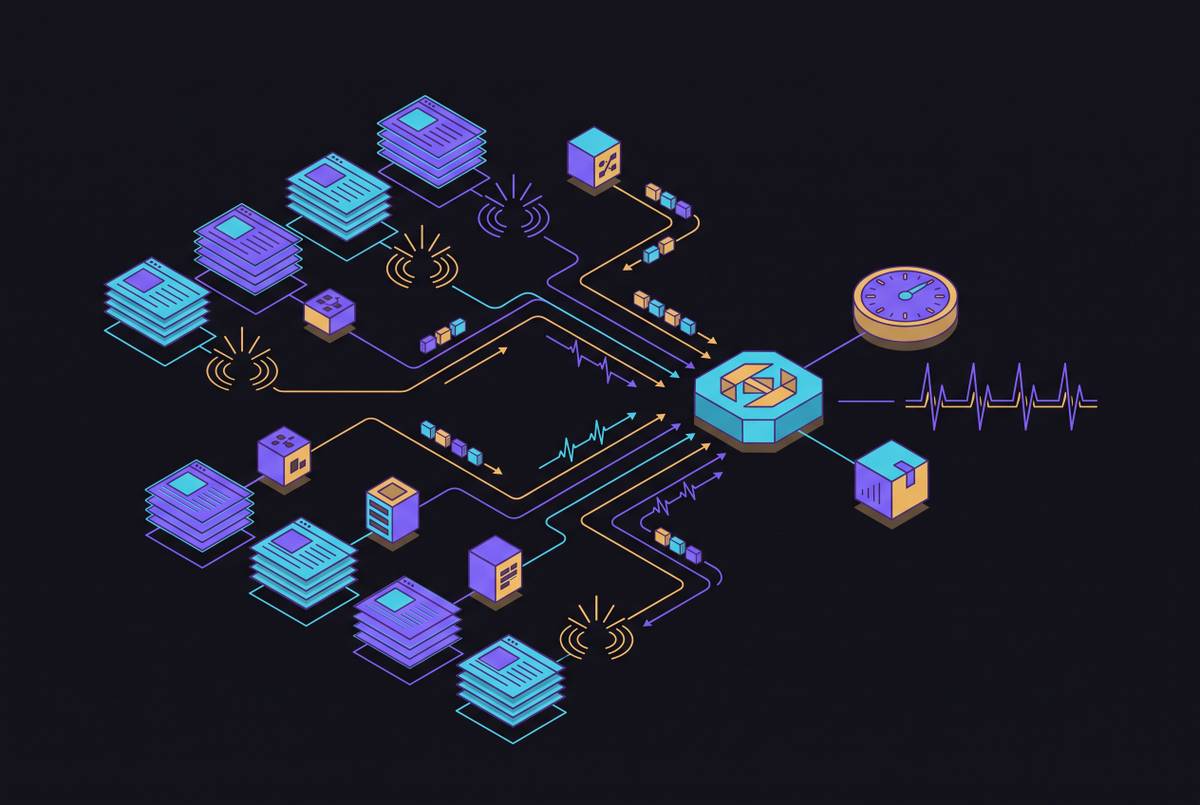
A production system does not pick a side between static and live. It runs both as parallel branches that converge before the model generates anything. The live branch, when triggered, follows a seven-stage flow.
It starts with query understanding: rewriting the raw question into search intent, pulling out entities, judging how time-sensitive the question actually is. Source discovery comes next, where a search API returns candidate URLs; this is where most pipelines quietly fail, since a mediocre search layer returns irrelevant or duplicate pages that nothing downstream can fully recover from. Fetch and clean follows: each URL is rendered into clean Markdown rather than raw HTML, cutting token cost and stripping navigation, ads, and boilerplate before chunking. Chunk and embed comes next, splitting and embedding the Markdown at query time into a vector store that is small, short-lived, and often scoped to a single query or session. The system then retrieves top-k chunks ranked against the query embedding, grounds the answer only in those chunks with source links attached, and caches the result with a time-to-live deadline so similar future queries can skip the live fetch.
That last stage holds the hardest operational question in the whole architecture: when does a cached chunk still count as fresh, and when does it need a live re-fetch? There's no universal answer. It has to be governed by a per-topic freshness TTL tuned to how fast that category of information moves.
Ownership stays clean in a well-built hybrid system. The vector store owns anything proprietary and slow-moving. The web retrieval path owns anything public and fast-moving. That boundary, drawn clearly and enforced structurally, is what keeps the system from breaking under real traffic. Static retrieval, run well within its lane, still performs strongly: Onyx's early-2026 benchmarks reported a strong win rate on workplace-question quality against ChatGPT, Claude, and Notion AI, across a large multi-source corpus spanning GitHub, Gmail, Drive, and Slack. The hybrid model is not a concession that static retrieval underperforms. It is an admission that no single retrieval mode covers every kind of question a production system will actually face.
What the live retrieval path requires from web infrastructure
The live branch looks simple in a diagram and gets complicated fast in production. Several failure modes appear only under production-scale concurrent traffic, not in a demo.
Bot detection is one of them. Much of the modern web runs as single-page applications, and a scraper that does not execute JavaScript pulls back an empty body tag instead of content. Anything meant for production needs headless browser support to render pages the way a real user's browser would, or the fetch stage returns nothing worth chunking.
Raw HTML is a second problem, and a subtler one. Every token spent on navigation menus, ad slots, and cookie banners is a token not spent on the content the model needs, a context-window cost. That is a context-window cost. Related is token cost inflation: pulling an entire article to extract two useful paragraphs burns budget without improving answer quality. Timeouts and site redesigns add fragility, since any request can stall and any scraper built against a specific layout breaks when that layout changes, cascading downstream without fallback logic.
A production-grade live retrieval layer needs three properties at once: high-fidelity extraction past bot detection, aggressive cleaning that preserves context-window space, and update frequency matching the freshness TTL the use case demands. Before reaching the model, content also needs a context selection pass: deduplicating near-identical URLs, filtering repeated snippets, ranking by relevance, capping context length, and keeping attribution intact. Done well, this stage returns a handful of focused paragraphs per result rather than whole articles, since the model reasons over tokens, not pages.
Why purpose-built web search APIs serve AI retrieval better than traditional SERP tools
Traditional search tooling doesn't solve the tooling decision the previous section points toward. SERP APIs were designed for human-readable search monitoring (rank tracking, SERP feature detection, and ad visibility). They were never designed to hand an LLM machine-ready context.
That mismatch is structural. A SERP API typically returns raw HTML and metadata, so an agent must parse it before use, and that parsing burns tokens and raises latency, which is visible in production cost and response time. A second extraction pipeline atop a SERP API is the common workaround, and every added step is another failure point.
AI-native web search APIs return clean Markdown or structured JSON directly, built for machine consumption rather than click generation. The rule is fairly clean: systems needing rank positions, ad placements, or local pack data still want a SERP API, but systems needing model-ready text should evaluate APIs returning content directly, comparing total system cost rather than sticker price. A 2026 industry benchmark covering fifteen providers found the market sorted into three categories: full SERP APIs that scrape and parse results, fast APIs trading feature coverage for speed, and independent indices built for AI workloads. A separate provider landscape overview found LLM-native APIs had already overtaken traditional SERP wrappers in active developer adoption, suggesting the market has largely decided.
What an AI-native web search API should provide for a production RAG pipeline
Output format should be clean Markdown or structured JSON usable directly, rather than raw HTML needing a separate parsing stage bolted on afterward. Content depth matters too, full page extraction or genuinely focused excerpts, not teaser snippets built to drive clicks rather than answer questions.
Latency predictability under real production load affects reliability more than demo latency does, since demos rarely resemble concurrent traffic at scale. Geotargeting matters for anything touching price or regulation, since the correct answer to "what's the current rate" depends on which jurisdiction is asking. Freshness has to mean retrieval at the moment of query rather than a cached index with an unnamed staleness horizon. Enterprises need clarity on where retrieved content goes, who can access pipeline data, and confirmation that the provider controls its own infrastructure end to end.
Per the spider.cloud analysis: you build, demo successfully, then two weeks later the system cites something that changed last Tuesday. An API built as a wrapper around a third-party service inherits every reliability constraint and data policy that party imposes, disclosed or not. A provider that owns its full pipeline can make and keep guarantees about latency, freshness, and data handling, since nothing upstream is outside its control. Enterprise security properties (data residency, audit logging, access controls) belong in the initial evaluation of a retrieval API, not bolted on later once the system is in production.
Cost should be grounded in something concrete rather than treated as an abstraction. As a market reference for the scraping layer, Firecrawl offers both a free tier and a paid Standard plan, giving teams a real number to benchmark against rather than guessing at "affordable". None of this replaces the routing framework built earlier in this piece. This layer makes the live half of that framework actually work once a demo becomes a system real users depend on.
Sources
- Building a RAG Pipeline on Live Web Data - Joinmassive
- Web Search API for RAG Pipelines: Enterprise Guide
- Step-by-step Guide to Building a RAG (Retrieval-Augmented Generation) Pipeline
- Real-time web search for RAG: stop feeding your LLM stale data
- Building RAG Knowledge Base from Web Scraping: A Strategic Guide
- The 10 Best AI Agent Search Tools (August 2026): Features, Tradeoffs, and Use Cases | Mastra Articles