SERP Snippet Depth and Why It Fails Production AI
Standard SERP results starve production agents of the context they need to reason reliably.

What the agent loop needs from snippets
Most agent failures blamed on "the model" actually trace back to retrieval. Production AI agents built in 2026 run on a search layer that was designed for a completely different job: SERPs were built to help a person scan ten blue links and pick one to click, not to feed a reasoning engine that has to act on what it reads. That mismatch is the single most underdiagnosed source of failure in agent architecture, and it doesn't announce itself. It just quietly degrades every downstream step until the output looks confident and wrong at the same time.
An agent doesn't run as one function call. It runs as a loop: a goal comes in, a reasoning layer (the LLM) breaks that goal into steps, an orchestration layer sequences and retries those steps, a memory and data layer holds context across the session, and a tool integration layer reaches out to the APIs and services that let the agent actually do something rather than just describe doing it. Web search is one of those tool calls. Whatever content it returns becomes the raw material the reasoning layer thinks with, and if that material is thin, every layer downstream inherits the shortfall.
Retrieval sits at the intersection of two layers at once: it feeds working memory for the task in front of the agent, and it feeds the tool layer's ability to act on something current rather than something baked into training data from a year ago. For that to work, a result needs semantic continuity (enough surrounding text that a claim isn't severed from the reasoning that supports it), structure a machine can parse efficiently rather than formatting meant for a human eye skimming a page, ranking by meaning instead of the click-based signals search engines optimized around for two decades, and freshness pulled from the live web rather than a stale cache or the model's frozen training set.
Multi-agent systems don't fix this. They multiply it. A supervisor agent routing tasks to specialized workers creates more entry points for a shallow web-search result to slip into the chain, and a thin result at any single node degrades the final output the supervisor eventually assembles. Agentic RAG, where the model decides whether to retrieve again, plan differently, or accept what it has, depends entirely on that first retrieval giving it something worth judging. Come back thin, and the model either retrieves blindly again or moves forward on too little context to justify the answer it hands back.
Developer trust in AI output reflects this gap directly. In Stack Overflow's developer survey, cited in Redis's guide to AI agent architecture, 46% of developers say they distrust the accuracy of AI output, while only 33% say they trust it. That thirteen-point gap doesn't trace back to the model's reasoning. It traces back to what the model was handed to reason over, and no amount of prompt tuning fixes a reasoning layer working from a fragment.
What traditional SERP APIs return, and what that costs an agent
Firecrawl's provider benchmark shows a typical SERP API call returns a title, a URL, and a snippet running somewhere between 150 and 300 characters, the entire payload. That's the entire payload. Not a document, not a passage, not an argument: a pointer telling the agent a page exists and gesturing vaguely at what might be on it.
Two or three hundred characters can't carry a supporting statistic, the second half of an argument, or the one caveat that changes what the first sentence means. So teams build a second pipeline just to get real content out of those pointers: fetch each URL, get past bot detection and CAPTCHA walls, render whatever JavaScript the page depends on, strip out nav bars and ad units and boilerplate, then normalize what's left into something a model can actually read. Each step is its own failure mode, and each one is infrastructure somebody now owns, patches, and monitors for the morning a target site changes its markup without warning.
Even when that pipeline runs clean, it tends to overcorrect. Full pages dumped into a context window bring the footer, the newsletter signup, the "related articles" rail, and whatever ad copy sat next to the paragraph that actually mattered. None of that helps the model reason, and all of it costs tokens. Signal gets diluted, the agent pays for noise it never asked for, and in a multi-step loop, a slightly degraded answer at step one becomes the input to step two, then step three. Errors don't stay where they started. They compound.
None of this makes SERP APIs badly built, and the fix isn't to blame the tool for doing its job. They were built for rank tracking, multi-engine coverage, and human-facing verticals like Scholar, Patents, or Shopping listings, and they still handle those jobs well. What they were never asked to do is feed a reasoning engine, and asking them to now, inside an agent's critical path, adds round-trips and scraping steps at the exact moment a user-facing agent can least afford the latency.
Why RAG pipelines worsen retrieved snippets lacking sufficient depth
RAG is the default architecture in 2026 for almost anything that needs current or private data: enterprise chatbots, internal knowledge bases, search products built on top of a model. The pitch is simple. Retrieve the relevant documents at query time, hand them to the model as context, skip the cost of fine-tuning. That pitch only holds up if what gets retrieved is actually relevant and actually substantial, and thin snippets don't just limit the architecture. They break it.
Naive RAG pipelines, built without real retrieval engineering behind them, fail at the retrieval step roughly 40% of the time, and the failure doesn't look like a failure. It generates an answer that reads as confident and well-structured while being grounded in the wrong source. The user has no way to tell. An answer that sounds right while being wrong is worse than one that sounds wrong.
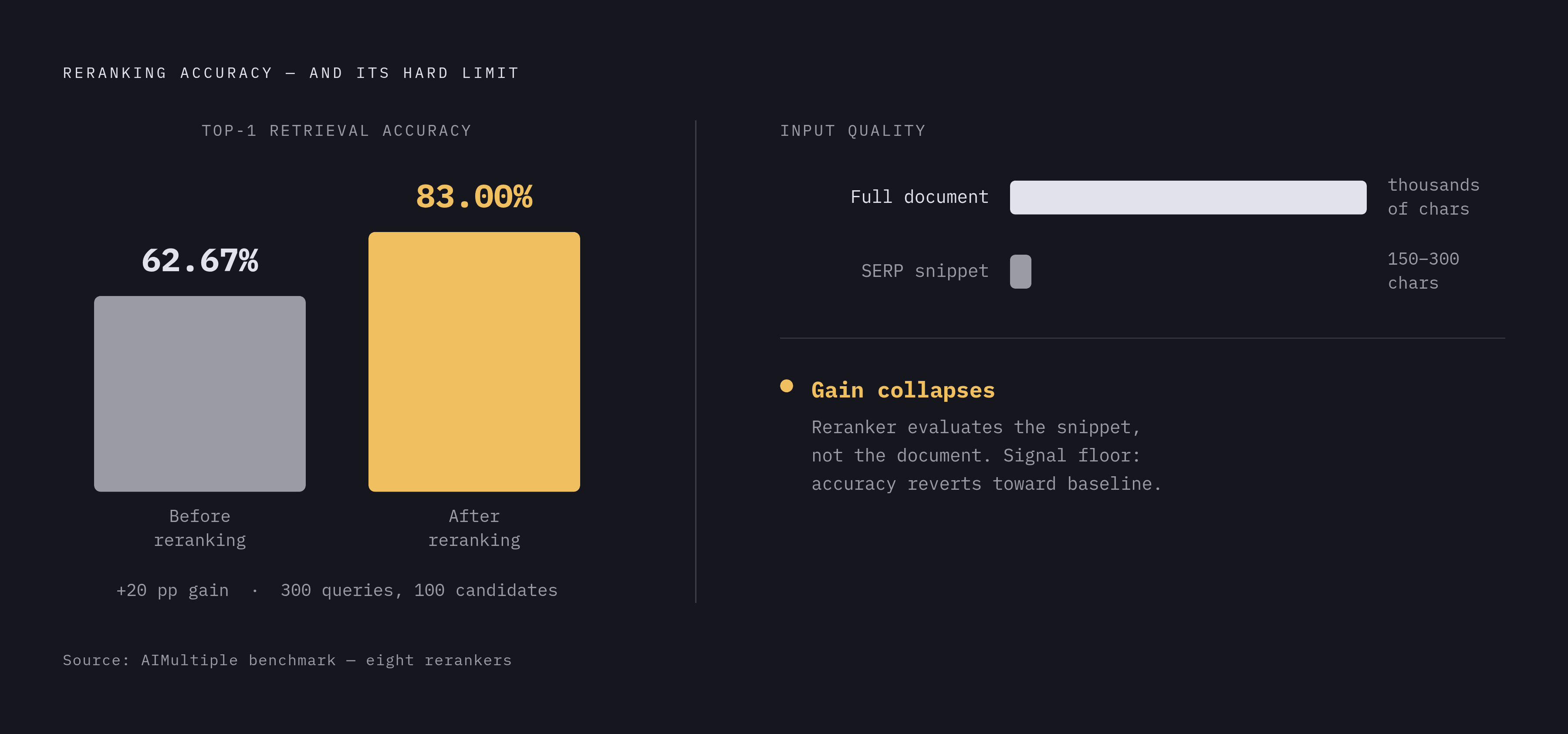
Rerankers exist to fix exactly this kind of problem. A cross-encoder reranker reads the query and each candidate document together and re-scores them for relevance. AIMultiple's benchmark of eight rerankers on English retrieval, running 300 queries against a pool of the top 100 candidates, found that adding a reranking stage pushed top-1 accuracy from 62.67% up to 83.00%, a jump of just over twenty points from one additional stage. That's a real gain, but it means nothing if the upstream retrieval never returned anything worth reranking to begin with. A reranker scores what it's handed. Feeding it 150 to 300 character snippets instead of real document chunks means there's no document behind the score for it to evaluate. It's grading blank pages and calling the grade meaningful.
Most retrieval post-mortems blame the wrong layer: chunking strategy, embedding quality, retrieval tuning. All of that assumes full clean text is sitting there waiting to be chunked. Practitioners generally recommend chunks large enough for each piece to stand on its own and answer a question without leaning on its neighbors. A SERP snippet is already shorter than that target before anyone touches it. Tuning the chunker or the embedding model can't manufacture raw material that was never there. And the direction RAG is actually heading, toward long-document memory, adaptive retrieval, graph-based reasoning across sources, multimodal grounding, demands richer source material, not thinner. Every step forward in RAG sophistication widens the gap between what these pipelines need and what a snippet can supply.
Platform dependency and the structural instability of SERP API access
SERP APIs ride on top of Google's and Microsoft's search infrastructure, and both platforms have moved to tighten that access in ways that hit production teams directly, not gradually. Microsoft shut down its Bing Search APIs on August 11, 2025, pointing developers toward Azure AI Agents' "Grounding with Bing Search" instead: a documented shutdown that broke production dependencies for teams built on the old API. Google's Programmable Search Engine and Custom Search JSON API also moved to restrict access for new projects, cutting off general web retrieval for anyone building fresh. Scraping directly off a results page has gotten harder too, as protective measures like SearchGuard raise the cost and complexity of pulling results without permission.
For a system with a multi-year roadmap, that's an architectural risk sitting at the foundation. It's an architectural risk sitting at the foundation, because a retrieval layer that depends on a third-party platform can be degraded or shut off entirely by a decision made somewhere else, for reasons that have nothing to do with the agent depending on it. Teams tend to find out after the fact, when the remediation path turns out to be "rebuild," not "patch."
A production agent wrapping a SERP API is renting its retrieval layer rather than owning it, and the landlord's incentives were never about serving AI workloads. Teams that pick a vendor on price alone tend to miss that the vendor's roadmap answers to search engines and advertisers, not to whoever needs a stable interface three years from now. Owning the pipeline end to end is the only way to guarantee quality and control at scale. That's an engineering principle, not a preference, and it holds regardless of which vendor sits underneath.
The 2026 provider landscape: how the market has reorganized around AI workloads
A 2026 industry benchmark of fifteen providers found the market had split into three distinct categories: full SERP APIs that scrape and parse traditional search results, fast APIs that trade feature coverage for speed, and a newer category of independent indices built specifically for AI workloads. That three-way split is itself the evidence. The market looked at SERP APIs, decided collectively that they weren't the right tool for what agents need, and built around them rather than waiting for them to catch up.
Traditional SERP APIs still return titles, URLs, snippets, and ranking metadata, with page content always requiring a separate extraction step layered on afterward. They remain the right choice for multi-engine coverage, rank tracking, and Google's specialty verticals like Scholar, Patents, or Shopping. What they were never built to do is hand a model clean, relevant, ready-to-reason-over context, and the pricing gives away the mismatch. Firecrawl's benchmark shows one major provider in this category starting at $75 a month for 5,000 searches: ten to fifty times more expensive than AI-native alternatives at comparable volume. Paying a premium for a payload that then needs a second pipeline to become usable is the wrong trade. It's the wrong one.
AI-native search APIs start from a different design question entirely: what does a model need, not what does a search results page look like. They return content that's already pre-processed, already ranked by relevance, already shaped for context, in a single call, which removes the entire secondary scraping pipeline teams would otherwise build and maintain themselves. They lean on semantic understanding and neural ranking instead of keyword-matched metadata, and they fit naturally into RAG systems and agent architectures that need retrieval by meaning, not a list of links to sort through later.
A handful of design choices separate this category from a SERP wrapper. One call returns both the search results and the extracted content, so there's no second pipeline to build on top. Output comes back clean, structured, and token-efficient, not raw HTML someone has to normalize by hand. Ranking runs on semantic relevance instead of click history, and bot detection, proxy rotation, and page rendering get handled inside the API rather than pushed onto whoever's consuming it. The whole thing has to hold up at thousands or millions of requests without latency creeping upward, because production agents send real volume, not demo traffic.
For teams deciding what to build on, the choice isn't close: a Web Search API that owns its data pipeline end to end, handling selection, filtering, ranking, and shaping specifically for LLM consumption, solves shallow content, round-trip latency, and third-party dependency all at once. A SERP wrapper, by its structure, cannot do all three. It was never built to.
Context engineering: why filtering and shaping retrieved content is itself an engineering discipline
Context engineering, as the term is used in 2026, refers to the engineering of agent state: not the phrasing of a prompt, but what the agent actually knows, sees, and holds in memory at the exact moment it has to act. That's a meaningfully different problem than prompt design, and treating it as an afterthought bolted onto retrieval is where most agent teams lose their footing.
A scraped full page is not the same thing as machine-ready context, even after a second pipeline has stripped and normalized it. Raw content still needs filtering to remove boilerplate, ranking to surface the chunks that actually matter, and shaping so the result fits a token budget efficiently instead of wastefully. Query expansion matters here too: a single user question is usually underspecified, and strong pipelines expand the query space before retrieving, which improves recall before ranking ever gets a chance to help. Chunking targets a size that lets each piece answer a question on its own rather than depending on context that got cut off somewhere else. Reranking pushes the genuinely relevant chunks to the top before anything reaches the model's context window, and someone has to manage that window actively: what stays, what gets compressed into a summary, what gets dropped. Getting that last part wrong is a common reason long-running tasks quietly fall apart partway through, long after the failure that caused it.
None of that is possible starting from a 150 to 300 character snippet. There's nothing to chunk semantically, nothing substantial enough to rerank for depth, and nothing to shape, because there was never enough content there to engineer against. The fix is moving filtering, ranking, and shaping upstream, as close to the data source as the architecture allows, where those operations are cheaper to run and far more effective, rather than bolting a smarter context-engineering layer onto a retrieval call that was shallow from the start.
Enterprise teams building agents shouldn't have to construct context-engineering infrastructure on top of a retrieval layer that was never designed to support it. That's the wrong layer to carry that weight, and the maintenance burden only grows heavier as query volume climbs, not lighter, no matter how much engineering gets stacked on top to compensate for a foundation that was thin to begin with.