Full Pipeline Ownership vs. Third-Party API Wrapping
Building your own pipeline beats wrapping APIs for production agents.
What production AI agents demand from a data pipeline
Every production agent running in 2026 is built on more or less the same four-layer stack, regardless of vendor or use case. A reasoning layer, where the LLM does the actual thinking. An orchestration layer that manages control flow, retries, and error handling. A memory and data layer covering short-term context and long-term retrieval through RAG. And a tool integration layer, where the agent calls out to APIs, databases, and other external services.
Web knowledge enters the system at that last layer, and a pipeline decision made early there quietly caps what every other layer can do later. Guidance on AI agent architecture is consistent on this point: tool invocations need reliable error handling, input validation, and retry logic, because a failure at the tool layer doesn't stay contained. The failure propagates upward and appears as an agent failure. The agent didn't get dumber. The plumbing underneath it broke.
That should settle an argument teams keep having about which model to buy. A merely capable model sitting inside a well-designed architecture beats a frontier model bolted onto a bad one, consistently, and most teams still spend their whole budget on the model while treating the pipeline as an afterthought. That approach is backwards, since architecture determines reliability. Architecture determines reliability. A broken retrieval layer stays broken no matter how much is spent on the frontier model.
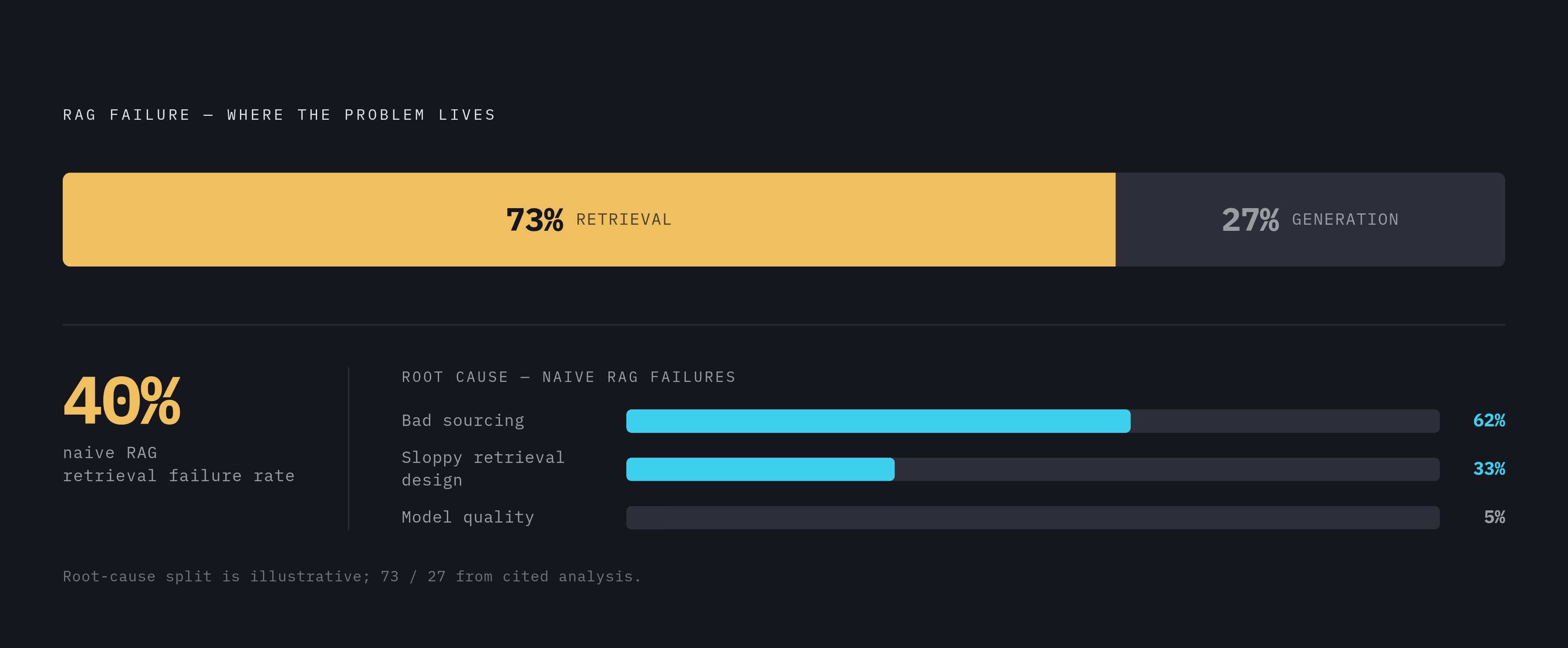
Production RAG has to clear specific, measurable bars. Customer-facing systems generally need faithfulness scores above 0.85 and context precision above 0.75. When RAG fails, the failure is in retrieval roughly 73% of the time, not generation. Naive RAG (the single retrieve-then-generate kind) fails at retrieval close to 40% of the time, and the cause is almost never the model. It's bad sourcing and sloppy retrieval design.
That's a big part of why agentic RAG took over as the dominant pattern in 2026. Retrieval stopped being one round-trip and became a multi-step decision loop: the agent checks whether what it pulled back is actually enough, re-queries if it isn't, and reaches for another tool if the knowledge base comes up empty. A pipeline built for a single request-response cycle can't carry that loop. Iteration has to be designed in from the start, not bolted on as an edge case once something breaks in production.
Latency has to stay predictable under real load too, and a demo never tests that the way production does, immediately and without mercy. Multi-step, multi-tool workflows favor asynchronous, event-driven designs with message brokers over synchronous REST calls, because synchronous APIs start timing out the moment a workflow branches into parallel sub-processes.
What third-party API wrappers deliver versus what agents need
Most traditional search APIs were built to return search results, not knowledge. That means titles, URLs, and snippets running somewhere between 150 and 300 characters. An agent doesn't want a summary of a page. It wants the actual content, structured cleanly enough to reason over directly. That mismatch is what wrappers paper over instead of solving.
When that gap opens, the agent inherits the cleanup work. Raw HTML and bloated metadata have to get parsed before anything useful comes out, and parsing burns tokens and adds latency on every single call. At low volume, that's a rounding error nobody notices. At production volume, it's a line item that grows every month the system stays live, and nobody budgeted for it because nobody saw it coming at demo stage.
Put in retrieval terms: a 150 to 300 character snippet doesn't carry enough semantic density to hit a faithfulness score above 0.85, full stop. The model ends up reasoning over a summary of a summary, one step further removed from the source than it should ever be.
A specific optimization gets closed off here. Hybrid retrieval, combining dense vector search with BM25, improves recall by as much as 17% over dense-only retrieval while adding under 6 milliseconds of latency. None of that is available to a team using a wrapper that doesn't expose retrieval internals. A team can't tune what it can't see, and most wrapper contracts never let anyone see it.
Chunking runs into the same wall. Semantic chunking can deliver up to 70% better retrieval accuracy than fixed-size chunking. When a vendor hands over pre-chunked content, the team inherits the vendor's chunking decision whether or not it fits the domain. Nobody on the team chose it. They just live with it, quarter after quarter, wondering why retrieval quality plateaus.
The agentic loop makes the mismatch worse, not better. Iterative retrieval, re-query, inspect, decide, needs a serving layer built to sustain that rhythm. A synchronous REST wrapper that times out or rate-limits mid-loop breaks the decision cycle at exactly the moment the agent needed another answer fast.
One design question produces this pattern: what shape of context is most likely to produce the model behavior you actually want? A vendor optimizing for broad developer adoption is answering a different question than the one your agent is asking, and that difference is the entire argument against wrapping.
Legal and infrastructure risk at the vendor layer
Vendor dependencies carry legal and infrastructure risk that has nothing to do with model quality, and most teams never price it in. Google removed the num=100 parameter from its search results in September 2025, and its official Custom Search JSON API is set to sunset in January 2027. Neither change was optional for the teams built on top of it. Both arrived on someone else's timeline, not theirs.
The risk appeared in the vendor layer in both cases, not the model layer. Teams that had wrapped the API absorbed the disruption on the vendor's schedule, with no say in its timing and no say in its severity.
A separate governance problem sits alongside the operational one. Enterprises need granular data access controls to keep an AI platform from turning into a leak vector, and when a third-party API sits inside the retrieval path, data flows through infrastructure the enterprise never audits and never governs directly. Federated RAG research points at a related constraint: plenty of organizations can't centralize their knowledge into one vector database, for privacy reasons or infrastructure reasons or both. A vendor-hosted retrieval layer doesn't solve that problem. It stacks another layer of opacity on top of it.
None of this is an argument against ever touching a third-party API. It's an argument for knowing exactly which risks land on your books the moment you hand a critical pipeline layer to a vendor whose incentives, legal footing, and roadmap you don't control.
What owning the full data pipeline means in practice
Owning the pipeline means holding the decisions that actually determine quality, reliability, and governance at each layer: what gets crawled and how fresh it stays, how raw content gets cleaned and normalized before... It means holding the decisions that actually determine quality, reliability, and governance at each layer: what gets crawled and how fresh it stays, how raw content gets cleaned and normalized before it reaches the model, whether chunking is semantic or fixed-size and tuned to the task, whether retrieval combines BM25 with dense vectors and re-ranks for the domain, how content gets shaped for the model's reasoning rather than a human reader's eyes, and what latency guarantees and retry logic the serving layer delivers under load.
Context shaping is where the two approaches diverge most visibly. A purpose-built pipeline filters, ranks, and formats content around one specific reasoning task. A wrapped API hands back whatever the vendor decided was broadly useful across its widest customer base. Broadly useful and precisely useful are not the same design goal, and treating them as interchangeable is where most of these pipelines go wrong.
That's what makes the finding that 73% of RAG failures occur at retrieval concrete rather than abstract. Chunking, hybrid retrieval, re-ranking, freshness: every one of those failure points is fixable through pipeline design. Only a team that controls the pipeline can actually fix it, which is the entire case for owning it instead of renting it.
The hallucination numbers make the stakes hard to argue with. Vanilla LLM output hallucinates somewhere in the 15 to 25% range. Well-tuned RAG brings that down to the low single digits, roughly 2 to 5%. The distance between those two figures is retrieval quality, and retrieval quality is a pipeline design choice, not a model choice, no matter how the marketing around any given model reads.
Machine-ready content means material selected, filtered, ranked, and shaped to maximize usefulness for a reasoning model, not for a person skimming a search results page. That's a different product entirely from a snippet or a block of raw HTML. Production systems also need that content fresh on a rolling basis, since a model's training data freezes at a point in time and can't stand in for what's happening right now. Freshness is part of the baseline job a pipeline exists to do. It's part of the baseline job a pipeline exists to do.
The gap between owning and wrapping as systems scale
At demo scale, a 70% gap in retrieval accuracy between semantic and fixed-size chunking barely registers. Nobody notices one bad answer in a five-minute walkthrough. At production scale, running thousands of queries an hour, that same gap becomes a quality ceiling the team can't lift without ripping out the pipeline and starting over. By then the sunk cost makes starting over feel impossible, even when the system needs exactly that.
Cost tracks the same curve. Per-query pricing gaps between API providers widen substantially at high volume, and the architecture decision made when the system was small locks in a cost structure that only gets harder to unwind as everything built around it keeps growing.
Multi-agent systems make this exposure worse, not better. In a supervisor-worker setup, each worker agent calls the retrieval layer on its own. A rate limit or latency spike that a single-agent system shrugs off cascades across an entire pool of workers in a multi-agent one, because every worker is hitting the same constrained resource at the same time.
The surrounding infrastructure keeps expanding too. Agent memory and deployment tooling now spans 21 frameworks and 20 vector stores, and every new piece a team adds creates one more integration surface. A third-party API sitting at the data layer becomes a fixed point that every new component has to route around instead of build on, and that routing tax only grows.
Governance debt piles up on a separate track from quality debt, and it may be the more dangerous of the two. "Handle access controls later" is an easy sentence to say during a pilot. At scale it becomes an audit finding, because granular data access control isn't optional for production RAG, it's a prerequisite. Retrofitting governance into a pipeline someone else owns is structurally harder than building it in from the start, since the controls a team needs may not even exist on the vendor's side to retrofit.
MIT's 2025 GenAI Divide report found a 95% failure rate among generative AI pilots, and that number connects directly to everything above it. The infrastructure choices made at pilot stage, pipeline ownership very much included, carry forward into whichever deployments end up succeeding, and which ones join that 95%.
Evaluating a web knowledge infrastructure provider against these criteria
Start by asking whether the provider owns its data pipeline end-to-end, or is aggregating someone else's API and repackaging it behind a nicer interface. A wrapper inherits its upstream provider's deprecation risk, legal exposure, and quality ceiling, whether or not that gets disclosed anywhere in the sales conversation. It usually doesn't.
Then ask about extraction directly. Does the provider return full, structured content, or metadata snippets dressed up to look like content? Whether a faithfulness score of 0.85, the minimum required for customer-facing production RAG, is even achievable depends on that answer, regardless of how good the model sitting on top of it happens to be.
Ask what retrieval architecture is actually exposed, whether it's dense-only, hybrid, or re-ranked, and ask whether the team can control chunking strategy directly rather than accept whatever the vendor pre-chunked. The 17% recall gain from hybrid retrieval and the up to 70% accuracy gain from semantic chunking are only accessible to a team if the pipeline hands over the dials to turn them.
A synchronous API that works fine in a demo starts timing out the moment an agent needs to re-query mid-conversation. Ask about latency under real load. Then confirm the serving layer actually supports async patterns for multi-step agentic loops.
Ask about data governance without hedging: where does retrieved content flow, who can audit that flow, and what security controls exist at the retrieval layer itself. That question usually separates infrastructure built for enterprise production from a tool that happens to work fine in a demo and nowhere past it.
A provider deserves to be held to the standard of context-engineered content: material selected, filtered, ranked, and shaped specifically to make an AI system reason better. That's the opposite of what a search API built for human eyes was ever designed to return.
For a team already running on a wrapped API, what matters is knowing exactly which layer of its pipeline it currently can't optimize, and what that costs at the scale it's planning to reach. Pipeline ownership is cheap to decide early and expensive to unwind late. That asymmetry doesn't go away just because a team decides not to look at it.