Factuality Decay in LLMs Without Live Web Grounding
Models trained on static data drift away from current facts without live data connections.
In an earlier month of that year, Google posted a promotional GIF for Bard on Twitter, showing the chatbot answer a question about the James Webb Space Telescope. The chatbot's answer to the question was wrong. Bard claimed Webb took "the very first image" of a planet outside our solar system, a claim that belonged to a different telescope. Google's stock dropped between 7 and 9 percent that afternoon, wiping out roughly $100 billion in market value in a matter of hours. That's the price tag on an ungrounded system trusted at scale, and it's the clearest entry point into a problem that keeps getting more expensive: factuality decay, the widening gap between what a model learned during training and what's actually true right now.
Decay isn't the same thing as a model "going out of date." It follows a shape you can trace, tied to how fast a given domain moves. API documentation and pricing pages rot in weeks. Regulations and personnel changes rot in months. Foundational math doesn't rot. Closing that gap takes infrastructure, not a bigger model, and the rest of this piece traces what building that infrastructure actually involves.
How the training objective creates a confidence-without-evidence failure mode
Large language models learn by predicting the next word in a sequence, over and over, across enormous amounts of text. That objective rewards fluency and coherence, not truth. A sentence that reads smoothly and sounds right will score better under this training setup than an awkward, hedge-filled sentence that happens to be correct. Google's own FACTS Grounding paper, published with Kaggle in January 2025, states this directly: next-token prediction doesn't push a model toward factuality on its own. Nothing in the loss function checks the output against reality.
That leaves models with no internal way to distinguish between something they know cold and something they're inventing on the spot. A confidence score out of a language model reflects how plausible the sentence sounds, not how well-supported the claim is. Lakera's 2026 analysis, citing calibration research in the field, notes that models routinely express high confidence on claims that turn out to be wrong at a substantial rate. That's a system that has learned to sound sure regardless of its actual grounds for confidence.
OpenAI's September 2025 paper, also cited in that Lakera analysis, gets at why: training objectives and the leaderboards used to benchmark models both reward confident guessing over honest uncertainty. A model that says "I don't know" loses points against a model that guesses and gets lucky, so models learn to bluff instead. Training data itself skews heavily toward high-frequency topics, the Wikipedia entries and major news stories and widely used documentation. Enterprise queries often live in the long tail the training corpus barely covered. More parameters cannot supply knowledge that was never there to begin with. Without grounding, hallucination rates on factual queries commonly run between 15 and 25 percent, and scaling the model up doesn't move that number much.
The failure is architectural. The fix can't come from more of the same architecture. It has to come from outside the model.
The decay pattern across domains
Not all knowledge ages the same way. API specs, pricing, stock availability, regulatory requirements, leadership changes, and funding status sit on the fast end, sometimes stale within days. Product feature sets, competitive landscapes, and compliance frameworks move at a medium pace, changing over months. Foundational concepts, mathematical relationships, and historical facts barely move.
The dangerous case sits in between the extremes, not at either end. A model can describe a framework or a library accurately in almost every respect, then cite a method inside it that was deprecated two versions ago. The surrounding accuracy is what makes the error hard to catch: readers trust the paragraph because ninety percent of it checks out, and that ninety percent does the work of vouching for the ten percent that's wrong.
The distribution across languages and formats is uneven too. Benchmarks like Mu-SHROOM (SemEval 2025) and CCHall (ACL 2025) both found higher hallucination rates outside English text-only settings. Training data skews toward English-language web content, so decay compounds faster in underrepresented languages, and scale alone doesn't close that gap.
The consequences aren't abstract. In Mata v. Avianca, a lawyer submitted a legal brief built partly on case citations ChatGPT had fabricated, and was sanctioned for it. A 2025 study in Scientific Reports that combed through three million mobile-app reviews found that among the reviews flagged as potentially relevant, about 1.75 percent were confirmed as describing hallucination-like errors. Regular users are running into this at scale, in production apps, right now, not in some hypothetical edge case reserved for lab benchmarks.
The structural gap training-side fixes and detection techniques don't solve
Fine-tuning and reinforcement learning after pretraining can nudge a model toward better factuality, but the FACTS Grounding paper flags a real tension here: pushing hard on factuality during training tends to cost the model some of its creativity and flexibility. You can't fully optimize for both at once, which rules out a training-only fix as a complete answer. Prompting tricks and interpretability techniques at inference time help around the edges too, mostly by making the model express uncertainty more honestly. None of that supplies knowledge the model lacked during training.
Detection has come further, and it deserves real credit. Cross-Layer Attention Probing (CLAP) trains small classifiers on a model's internal activations to flag likely hallucinations as they happen. The MetaQA framework, presented at PACMSE/FSE 2025, uses metamorphic prompt mutations to catch hallucinations in closed-source models without needing access to token probabilities or outside tools. Both represent genuine engineering progress, and neither one is enough.
Detection catches the symptom after the model has already generated it. In an agentic system where an output triggers a real action, an API call, a purchase, a filed document, catching the error after generation is already too late. Anthropic's "Tracing the Thoughts" research, also cited by Lakera, found something telling inside Claude: refusal is the model's default behavior, and a "known entities" feature suppresses that default when the model recognizes it has a real answer. Hallucination happens when that feature fires incorrectly, when the model thinks it knows something it doesn't. The mechanism is worth understanding, but it says nothing about whether the knowledge itself is current.
None of these methods touch what the model actually knows about the present state of the world. They improve how the model handles uncertainty over frozen knowledge, a related problem but not the same one. Hallucination is a symptom of running a system with no connection to ground truth, an artifact of that missing connection rather than an unavoidable tax on using language models. The fix is grounding, full stop.
RAG's evolution from research idea to production infrastructure
Retrieval-augmented generation starts from a simple, well-tested insight: a model answers better when it can read something real at the moment of answering, instead of relying only on what got baked in during training. That insight has held up across nearly every domain where these systems get deployed.
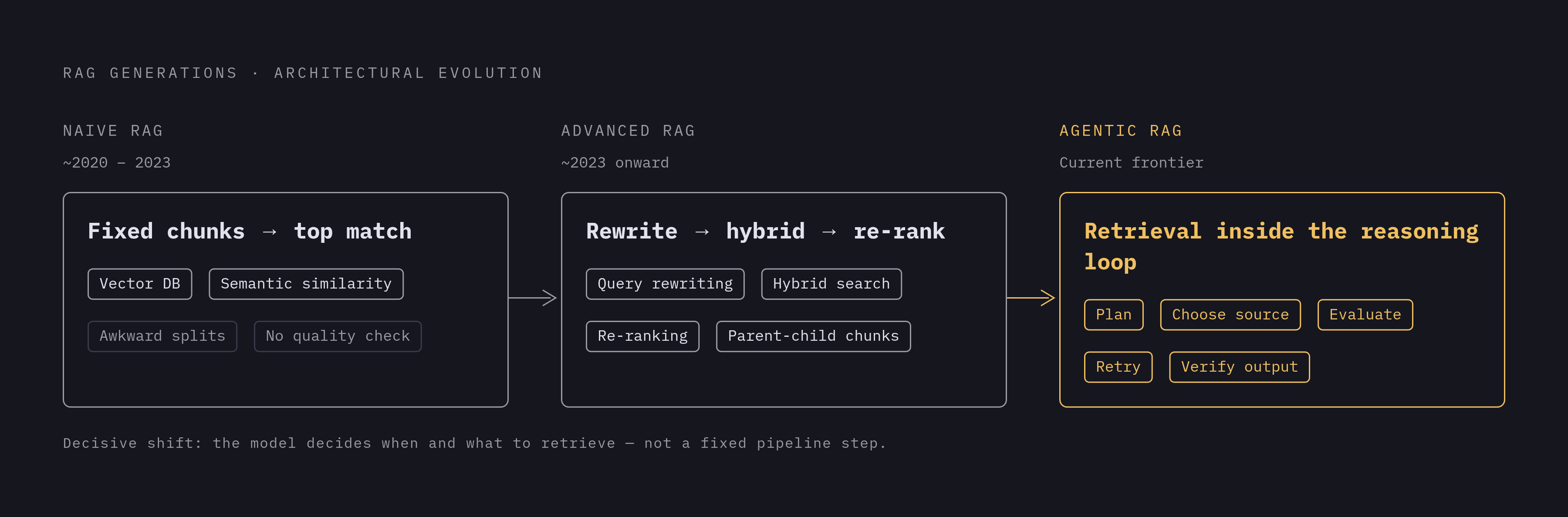
The architecture has gone through three rough generations. Early or "naive" RAG, roughly 2020 to 2023, chopped documents into fixed-length chunks, stored them in a vector database, and pulled back the top matches by semantic similarity. It worked, until it didn't: chunks split ideas awkwardly, retrieval missed the right passage, and nothing checked the quality of what came back. Advanced RAG, from about 2023 onward, added query rewriting, hybrid search that blends keyword and semantic matching, re-ranking of results, and smarter chunking strategies that keep parent context attached to child fragments. Agentic RAG, the current frontier, treats retrieval as a decision the model makes rather than a step that happens automatically before generation: the model plans, chooses where to look, checks whether what it found is good enough, and decides whether to look again. Retrieval works as part of the reasoning itself rather than a passive pipe.
Most production RAG systems are still built wrong, and the mistake is almost always the same one. Teams bolt on a vector store, skip any real governance of the underlying documents, and end up with a system that sounds grounded and answers confidently while staying unreliable underneath. The deployments that hold up treat the knowledge source as the real investment, not an afterthought bolted onto the model after the fact.
RAG has also beaten fine-tuning as the practical route to keeping a system current, and for good reason. Fine-tuning on proprietary data costs real compute, needs carefully labeled examples, and bakes knowledge in at a fixed point in time rather than keeping it live. RAG sidesteps all of that by keeping the knowledge external and swappable. MarketsandMarkets puts enterprise RAG at a market size in the low billions of dollars in the mid-2020s, projected to grow several times over by 2030 at a 38.4 percent compound annual growth rate. That growth curve is a bet on an architecture, not a feature.
Done well, RAG cuts hallucination rates by 70 to 90 percent. Done poorly, with sloppy chunking or a similarity threshold set too loose, it passes bad material straight into the model's context and produces answers that sound grounded and simply aren't.
Where static RAG hits its own freshness ceiling
Static RAG earns its keep on stable, controlled material: internal wikis, product manuals, policy documents, anything that doesn't change every week. The vector database holds a curated, pre-indexed snapshot that stays genuinely useful until the material underneath it moves.
It inherits three limits it can't engineer its way out of. Indexed content goes stale between re-indexing runs, so there's always some lag between the world and the corpus: smaller than a model's training cutoff, but real. Scope is capped by whatever's already been ingested, so a brand-new regulation or a competitor's announcement or an API change from yesterday simply doesn't exist to the system. And someone has to keep curating and updating that corpus by hand, which turns into a real scaling headache the moment the domain starts moving fast.
A quieter risk runs through all three: a RAG system built on weak chunking or a loose similarity threshold will still label its answer "grounded," even when the source document it pulled from is a year out of date. A RAG system built on weak chunking or a loose similarity threshold will still label its answer "grounded," even when the source document it pulled from is a year out of date. The label creates false confidence exactly where confidence shouldn't exist, which arguably makes static RAG more dangerous than no retrieval at all in cases where the corpus has quietly gone stale. GraphRAG, which layers structured knowledge graphs and taxonomies on top of vector search, improves how consistent and traceable answers are, but it's still built on a pre-indexed corpus. It sharpens the tool without lifting the ceiling.
Any system built on an index shares the model's core weakness: what it knows is frozen at the moment of indexing. Live web grounding is the only architecture built to move at the same speed as the world it's describing. On benchmarks like SimpleQA and FRAMES, web-grounded models show factual accuracy gains of 25 to 40 percentage points over ungrounded ones, consistently, across different types of queries and domains.
What live web grounding requires from the retrieval infrastructure
Live web RAG works differently from its static cousin: it queries real-time search infrastructure at the moment a question comes in, and returns current web content instead of something indexed last week or last month. There's no indexing lag and no fixed scope, because freshness is built into how the system works rather than scheduled into it.
That comes with a real tradeoff. A vector database answers in milliseconds. A live web query has to make a round trip out to the open internet, which takes longer, and if the results aren't filtered carefully, they flood the model's context with irrelevant noise. Both sides of that tradeoff need real engineering, and skipping either side slows response times or floods the model's context with irrelevant noise in production.
Standard search APIs weren't built for this job, and treating them as interchangeable with an AI retrieval layer is where most of these systems go wrong. They typically return titles, links, and short snippets, often somewhere in the 150 to 300 character range: enough for a human to decide on a click, far short of what a model needs to reason over. Turning that into something usable takes an extra layer of processing after the fact, which adds latency and another place for things to break. Scraping the full pages instead runs into its own wall: anti-bot defenses, JavaScript-heavy sites that don't render cleanly, and rate limits that choke a pipeline the moment it scales past a demo.
Production AI retrieval needs full page content rather than a fragment, so the model has enough to reason over instead of guessing at what a truncated snippet implies. It needs relevance filtering and ranking done before that content ever reaches the model, since noise in the context window degrades reasoning quality directly. It needs the content shaped for a machine to read, clean and structured and not bloated with wasted tokens, rather than formatted for a person skimming a search results page. It needs latency and uptime that hold steady under real load, not just in a demo. And it needs a clear line on data ownership: a large share of enterprises point to data security as the main obstacle standing between them and wider AI adoption, and retrieval infrastructure that routes content through some opaque third-party pipeline creates a control gap most enterprise deployments can't accept.
A search API purpose-built for AI, one that owns its pipeline end to end instead of wrapping someone else's search results, is the only setup that can guarantee quality, speed, and control together. Wrap a general-purpose search API instead, and every one of its limits rides along for free, plus a new dependency to manage on top of it.
AI agents and the urgency and failure mode of ungrounded retrieval
Agents don't just answer questions. They act on the answers: calling tools, chaining steps together, and often deciding their own path through a task without a human checking each move. That changes what a wrong fact costs, and it changes it by an order of magnitude.
For an agent, dynamic retrieval is a requirement. It's a requirement, because agents constantly need information that sits outside anything baked into the base model: a company's internal state, a live API response, something that happened an hour ago. Agentic RAG is the architecture built for that. The agent decides on its own whether it needs to retrieve anything at all, picks which source to pull from (a vector store, a knowledge graph, a live web search, an API), judges whether what it got back is actually good, retries if it isn't, and checks its own output afterward. Retrieval becomes part of the reasoning loop itself, folded into the model's decisions rather than run beforehand.
Anthropic's Model Context Protocol, with a specification dated November 25, 2025 at modelcontextprotocol.io and a monthly download count in the tens of millions as of late 2025 and early 2026, signals where this is heading: tool use and context management are turning into standard infrastructure, not one-off custom integrations built fresh for every project.
That standardization matters because the failure mode itself has changed shape. A single hallucinated fact used to produce an embarrassing sentence and nothing more. Now it can trigger a downstream tool call: an order placed against a wrong price, an API hit with a malformed parameter, or a document filed on the basis of a citation that never existed. Tool failures cascade into agent failures. When retrieval sits at the center of a decision loop instead of at the end of a text response, grounding shifts from getting a paragraph right to determining whether the whole chain of actions was built on something real.