Structured Output Contracts in Web Retrieval APIs
Enforcing structured guarantees prevents extraction failures that cascade through RAG pipelines.

An output contract, in the context of a web retrieval API, is the set of guarantees governing what shape a response takes, whether it's complete, and whether its types hold up when an LLM tries to use it downstream. That sounds like a technical footnote. That sounds like a technical footnote, but it isn't. Amazon's PARSE research found GPT-4 producing an invalid response rate on complex extraction tasks that means a substantial share of structured outputs arrive broken before an agent ever gets to reason over it. When that happens, ingestion into a vector store fails, reranking has nothing usable to score, and the reasoning chain built on top of it stalls out. This isn't a rare edge case anymore either: research cited in industry coverage estimated that by early 2026, 72% of enterprises had RAG running in production, so the exposure to this specific failure mode has scaled right alongside adoption. The failure is structural and needs a different design philosophy rather than a patch bolted onto the output layer.
What an output contract is in a retrieval API context
Call it a schema file if you want, but that undersells it. A real output contract covers four separate guarantees, and a retrieval API that only satisfies one or two of them isn't actually honoring the contract, it's just approximating it.
Schema conformance is the most visible one: does the response match the declared field types and nesting structure. Semantic integrity goes deeper, asking whether the fields actually carry the meaning the schema intended or just pass a type check while containing noise. Completeness asks whether required fields appear populated, rather than silently returning null in a way that looks fine to a validator but is functionally empty. And stability asks whether the contract holds steady across API versions, or quietly drifts underneath consumers who never asked for a change.
Traditional API contracts get to assume predictability because the logic is deterministic. Call an endpoint with the same inputs twice, get the same shape back both times. A useful way to think about well-designed APIs is that they are, in effect, boring: predictable to the point of being uninteresting to talk about. LLM-mediated extraction breaks that assumption at the root. The same input can produce structurally different output on two separate calls, so a contract can't be assumed from the underlying logic the way it can with a conventional API hitting a SQL database. It has to be enforced, actively, at multiple layers.
Schema extraction is when a developer defines the structure up front, while entity extraction is when the API identifies fields on its own without a predefined schema. They fail differently. A schema extraction task fails when the model can't force content into a rigid shape; entity extraction fails when the model has to guess at boundaries nobody specified. Both need contract guarantees, but the guarantees look different in each case, and conflating them is one of the quieter ways output contracts get under-engineered.
And even when no formal contract gets written down, one still exists in practice. Any agent consuming a retrieval API without an explicit contract is implicitly accepting whatever shape the response happens to take that day. An unwritten contract still exists in practice, and unwritten contracts are the ones that break without anyone noticing until the pipeline downstream is already producing garbage. It's an unwritten one, and unwritten contracts are the ones that break without anyone noticing until the pipeline downstream is already producing garbage.
How weak contracts propagate failure through the retrieval stack
Naive RAG pipelines fail at the retrieval step somewhere around 40% of the time. That number gets treated, often, as evidence of a retrieval quality problem: bad embeddings, bad chunking, bad reranking. It's worth reframing. A meaningful share of that failure rate is what happens when there's no contract enforcement at the boundary where content enters the pipeline in the first place.
The cascade runs in a fairly predictable order. Malformed extraction produces badly structured content. That content gets chunked without the structural boundaries a chunker needs to do its job well. The retrieval surface degrades as a result. Reranking, which depends on clean signal to distinguish good candidates from bad ones, has nothing solid to work with. And the LLM at the end of the chain ends up reasoning over noise it can't distinguish from signal.
Semantic chunking outperforms fixed-size chunking on retrieval accuracy, but only under one condition: the content arriving at the chunking stage needs its structural boundaries intact. Extraction that ignores the output contract destroys those boundaries before chunking ever gets a chance to use them. A pricing table is the cleanest example. The meaning of a pricing table lives in the relationship between rows and columns, not in the individual cell values read in isolation. A scraping tool that flattens that table into a wall of prose has thrown away the structure that made the table meaningful, and there is no recovery step downstream that puts it back.
Agent loops make this worse, not better. A single malformed response from a retrieval call can stall an entire multi-step reasoning chain, because the agent's next action depends on parsing the last one correctly. Retry logic doesn't fix this, either: retrying against a tool with no contract just means retrying against the same structural failure, over and over, at additional token cost each time.
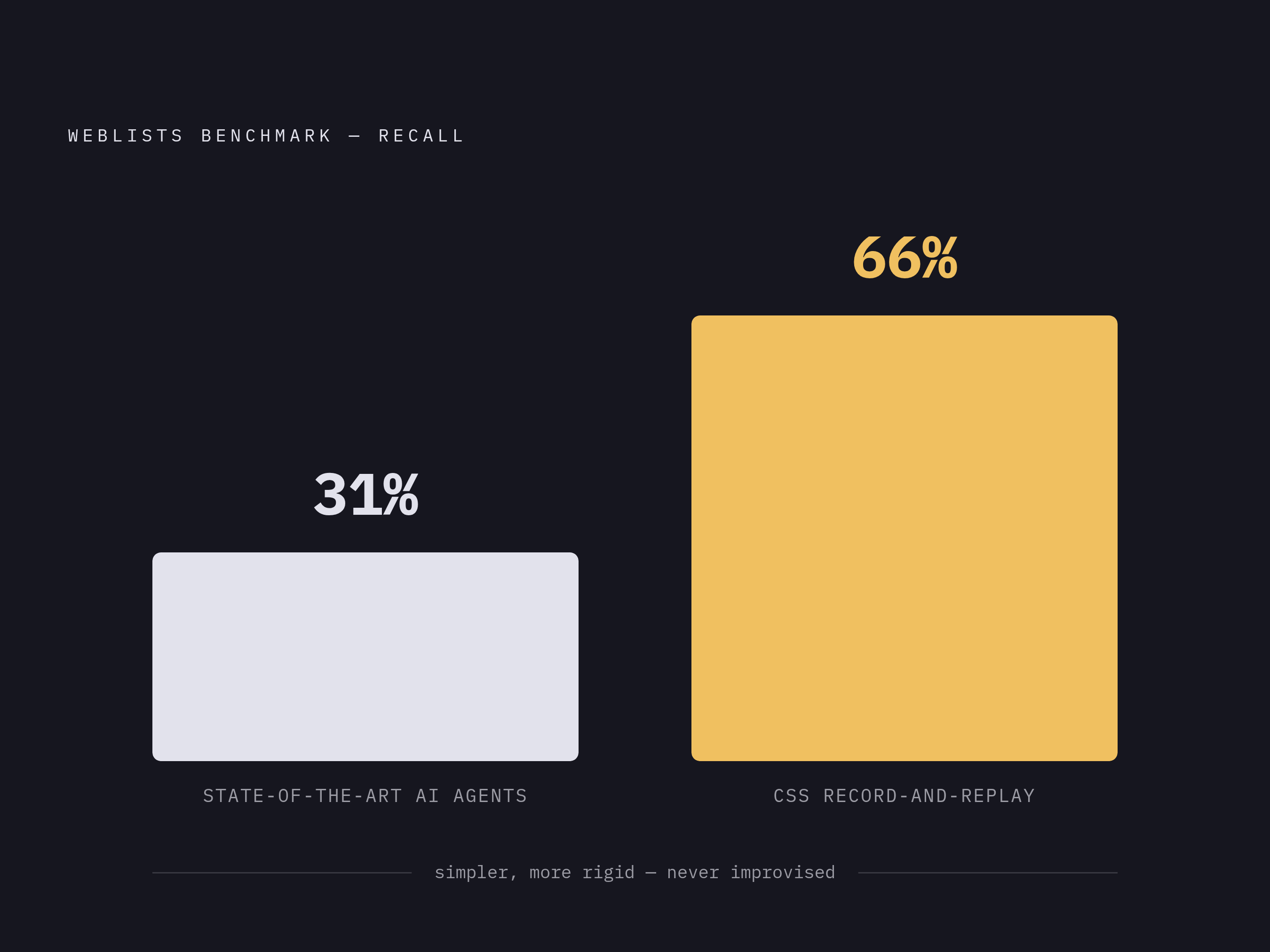
The WebLists benchmark makes the scale of the gap concrete. State-of-the-art agents reached only 31% recall on structured extraction tasks in that benchmark, while a comparatively low-tech record-and-replay system using CSS selectors hit 66%. It's a gap in structural reliability, and it says something uncomfortable: a simpler, more rigid extraction method beat a more sophisticated model precisely because it didn't depend on the model improving. It's a gap in structural reliability, and it says something uncomfortable: a simpler, more rigid extraction method beat a more sophisticated model precisely because it didn't depend on the model improvising a structure it was never given.
There's a security angle too, and it doesn't get enough attention. OWASP ranks prompt injection as the number one risk on its LLM security top-10 list. An unprotected retrieval endpoint with no output contract is a direct attack surface for exactly that risk: malformed or injected content passes straight through, because there's no contract-level check to catch it.
The engineering components of a well-designed output contract
Start with schema definition itself, because it's usually treated as a formality when it should be treated as a discipline. Field descriptions written for a human reader (short, vague, assuming context) are not the same thing as field descriptions written for a model to consume at inference time. PARSE research identifies ambiguous field descriptions and unclear entity boundaries as a specific, identifiable root cause of hallucination in structured extraction. This is fixable at the design stage, and it's one of the cheapest fixes available, which makes it one of the more frustrating ones to see skipped.
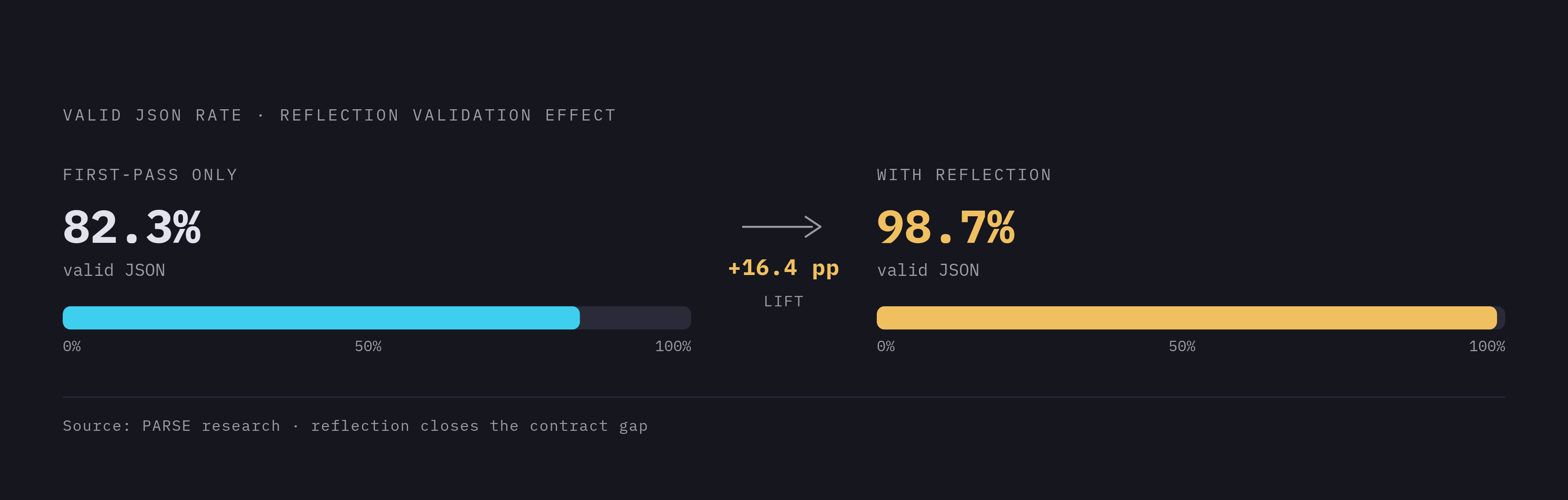
Validation matters just as much as definition. PARSE's reflection-based approach, which adds a validation pass after generation rather than trusting the first output, lifted valid JSON rates from 82.3% to 98.7%. That's a substantial improvement. It's the difference between a contract that mostly holds and one that reliably holds, and it demonstrates that validation is the mechanism that actually closes the gap between what a model produces on its first pass and what the contract requires, not a post-processing nicety tacked onto the end of a pipeline. It's the mechanism that actually closes the gap between what a model produces on its first pass and what the contract requires.
Output format is a real architectural decision, not a stylistic preference. Markdown runs to roughly 11,612 tokens for a given piece of content, against 13,869 tokens for the same content in JSON, a difference of around 16%. For retrieval and summarization tasks, that token efficiency makes Markdown the better default. But JSON wins when downstream code needs named fields to key off of; the structural clarity there saves more than the token overhead costs. This choice belongs in the contract itself, stated explicitly, not left for the model to decide on the fly depending on how it feels about the prompt that day.
Structured output APIs can enforce schema compliance more reliably than free-form generation, but that same rigidity can introduce tradeoffs in content generation that affect field-level accuracy. A contract that's airtight on syntax can end up looser on semantics. And contract design has to account for which enforcement mechanism actually fits the model sitting in the pipeline, rather than assuming the more rigid option is always the safer one.
Completeness deserves its own callout, separate from schema validation. A required field that comes back null, silently, passes most schema validators without a hitch, because null is a valid type. It's a contract violation in every practical sense, but only if null-handling gets specified explicitly in the contract itself. Otherwise nobody notices until a downstream process treats a missing price as a zero.
For content with genuine hierarchical complexity, like financial derivative contracts, structure preservation gets even harder. The CDMizer framework, developed through research at Rensselaer Polytechnic Institute, uses depth-based retrieval and hierarchical generation specifically to hold schema adherence together at scale on that kind of document. It's a useful signal that contract enforcement for complex, nested content needs purpose-built mechanisms, not a generic schema validator applied uniformly across every content type.
Where traditional SERP APIs and scraping tools break the contract by design
Search engine results page APIs were never built to solve this problem, and it shows. They return titles, URLs, and snippets typically running 150 to 300 characters. That's metadata about content, not content itself, and there's no schema and no contract attached to it. The LLM on the receiving end has to interpret a fragment with no grounding behind it, guessing at context the snippet never provided.
Then there's the token overhead. Traditional SERP tools often hand back raw HTML alongside bloated metadata, and an agent has to parse all of that before it can do anything useful with it. That parsing step burns tokens, adds latency, and, worse, has no contract guarantees of its own. Parsing only defers the contract's unreliability rather than fixing it. It just gets deferred one layer downstream, to whoever has to write the parser.
Scraping tools carry their own set of structural weaknesses. JavaScript-heavy pages, CAPTCHA layers, and anti-bot defenses require infrastructure that a lot of scraping tools simply don't have. When a scraper hits one of those walls mid-pipeline, it comes back with partial HTML, or nothing at all, and the contract breaks silently, with no error loud enough to flag the failure before it propagates. Tools that hand back raw HTML as their default output are, functionally, deferring the entire structuring job to whichever team consumes the response. It's a promise to provide a contract later, made by someone else. It's a promise to provide one later, made by someone else.
The market splits cleanly on this point. Some retrieval tools hand back model-ready JSON on the first call. Others hand back raw HTML or a bare proxy connection and call it a day. The contract either exists at the API boundary, enforced before the response leaves the provider's infrastructure, or it doesn't exist at all, and the burden shifts entirely onto the consuming team's own code.
This gap compounds into a security risk. Research has found that around 70% of code instances generated for security API consumption contained some form of API misuse. When a retrieval tool ships with no output contract, an LLM agent consuming it doesn't correct for the gap, it compounds it, generating calls that violate the contract further downstream in ways nobody's watching for.
What AI-native retrieval APIs deliver that SERP and scraping tools cannot
The defining shift with AI-native retrieval APIs is that search and full content extraction happen in a single call, and the content comes back in the format the caller declared up front. The contract is the product being sold, not a side effect of the architecture. It's the product being sold.
A well-engineered version of this delivers structured metadata as typed fields rather than something buried inside raw markup: publication date, author, page category, and, for commerce-relevant use cases, domain-specific fields like product price or stock availability. Output format gets declared and actually enforced, whether that's Markdown or JSON, rather than left to whatever the underlying model happened to produce on a given run. Zero Data Retention configurations, where a provider commits to not retaining queries or results, matter directly for enterprise deployments carrying data governance obligations that a standard logging setup would violate. And native integrations, LangChain tools, LlamaIndex tools, MCP server support, mean the contract is actually consumable inside the agent frameworks teams have already built around, rather than requiring a custom adapter layer just to bridge the gap.
The Model Context Protocol is a contract-alignment mechanism, not just a convenience feature. It lets an agent call an extraction tool directly, mid-task, without custom glue code sitting in between. Context.dev's MCP integration lets an agent request structured data in the middle of a task and receive it in the declared schema, without routing it through a separate parsing layer first.
Automatic entity extraction, done well, can meet contract guarantees without requiring the caller to define a schema at all. Systems that use computer vision and machine learning to extract structured data without hand-written extraction rules, returning entity-level facts (companies, people, products, articles) as structured JSON, show that schema-free extraction and contract reliability aren't mutually exclusive. The schema doesn't have to be written by hand for the guarantee to hold.
Regardless of which provider is under consideration, test a retrieval API against the hardest schema in the pipeline, never the simplest one. A simple schema will pass on almost any tool. It tells you nothing about where the contract actually breaks once real production load and real content complexity occur.
Treating output contracts as continuous pipeline concerns, not one-time configurations
A schema that's accurate on deployment day doesn't stay accurate by default. Web content changes shape constantly, provider APIs get versioned and re-versioned, and field semantics drift in ways nobody flags until something downstream quietly stops matching. A static schema, treated as a one-time configuration, becomes a liability the moment the world it was built to describe moves on without it.
Production RAG systems need a three-layer evaluation discipline to keep the contract honest over time. An offline golden dataset test suite, targeting a faithfulness score above 0.85, catches regressions before they ship. A CI/CD quality gate, using a tool like DeepEval, blocks those regressions from reaching production in the first place. And continuous production monitoring, sampling live queries through observability tooling, catches the drift that only becomes visible once real traffic starts hitting the system in ways the test suite never anticipated.
Agentic RAG raises the stakes on all of this, because autonomous agents that re-query when their first retrieval attempt comes back insufficient are depending on the retrieval API to return a contract-valid response on every retry, not just the first call. Reliability under repeated, real-world load is part of the contract itself. It's part of the contract itself, and a system that only holds up on a clean first attempt hasn't actually earned that reliability claim.
Freshness deserves treatment as its own contract dimension, separate from structural correctness. A model's training data cannot substitute for live web content on anything time-sensitive. An agent qualifying sales leads off data that's six months stale will miss recent funding rounds, leadership changes, and shifts in the technology a target company has actually adopted. Structural correctness with stale content is still a broken contract, just a broken one that looks fine on a schema validator.
The finding on enterprise GenAI adoption is a useful close, because it puts a number on what happens when this discipline gets skipped. Around 95% of enterprise GenAI pilots fail to reach measurable P&L impact. Vendor-partner deployments succeed roughly 67% of the time, against 33% for builds done entirely in-house. The gap between those two numbers is usually the infrastructure discipline surrounding the model, and output contracts sit near the center of that discipline. It's the infrastructure discipline surrounding the model, and output contracts sit near the center of that discipline.
Schema definition, validation, content shaping, and freshness enforcement aren't retrieval-layer concerns that a team can hand off to the model and forget about. They're pipeline engineering disciplines, and they require active ownership at every stage the content passes through, not a one-time schema written at project kickoff and never revisited. An output contract is the boundary condition that decides whether retrieved web knowledge is actually usable at inference time. Designing it with intent, enforcing it continuously, and building on infrastructure engineered around that enforcement, rather than infrastructure that assumes it, is the difference between a system that survives a demo and one that survives production.