Web Retrieval API Design Principles for LLMs
Retrieval, not the model, is where most AI agents fail in production.

A retrieval API built for language models has to solve a different problem than one built for humans. Human search returns a ranked list of blue links and a scattering of text meant to catch an eye scrolling past. An LLM doesn't scroll. It reads whatever gets handed to it and reasons over it as if every word were load-bearing. The retrieval layer's job is not to rank for click-through but to select, shape, and deliver content the model can actually use. Get that wrong, and the model doesn't stumble, it produces a confident, fluent, wrong answer. That gap between "looks right" and "is right" is where most production AI systems quietly fail, and it traces back to retrieval quality rather than model capability.
This matters because the skepticism toward AI output is earned. Developer sentiment tracked in industry surveys shows more distrust of AI-generated accuracy than trust, and that distrust isn't irrational: it's a rational response to systems that were fast in the demo and wrong in production. A sales-qualification agent pulling six-month-old company data will cheerfully report a funding round that closed, a CTO who left, or a product that got sunset. None of that is a hallucination in the technical sense. It's stale retrieval dressed up as fact. What follows is a layered framework for the design decisions that separate a retrieval API that works in a demo from one that holds up when an agent calls it fifty times an hour under real load. None of this touches SEO, human search UX, or which consumer engine ranks where. This is about wiring retrieval into a reasoning loop.
How agents consume retrieved content, the retrieval layer in context
Production agent architectures generally break into four layers: a reasoning layer (the model itself), an orchestration layer, a memory and data layer where retrieval and RAG live, and a tool integration layer that connects the agent to the outside world. Retrieval sits in that third layer, but functionally it behaves like a tool the reasoning engine calls, not a preprocessing step that happens once before the agent starts thinking.
That distinction changes everything about how the API should be built. In an agentic workflow, retrieval can get called mid-reasoning, repeatedly, with queries that evolve as the model narrows in on an answer. An agent might retrieve once, inspect what came back, decide the evidence is thin, and retrieve again with a sharper query. This is the dominant pattern now: a single retrieve-then-generate call is a simplification that doesn't match how production systems actually operate. Which means the retrieval API has to be fast enough to sit inside a reasoning loop without blowing the latency budget of a multi-step task, and it has to fail gracefully. Tool failures cascade upward. A retrieval call that times out or returns malformed input doesn't just fail quietly, it corrupts whatever the agent does next, so error handling, input validation, and retry logic inside the retrieval layer are not implementation details. They're reliability requirements.
The Model Context Protocol has emerged as the standard way tools, including retrieval tools, get exposed to agents, and any retrieval API built today should be thinking about MCP-compatible interfaces as a baseline expectation rather than a nice-to-have. Retrieval-augmented generation itself has moved from experimental to default architecture across a large share of production LLM applications, and that shift means retrieval API design is now mainstream engineering work.
The retrieval bottleneck: why the failure is almost never the model
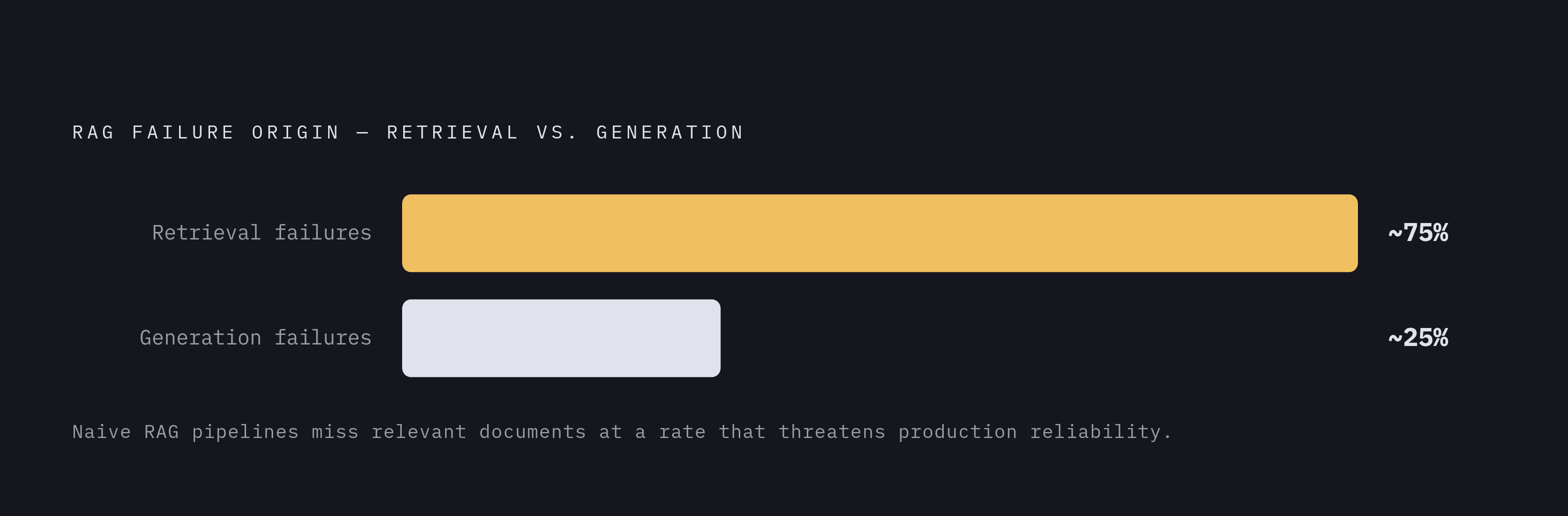
Industry analysis of RAG systems consistently points to the same conclusion: when these systems fail, retrieval is the failure point roughly three times out of four, not generation. Naive RAG pipelines miss the right documents at a rate high enough that it should worry anyone shipping one to production, generating fluent, well-structured answers grounded in the wrong evidence.
Wrong documents get retrieved when semantic similarity is high but factual relevance is low, the classic case of an embedding model finding something that sounds related without being correct. Wrong documents get retrieved when semantic similarity is high but factual relevance is low, the classic case of an embedding model finding something that sounds related without being correct. Stale content gets served when a newer version of a document exists but the retrieval layer has no mechanism to detect or prefer it. And conflicting versions get pulled when a corpus contains both a superseded document and its replacement, with embedding similarity scoring them nearly identically and no structural signal telling the system which one is current. A compliance agent ingesting regulatory guidance alongside internal wiki pages can retrieve the outdated policy with total confidence, because nothing in the pipeline flagged it as outdated.
None of this is something the generation model can fix on its own. A language model synthesizes from whatever sits in its context window, and it has no independent way to know that a document is six months stale or that a newer version exists somewhere else in the index. The fix has to happen upstream, before the content ever reaches the model. Everything that follows is about what "upstream" actually requires.
Content selection: what the retrieval API chooses to return matters as much as how fast it returns it
There's a meaningful difference between an API that wraps a search engine's results page and one built to select content for a reasoning model. A wrapper returns whatever ranks, including ads, navigational pages, and shallow snippets built for a human eye skimming a results page. None of that is structurally useful to an LLM trying to answer a multi-step question. An API designed for LLM consumption has to apply relevance, authority, and freshness filters before content ever reaches the model, treating the query's actual information need as the target.
Freshness deserves particular attention as a filter, not an afterthought. For time-sensitive queries, document age has to be a first-class parameter the API applies directly, rather than something the caller bolts on after the fact by filtering results themselves. An agent retrieving outdated company data doesn't know it's outdated, and will report old funding numbers or a former executive's name with the same confidence it would report current facts.
There's also a real design choice around breadth versus depth. Some retrieval systems aggregate across a wide number of sources in a single call, which helps with coverage but raises a structural question: does that aggregation happen inside the API, or does the caller have to stitch together results from multiple separate calls? Pushing that work onto the caller multiplies both latency and complexity. Handling it inside the API means the API has to own its own index and ranking logic rather than just forwarding requests to someone else's search endpoint.
Full-page extraction matters here too. Snippets exist because humans skim, but a model working through a multi-step question needs enough continuous text to follow an argument or trace a chain of facts. Retrieval APIs built for LLMs should treat full extracted content as a standard output mode.
Some industries have particularly strong incentives to adopt RAG precisely because they need source attribution the way a pure generation model can't provide. For those teams, getting content selection right is a compliance requirement. It's a compliance requirement.
Hybrid retrieval: why neither keyword search nor vector search alone is sufficient
Pure vector search misses exact keyword matches. Pure keyword search (BM25, in the technical vernacular) misses semantic relationships that don't share vocabulary. Neither gap is a mystery, and neither should still be showing up in a retrieval API built in 2026. Hybrid search, which combines both approaches, should be the default architecture, not an optional toggle a caller has to know to flip on.
The mechanics are fairly well established at this point. Dense semantic search through vector embeddings captures conceptual similarity: a query about "reducing customer churn" finds a document about "improving retention" even without shared words. Sparse keyword retrieval catches exact term matches, which turns out to matter enormously for proper nouns, product names, and technical identifiers that an embedding model can blur past. The two result sets then get merged and re-ranked, with Reciprocal Rank Fusion as one named merging technique and cross-encoder re-ranking as a named approach for the final pass. Hybrid search has been described as the single biggest quality improvement available to a naive RAG pipeline, and that claim tracks with how basic the underlying failure mode is when it's absent.
Vector store choice shapes what's possible here. One vector database ships with hybrid keyword-plus-vector search built in behind a GraphQL interface. Another vector database, built on a systems-level programming language, handles high-throughput workloads with strong multi-tenancy support. A third option runs natively inside a popular relational database and suits smaller corpora well, without requiring a team to stand up new infrastructure just to get vector search working. These are vector stores, not retrieval APIs in themselves, but an API's architecture depends heavily on what it's built on top of. An API that owns its retrieval layer can tune the blend between semantic and keyword signals and swap in a better re-ranking model as one becomes available. An API that just wraps someone else's search index inherits whatever limitations that index has, permanently.
Re-ranking, in particular, belongs inside the API, before results ever reach the caller. Pushing re-ranking downstream forces the caller to request more candidates than it needs just to have enough material to re-rank itself, adding token cost and latency for no real benefit.
Context shaping: how the retrieval API formats content for the model's reasoning process
Context engineering and prompt engineering get treated as synonyms sometimes, and they shouldn't be. Context engineering asks a narrower, more mechanical question: what configuration of context is most likely to produce the behavior a system needs from the model? Most agent failures at this point are context failures rather than model failures, and this distinction locates the fix in a different place than most teams initially look.
Chunking is where a surprising number of RAG pipelines quietly break. Fixed-character chunking, splitting a document every so many tokens regardless of content, routinely cuts a coherent idea in half across a chunk boundary. The model receives half an argument and treats it as the whole thing. Semantic chunking, which uses embedding similarity to detect where a topic actually shifts, does better: each chunk should be able to stand on its own and answer a question without needing the chunk before or after it for context. This is work the API should be doing, not something every individual caller has to reimplement from scratch.
Position within the context window is its own variable, separate from which content gets included. Research on long-context processing has documented that models show position-dependent bias, often underusing information buried in the middle of a long input while weighting the beginning and end more heavily, a pattern sometimes called "lost in the middle." That means where retrieved content sits in the context block is a design decision, not an afterthought: the most important evidence belongs at the start or end, not in the middle where a model is statistically likely to skim past it. An API that returns results already ranked by importance gives the calling system what it needs to make that placement decision correctly.
Token budget discipline matters just as much. There is reason to believe that retrieval quality can actually decline as context windows fill well past what a model can effectively process, which cuts against the instinct to just stuff in more retrieved content for safety. More isn't automatically better, and an API should expose real controls, result length, chunk count, total token budget, rather than a single blunt "top N results" knob that leaves the caller guessing.
Output format is a smaller point but not a trivial one. Markdown with clear section breaks gives a model much cleaner structure to reason over than raw HTML or a wall of unformatted text, and at least one provider has made pre-chunked, relevance-ranked Markdown an explicit design choice for exactly this reason. Contextual compression filters retrieved content against the current conversation, not just the raw query, keeping the context window focused on what the present reasoning step actually needs instead of everything the corpus happens to contain.
Freshness and reliability under real-world load, the production constraints that demos never test
Model training data has a hard limit that no amount of clever prompting fixes: it goes stale the moment training ends. Company funding, regulatory changes, product launches, market conditions, all of it needs live retrieval at inference time, which is the entire argument for treating web-grounded retrieval as a permanent architectural component rather than a stopgap bolted on until the next model release.
There are two dimensions of reliability that a demo simply never stresses. Latency predictability is the first. An agent workflow might call retrieval several times inside a single task, and if each call's latency varies unpredictably, the total time for the workflow becomes impossible to guarantee to whatever system depends on it downstream. The second is freshness under caching. An API that caches aggressively can look fast in a benchmark while quietly serving content that's hours or days old. Speed benchmarks alone tell a misleading story. Freshness needs to be a guarantee the API states explicitly, not an assumption baked into a latency number.
Because tool failures cascade into agent failures, retrieval calls need real error handling, input validation, and retry logic built in, not bolted on after something breaks in production. Scraping-based retrieval is particularly brittle in this respect: page structures change without warning, bot detection blocks legitimate requests, JavaScript rendering trips up naive scrapers, and rate limits throttle throughput right when an agent needs it most. A retrieval layer that depends on scraping tooling it doesn't fully own inherits all of that fragility. Owning the content pipeline end to end is the only way to actually offer a reliability guarantee rather than a hope.
Concurrency is the other blind spot demos almost always miss. Multi-agent frameworks running parallel workflows, with adoption now numbering in the thousands of companies for at least one popular framework, generate concurrent retrieval calls as a matter of course. An API that performs fine under a single-threaded test can degrade sharply once dozens of agents are hitting it at once, and that gap is visible only under real production traffic, never in a demo.
Federated approaches to retrieval address a related but distinct problem. Some organizations can't centralize their knowledge into one index for privacy, security, or infrastructure reasons, and architectures like Federated Dual-System RAG exist specifically to let retrieval respect those boundaries rather than assuming everything can live in one place. Enterprise retrieval APIs need to account for that reality rather than designing around a single unified index as the only option.
Security, data ownership, and governance as first-class retrieval API concerns
RAG corpus poisoning is a real, active threat category, not a theoretical one. Defenses like RAGPart and RAGMask have emerged specifically to counter it: RAGPart limits how much influence a malicious document can exert by exploiting how dense retrievers learn from partitioned training data, while RAGMask flags suspicious tokens by masking them and watching for abnormal shifts in similarity scoring. Any retrieval API design has to account for the possibility of adversarial content sitting in the corpus. Assuming everything indexed is trustworthy is no longer a defensible assumption.
The same regulated industries driving RAG adoption, healthcare, finance, legal, government, need that adoption paired with real audit infrastructure. Source attribution is the whole reason RAG appeals to them over raw generation, and attribution only means something if the retrieval layer logs what was retrieved, from where, and at what time, in a way that can be reconstructed later for an audit.
Data ownership is a related but separate concern. An API that wraps a third-party search index generally can't tell a customer with confidence what happens to their queries: whether they're retained, logged, or fed into training data for someone else's future model. Enterprise teams handling sensitive queries need clear answers to those questions, and a wrapper architecture structurally can't provide them the way an API that owns its own pipeline can.
Authentication, authorization, and audit trails round out the list, and they apply specifically to the retrieval layer, not just to the application sitting on top of it. Security boundaries have to be enforced at the point where content enters the system, with complete audit trails available for regulatory review. Standards efforts now underway, including a recently announced initiative from NIST focused on AI agent architectures, have flagged security and interoperability choices as concerns that ripple through an entire system in ways that model selection alone can't fix. Retrieval sits at the front of that chain. Getting it wrong at the API level isn't a problem a better model downstream can quietly absorb.