Lost-in-the-Middle Problem and Re-Ranking for LLM Context Windows
LLMs struggle to use information placed in the middle of long contexts.

Large language models reading long documents do not treat every part of the text equally. When the answer to a question sits near the start or end of a context window, the model finds it reliably. When that same answer is placed somewhere in the middle, accuracy drops, sometimes sharply. Plotted against position, the result is a U-shaped curve: strong at both edges, weak in the center. This pattern has a name in the field, the lost-in-the-middle effect, and it is not a bug that shows up occasionally under bad luck. It is a structural feature of how these models process sequences, and it is predictable.
Researchers at Rutgers, Nikolaus Salvatore, Hao Wang, and Qiong Zhang, tested whether this curve was something models pick up incidentally or something built into how they learn. The U-shaped curve appeared in models trained this way from the ground up. That result matters because it means the curve is not a side effect of scale or of some particular dataset quirk. It comes from the training dynamics themselves.
A separate research group, Shengnan An and colleagues at a major tech company and a partner university, trace the problem to a gap in supervision. During long-context training, models rarely see examples that force them to treat the middle of a passage as just as likely to hold the answer as the edges. Without that pressure, nothing in training pushes the model to assign uniform value across positions.
Two mechanisms inside the architecture reinforce this tendency. The first involves RoPE, the rotary position encoding scheme many transformer models use to represent where a token sits in a sequence. Because pre-training exposes models to a fairly uniform demand for long-range recall, combined with the autoregressive setup and a phenomenon known as attention sinks (where models learn to dump disproportionate attention on a small number of fixed positions), the training process bakes in a prior belief that the edges of a context are where the important information lives.
The Rutgers paper frames this as something closer to adaptation than defect. The parallel to human memory is not incidental. Cognitive psychology has documented primacy and recency effects in human recall for decades: people remember the first and last items in a list better than the ones in the middle. It reinforces the same underlying point: the U-shape is what happens when a system, biological or artificial, is shaped by competing demands to remember both the start and the most recent material.
Expanding the Context Window Does Not Eliminate the Problem
The intuitive fix, give the model a bigger window so nothing ever needs to sit "in the middle" of a cramped space, does not work. Liu and colleagues documented this in 2023 across models with a range of window sizes, and subsequent studies confirmed the same pattern in models with windows extending well beyond that range. A longer window does not flatten the curve. It stretches the middle out, and the stretched-out middle still underperforms.
The Rutgers framing explains why this has to be true. The bias comes from the interaction between model architecture (RoPE decay, softmax amplification, attention sinks) and training objectives (the mix of short-term and long-term recall demand baked into pre-training). The bias lives in the mechanism that decides how attention gets distributed inside that container, and stretching the container does not touch the mechanism.
Frontier models report near-perfect recall on needle-in-a-haystack benchmarks, where a single fact is planted somewhere in a long passage and the model has to find it. Production retrieval-augmented generation looks nothing like that. It involves multiple retrieved documents, partial relevance scattered across several of them, and questions that often require connecting facts across more than one source. That is a harder and different problem than finding one needle in one haystack, and strong needle-in-a-haystack scores do not predict strong performance on it.
The practical consequence follows directly. A retrieval-augmented generation system that finds the correct source material but assembles it into the context window without regard to position will still suffer the same degradation a shorter window would produce. The problem does not disappear with scale. It relocates, from a limitation of the model to a design choice in the pipeline that sits on top of it.
How RAG pipelines inherit the positional bias problem at the retrieval stage
Retrieval-augmented generation systems work by finding relevant chunks of text and handing them to the model alongside the user's question. That ranking tells the system how relevant each chunk is believed to be. It says nothing about where that chunk should sit once it gets placed into the prompt. Similarity score and positional value are two different signals, and most pipelines only compute the first one.
An and colleagues describe the consequence precisely: the lost-in-the-middle challenge undermines the model's ability to use context it has already received, making it a utilization failure. The Rutgers paper makes a related point: getting an answer right depends on retrieving the correct material, but retrieval correctness and positional placement are two separate conditions, and a system has to satisfy both. A pipeline can retrieve exactly the right three documents out of a million and still produce a wrong answer, if the single most important one of the three ends up buried in the middle of the assembled prompt.
This happens constantly in default implementations. Retrieval recall and generation faithfulness measure two different things. A high recall score tells you the right information was found. It tells you nothing about whether the model could actually use it once it arrived.
What Re-Ranking Does
Re-ranking is a second pass over retrieved candidates that scores each one for how genuinely relevant it is to the query, applied after the first retrieval step and before the context gets assembled and sent to the model. That position in the pipeline, after retrieval, before assembly, is what makes it the natural place to intervene on lost-in-the-middle degradation.
First-stage retrieval exists to cast a wide net efficiently. Methods like BM25 or dual-encoder embedding search are built for speed across large corpora, and that speed comes from a shortcut: dual-encoders compute a representation for the query and a separate representation for each document independently, then compare them. That approach scales well, but it cannot capture fine-grained interaction between a specific query and a specific document, because the two were never processed together.
Re-rankers close that gap by processing the query and each candidate document jointly. Cross-encoders, and increasingly LLM-based rerankers, take the pair as a single input and produce a relevance score that reflects how the two actually interact, not just how similar their separate vector representations happen to be. This joint processing is more computationally expensive, so it runs as a second stage over a shortlist, after the first pass over an entire corpus.
The standard pipeline sequence looks like this: ingest the source material, chunk it, embed it, run a nearest-neighbor retrieval pass optimized for recall, re-rank the resulting candidates for precision, assemble the final context, and generate the answer. Because it is the last point in the pipeline where chunk order is still an open decision, it is the point where lost-in-the-middle degradation can actually be addressed before it does any damage.
How Re-Ranking Scores Translate Into Context Placement
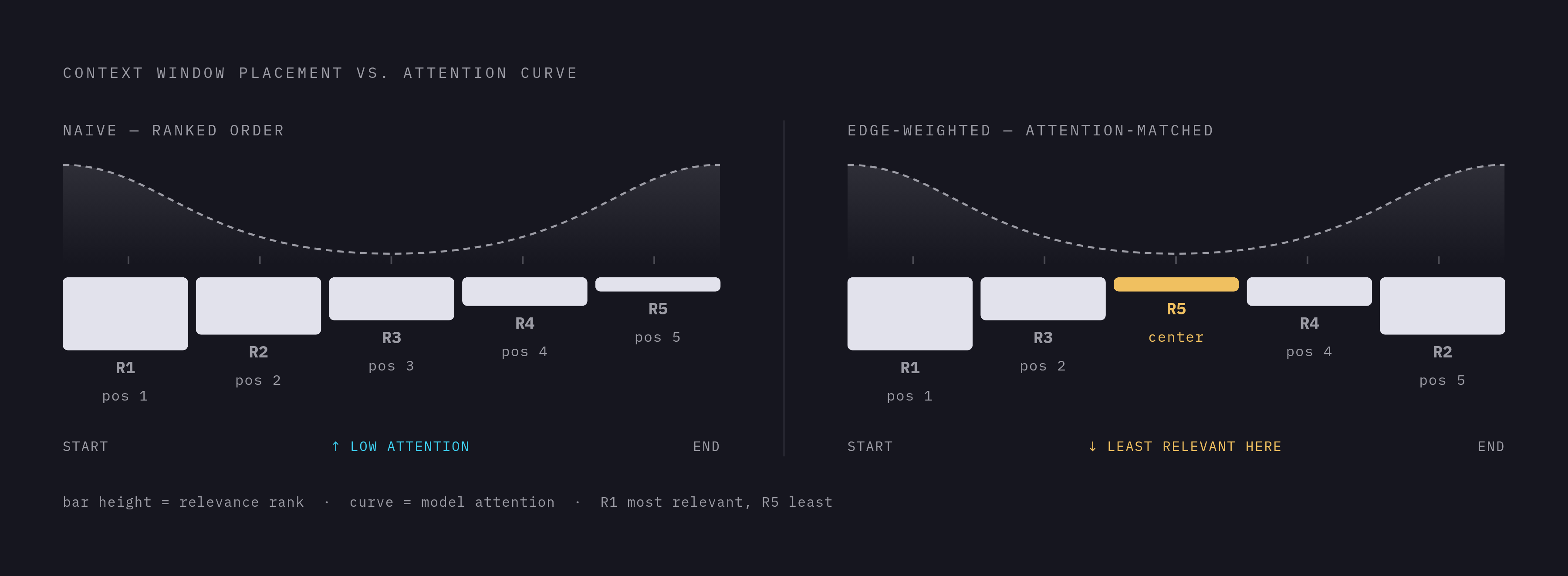
A relevance score by itself fixes nothing. The score has to be used to decide where each chunk sits in the final prompt, and that placement decision has to work with the U-shaped attention curve. The logic is two steps, not one: first re-rank to produce an accurate relevance score for every candidate, then place chunks in the context window according to that score, with the highest-relevance material pushed to the beginning and end rather than left wherever the sort order happens to put it.
Consider five retrieved chunks, re-ranked from most relevant (rank 1) to least relevant (rank 5). A naive assembly strategy simply lays them out in order: rank 1, then 2, then 3, then 4, then 5. That places ranks 2, 3, and 4, the middle of the relevance distribution, in the middle of the context window, which is also the zone where the model's attention is weakest. An edge-weighted assembly strategy instead places rank 1 at the very start, rank 2 at the very end, and continues working inward from both sides, so that the single least relevant chunk, rank 5, ends up in the center where its low value matters least. The relevance ranking and the positional assignment are not the same operation, and treating them as if they were is what causes the naive approach to fail.
An and colleagues provide direct evidence that position-aware handling closes this gap. Their IN2 training method, applied to Mistral-7B to produce a model called FILM, explicitly supervises the model to pay attention to information at any position in a long context, including fine-grained segments as short as roughly 128 tokens buried inside passages of several thousand tokens. Training a model this way measurably addresses the lost-in-the-middle deficit, which demonstrates that handling position deliberately, rather than letting it fall out of whatever order retrieval produces, is what actually closes the gap. The Rutgers emergent-property framing explains why this has to be true at the pipeline level as well as the training level: primacy and recency advantages are structural features of how these models attend to context, so any assembly strategy that ignores them is fighting the model's own attention dynamics. Re-ranking that only filters, dropping irrelevant chunks without then reordering the survivors by edge-weighted placement, captures the precision benefit of a better candidate set but leaves the positional benefit sitting on the table unclaimed.
Evidence that re-ranking with deliberate placement measurably improves retrieval quality in production pipelines
The two-stage retrieve-then-rerank pattern already operates as the baseline approach for teams building serious retrieval systems. The TREC RAG 2024 evaluation, built on the Ragnarök framework, is a clear public example. The structure itself, fast recall followed by a distinct, slower precision layer, mirrors exactly the architecture described above, built and evaluated at scale in a public benchmark setting.
Databricks reported a 15-percentage-point average improvement in retrieval accuracy on enterprise benchmarks after adding a re-ranking step to its AI Search pipeline.
A third data point comes from outside the re-ranking literature entirely but corroborates the same underlying mechanism. McCammon's TimeStampEval work in 2025 tested a long-context retrieval task and found that a simple change in prompt structure, placing the query before the transcript rather than after it, improved accuracy by a range running from the low single digits up to roughly twenty percentage points, while also reducing token count. This is not a re-ranking experiment, and it does not isolate context-assembly placement the way the central argument of this piece does. It shows that the position of high-signal content relative to the query has a substantial effect on retrieval accuracy in long-context settings, independent evidence consistent with the lost-in-the-middle mechanism.
Taken together, the Ragnarök evaluation and the Databricks production result show the same pattern holding across two different contexts, a research benchmark and a commercial deployment. What they do establish is that the retrieve-then-rerank architecture, with attention paid to how the output gets used, is no longer an experimental idea. It is the operating baseline for teams that treat retrieval quality as a first-class engineering concern.
The strongest objection: why re-ranking alone is not a complete solution
Re-ranking with deliberate placement addresses where chunks sit in the context window. It does not solve everything that compounds with lost-in-the-middle in a live production system, and three limits deserve direct acknowledgment: context rot, latency cost, and the ongoing tension between recall and precision.
Chroma Research documented a separate degradation pattern, context rot, across 18 frontier models: performance drops as input length increases, even when the relevant chunk is well-ranked and well-placed within that input. Context rot is a distinct failure mode from lost-in-the-middle. Good placement does not cure it, because the degradation here comes from sheer input length rather than from where within that length the answer happens to sit.
Cross-encoder re-rankers carry a real computational cost. Even restricted to a shortlist, the added latency is a genuine constraint in systems with tight response-time budgets, agentic pipelines chasing fast multi-step reasoning chains being the clearest example.
A complementary line of work, including An and colleagues' IN2 training approach, targets the model itself rather than the pipeline around it, training the model to be inherently more robust to where information sits in its context. That approach suggests re-ranking functions as one layer of mitigation among several available, not as a full substitute for improvements at the model level. The Rutgers emergent-property framing carries a sobering implication here: as long as models continue training on a mix of short-term and long-term retrieval demands, some degree of positional bias will likely persist at the model level no matter how carefully the pipeline around it is engineered. Re-ranking manages the symptom at the moment context gets assembled. It does not remove the architectural cause sitting underneath it.
Some engineering teams, given sufficiently large context windows, may reason that retrieving more material and trusting the model to sort through it is a reasonable substitute for careful placement. The evidence here points the other way: accuracy degrades in proportion to how much low-relevance material accumulates in the middle of the window, regardless of how large that window is. Re-ranking with deliberate, edge-weighted placement is what keeps that accumulation from quietly eroding the quality of every answer the system produces.