Retrieval Recall vs. Precision Tradeoffs for Grounded Generation
Coverage-based retrieval metrics predict generation quality better than relevance scores alone.

A production RAG pipeline can pass its accuracy dashboard and still hand a user a wrong answer, because the failure that caused it never showed up on that dashboard. The retriever and the re-ranker do different jobs in the pipeline, and the moment a team starts treating them as interchangeable levers for the same problem, the system begins to fail in ways nobody can locate.
Why the retriever and re-ranker have different jobs
A user catches a wrong claim in a generated answer. The retrieval logs look clean: reasonable latency, chunks returned, nothing obviously broken. The team checks the re-ranker's output, and it looks fine too: scores make sense, ordering makes sense. What happened is that the chunk the answer actually depended on was never pulled into the candidate set in the first place, and no amount of re-ranking could have fixed that, because a re-ranker can only reorder what it's given. This is the diagnostic blind spot that defines most RAG failures in production: teams instrument one end-to-end quality score and have no way to tell whether a regression started at retrieval, at re-ranking, or at generation, so the problem persists until a user stumbles into it. Production RAG evaluation tracks three distinct failure surfaces separately, retrieval quality, faithfulness, and groundedness, each needing its own metric rather than a shared "accuracy" number that flattens them into noise. That three-way split is what makes the division of labor concrete: the retriever's job is to maximize the odds that every chunk the answer depends on lands in the candidate set, and the re-ranker's job is to restore signal-to-noise within that set once it exists. Neither tool substitutes for the other. Treating the tradeoff between recall and precision as a staged engineering problem, with distinct components responsible for distinct stages, is what separates pipelines that degrade gracefully under pressure from ones that fail silently until someone notices.
What context recall and context precision measure
Context recall and context precision measure failures that don't overlap, and a retriever can score well on one while quietly failing the other. Context precision is the fraction of retrieved chunks that are actually relevant to the query. When precision is low, noise competes with signal before the generator even processes a token, diluting the context window with material that doesn't help and may actively mislead. Context recall measures something different: whether the chunks the answer actually depends on were retrieved. Low recall is the more dangerous failure of the two, because a fluent, faithful-looking answer can still come out of an incomplete candidate set. The generator doesn't know what it wasn't given, so it writes confidently around the gap, faithfulness scores stay high, and users walk away with a partial answer that reads like a complete one. Enterprise RAG evaluation tracks precision@k, recall@k, MRR, and nDCG as separate retrieval-layer KPIs rather than folding them into one composite score: a single number can't tell a recall failure apart from a precision failure, and the fix for each is different. Recall@k is the leverage metric for the whole retrieval stage: it measures what fraction of all relevant chunks showed up in the top-k results, and it sets the ceiling every downstream component, re-ranker included, has to operate within. A retriever that misses a critical chunk can still produce a fluent, well-cited answer from what it did find, and that disconnect, invisible end-to-end but catastrophic for the user, is why enterprise RAG systems need instrumentation that separates retrieval-layer diagnostics from end-to-end quality scores. Infrastructure built for production AI reasoning, such as Seltz's web knowledge API, is built around that separation, so recall and precision are treated as first-class design concerns at the retrieval stage rather than problems pushed downstream for someone else to absorb.
Maximizing Retrieval Recall
The retriever should be tuned to maximize recall, and the right value of k, along with the right retrieval strategy overall, depends on how broad the corpus is rather than on any single setting that works everywhere. The logic here is asymmetric: widening retrieval to capture more candidates costs relatively little in precision terms, because the precision hit gets absorbed and corrected by the re-ranker downstream. That asymmetry is the actual engineering argument for retrieving aggressively at this stage. Corpus breadth changes how hard that is to pull off. A broad corpus spanning many topics gives you many distinct ways to miss a chunk the answer needs, so recall deserves priority there. A narrow, single-domain corpus runs the opposite risk, where noise looms larger relative to the useful candidate set because there's less terrain across which a relevant chunk might hide. Raising k raises recall, but it also raises latency and cost directly, and end-to-end evaluation makes that tradeoff explicit rather than hidden. The right k is a function of the cost budget and the domain rather than a constant that travels across use cases. Corpus breadth is also where the retriever's working material matters as much as its configuration. A retriever searching a narrow, stale corpus has to fight for recall against a shrinking pool of candidates, forcing hard compromises between coverage and noise, while a retriever with access to fresh, broadly indexed web content can afford to retrieve aggressively because the candidate set itself carries more range and more redundancy to draw from. Systems like Seltz own their full data pipeline and continuously surface real-time web context, so retriever designs can lean into recall without forcing the re-ranker and generator downstream to carry an unsustainable precision burden alone. HyDE, Hypothetical Document Embeddings, illustrates the recall-precision tension at the retrieval stage with unusual clarity. If you embed a hypothetical answer instead of the raw query, recall improves for abstract or underspecified queries, where the query's own vector sits far from any real document in the embedding space, and that's the gap where plain nearest-neighbor retrieval falls short. The same technique damages precision when the hypothetical answer hallucinates, pulling chunks into the candidate set that have nothing to do with what the user actually needs. Chunk boundaries compound the same problem: retrieval quality degrades when chunk size doesn't match the granularity the embedding model was trained or fine-tuned on, a mismatch that retrieval quality analysis has established as a recurring cause of recall loss. FloTorch's FinanceBench evaluations put a number on how much this matters in practice: semantic chunking paired with metadata filtering produced a large accuracy gap over fixed chunking without it, which makes chunking strategy a strategic retrieval decision rather than an implementation detail left to default settings.
Coverage-based retrieval metrics predict generation quality better than relevance-based ones
Research spanning TREC NeuCLIR 2024, TREC RAG 2024, and the WikiVideo benchmark, examining fifteen text retrieval stacks and ten multimodal stacks across four RAG pipelines, found consistent positive correlations between coverage-based retrieval metrics and the information coverage of generated responses, at both the topic level and the system level. That finding carries weight because once queries get complex, you need to optimize retrieval for coverage, not for relevance alone. The correlation holds most strongly when retrieval and generation objectives line up, and it weakens as RAG pipelines grow more iterative and complex, a signal that agentic and multi-hop architectures need instrumentation beyond coverage metrics alone to stay reliable. What this exposes in practice is a specific failure mode: LLMs can produce responses that are factually accurate at the sentence level but incomplete in what they cover, failing to address the full range of aspects a query actually raises, whenever upstream retrieval misses a facet of the question. Relevance-based metrics don't catch that failure, because every sentence in the answer can still be relevant and well-supported while the answer as a whole leaves out half of what was asked. Report-generation and multi-document synthesis tasks sharpen this further: the retrieval objective shifts from surfacing the single most relevant document toward surfacing a set of documents that collectively cover multiple aspects of the query without redundancy, a diversity-ranking problem that looks nothing like ad hoc single-document retrieval. The practical upside of this research extends past design philosophy. Coverage-based metrics can serve as efficient proxies for costly end-to-end evaluation, cutting down how often a full generation pipeline needs to run just to check whether retrieval is doing its job, a shortcut the Johns Hopkins and NIST research supports as a legitimate part of retrieval development workflow.
Re-ranking's conditions for helping or hurting
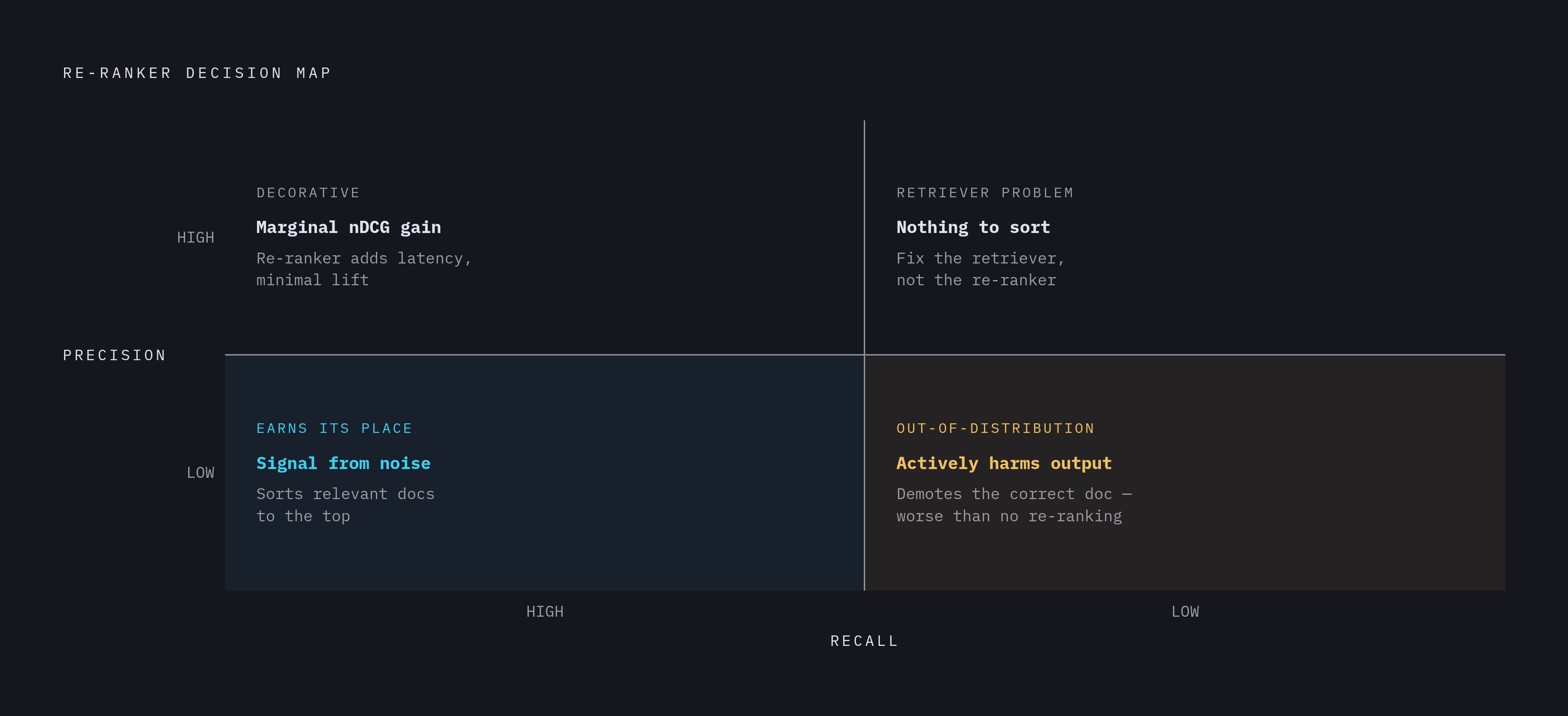
A re-ranker works entirely within the candidate set the retriever hands it, so its value depends completely on retrieval recall being sufficient before re-ranking ever starts. The re-ranker decides the order of what's already there; the retriever decides what's there. No amount of re-ranking sophistication recovers a chunk that never made the candidate list, which makes the retriever's recall the hard ceiling on everything the re-ranker can contribute. That ceiling plays out differently depending on the shape of the candidate set it's given. When recall is high but precision is low, the needed chunks are present but buried in noise, and the re-ranker earns its place in the pipeline, since sorting signal from noise is precisely the job it was built for. When both recall and precision are already high, the re-ranker's contribution shrinks to a marginal nDCG gain, and at that point it's decorative: the pipeline pays a latency cost to move results the LLM didn't actually need moved. When recall itself is low, the re-ranker has nothing useful to work with no matter how well it's tuned, because the document that would have answered the question was never retrieved, and the fix belongs to the retriever, not to the precision layer sitting downstream of it. The fourth condition is the one that catches teams off guard: queries that sit outside the re-ranker's trained distribution, a short query in one language against a multilingual corpus, for instance, can cause the re-ranker to actively demote the correct document, making the final output worse than if no re-ranking had happened. Distinguishing which of these four conditions is in play requires measuring three things together rather than any one in isolation: nDCG@k after re-ranking, the recall@k delta between before and after re-ranking, and the per-call latency cost the re-ranker adds. Scoring all three on a stratified golden set, with the re-ranker switched on and then off, is the only reliable way to separate what the re-ranker contributed from changes caused by the retriever, the chunker, the prompt, or a shift in query distribution. One further risk belongs in this accounting: re-ranking can actively drop recall for multi-hop questions that depend on a second supporting chunk, since the re-ranker may demote that chunk below the cutoff in the name of precision, trading away coverage the answer needed. That makes recall@k after re-ranking a required measurement rather than an optional one, and it's the exact failure mode that complex, multi-hop queries expose at scale.
How complex, multi-hop queries stress the retrieval-reranking boundary
Multi-hop and narrative queries expose a structural limit in the static retrieve-then-rerank model: the evidence needed to answer them is spread across multiple documents in ways a single retrieval pass isn't built to capture reliably. The TREC 2025 RAG Track, now in its second edition, shifted its query set from short, keyword-style queries toward long, multi-sentence narrative queries, a change made specifically to reflect the deep search task and the growing demand for reasoning-driven responses. That shift matters because it reveals, at the scale of a formal benchmark, the coverage failures that standard retrieval handles poorly under simpler query types. The same track now emphasizes attribution verification and response completeness alongside relevance assessment, treating factual accuracy and information coverage as separate dimensions that both need measuring, which makes TREC 2025 the field's largest structured stress test of how retrieval and generation integrate under pressure. The mechanical failure here is specific: a multi-hop question needs the retriever to surface multiple supporting chunks spread across different documents, and a re-ranker working from a candidate set that only captured the first hop will produce a result that scores well on precision while being fatally incomplete on coverage. Faithfulness holds up fine in that scenario, since every claim the generator makes still traces back to something retrieved, but the answer is still wrong by omission. One structural response to this problem is parent-child chunking, where retrieval searches across small, fine-grained child chunks to find precise matches, then expands outward to the parent chunk to give the generator fuller context. The Webex AI Agent's adoption of this hierarchical strategy for enterprise knowledge retrieval is a documented production case of handling the precision-versus-completeness tradeoff at the chunking layer itself, retrieving on narrow child chunks while generating from the broader parent chunk they sit inside. The coverage-correlation research out of Johns Hopkins and NIST reinforces the same conclusion from the measurement side: the relationship between retrieval coverage and generation quality weakens as pipelines grow more iterative and complex, which is the empirical signal that multi-hop workloads eventually need architectural responses that go beyond the two-stage retrieve-then-rerank model.
Faithfulness and groundedness failures versus recall and precision failures
A generator can produce a fluent, high-faithfulness answer from a candidate set that's incomplete or partly wrong, and that single fact is why faithfulness and groundedness scores can never substitute for retrieval-stage metrics. Faithfulness checks whether each claim in a response traces back to something actually retrieved. It fires when a model fabricates a claim out of nothing, but it stays silent when the model instead answers coherently from a partial context, so a coverage gap can sit underneath a faithfulness score that looks clean. Groundedness works at a finer grain, scoring per-sentence support: an LLM judge labels each sentence in a response as grounded, where a backing chunk for it actually exists, or ungrounded, and the fraction of grounded sentences becomes the groundedness score. That score can stay high even when the retrieved set missed half the relevant documents a complete answer would have needed, because every sentence the model did write can still be backed by something real. Citation presence adds one more layer of false comfort: a response can cite a retrieved chunk while overstating what that chunk says, mischaracterizing it, or ignoring parts of it that complicate the claim. Citation accuracy, meaning whether the cited chunk actually supports the specific claim attached to it, is the metric that turns a merely faithful-looking answer into one a reader can actually trust. None of this works as a substitute for retrieval-stage measurement; it works alongside it. The most instructive failure in production RAG is a diagnostic blind spot, where a team tracks end-to-end accuracy and has no way to tell whether a regression began at retrieval, at re-ranking, or at generation, so production systems need visibility into the quality of the content corpus itself, separating signal from noise at the source rather than downstream of it. Web knowledge infrastructure built for AI systems, including Seltz, is designed around that separation, engineering content for machine consumption upstream so that the retriever and the re-ranker can each do their own job without inheriting noise that originated somewhere else in the pipeline.
Sources
- Overview of the TREC 2025 Retrieval Augmented Generation (RAG) Track
- Beyond Relevance: On the Relationship Between Retrieval and RAG Information Coverage
- RAG Evaluation: 2026 Metrics and Benchmarks for Enterprise AI Systems
- Precision Is Not Faithfulness: Coverage-Aware Evaluation of Grounded Generation with a Complete Oracle
- Retrieval-Augmented Generation: A Comprehensive Survey of Architectures, Enhancements, and Robustness Frontiers
- MultiHop-RAG: Benchmarking Retrieval-Augmented Generation for Multi-Hop Queries
- LLM-Confidence Reranker: A Training-Free Approach for Enhancing Retrieval-Augmented Generation Systems
- From BM25 to Corrective RAG: Benchmarking Retrieval Strategies for Text-and-Table Documents