Event-Driven Web Retrieval for Time-Sensitive AI Agents
Agents need to know when to refresh data, not just how to reason.

For agents operating under time pressure, that distinction carries real operational weight. An agent that knows a fact has expired behaves differently from one that confidently repeats it anyway. Event-Driven Web Retrieval for Time-Sensitive AI Agents.
Why time-sensitive agents fail at the retrieval layer, not the model layer
Most engineering teams, when an agent starts giving stale or wrong answers, reach for the model. They swap in a newer version, adjust the prompt, add few-shot examples. Rarely do they look at what the agent actually retrieved before it reasoned.
The failure chain is mechanical and somewhat unglamorous. An agent pulls a page that's been superseded by newer information; the embedding similarity between the query and that stale page is high, because the topic hasn't changed even though the facts have; the model then synthesizes a fluent, confident answer built on outdated premises. Nothing in the pipeline throws an error. The system appears to work until someone reads the trace.
Consider a lead qualification agent pulling from a company knowledge base that hasn't been refreshed in half a year: it will miss a recent funding round, a leadership change, or a new tool the target company just adopted, because the underlying data never told it to look again. This is not hallucination in the conventional sense. Hallucination is the model inventing something with no support. This is worse in a specific way, because the model is doing what it's supposed to do: it's retrieving real text that is topically relevant and then reasoning faithfully from content that happens to be wrong. Similarity is not correctness, and conflating the two is where most production RAG systems quietly go wrong https://arxiv.org/abs/2604.11364.
The credibility gap this creates is visible in how developers actually feel about AI output Stack Overflow developer survey. That gap isn't purely a modeling problem. A meaningful share of it is a retrieval problem, because no amount of reasoning capability fixes an agent that's confidently reasoning from the wrong document Stack Overflow developer survey.
What scheduled and reactive-by-default retrieval get wrong
Two default patterns dominate production agents today, and both get the timing wrong in opposite directions https://arxiv.org/abs/2604.11364.
Scheduled retrieval re-indexes a knowledge store on a fixed interval, daily, hourly, whatever engineering set up during the initial build. The interval reflects convenience rather than the actual volatility of the underlying information.
Reactive-by-default retrieval takes the opposite failure path. It fires a web lookup on every single turn of the reasoning loop, whether or not the task actually needs fresh information. This burns tokens and adds latency for no benefit, and it treats a stable fact, something that hasn't changed in years, the same as a live stock price or a breaking news event. Standard retrieval-augmented generation was built around pre-indexed documents, and the field has increasingly recognized that limit, pushing instead toward agents that query the live web directly rather than a snapshot of it.
There's a cost dimension too that rarely gets discussed until the invoice arrives. Traditional search APIs return raw HTML and a pile of bloated metadata, and the model has to parse all of it before it can extract anything useful. That parsing overhead is a real bottleneck, and it gets expensive fast once you're running it at scale. Neither pattern treats retrieval as a decision the agent makes. Both treat it as plumbing, infrastructure that just runs in the background. The agent never actually asks if this specific task, right now, needs fresh web data.
What event-driven retrieval means as an architectural concept
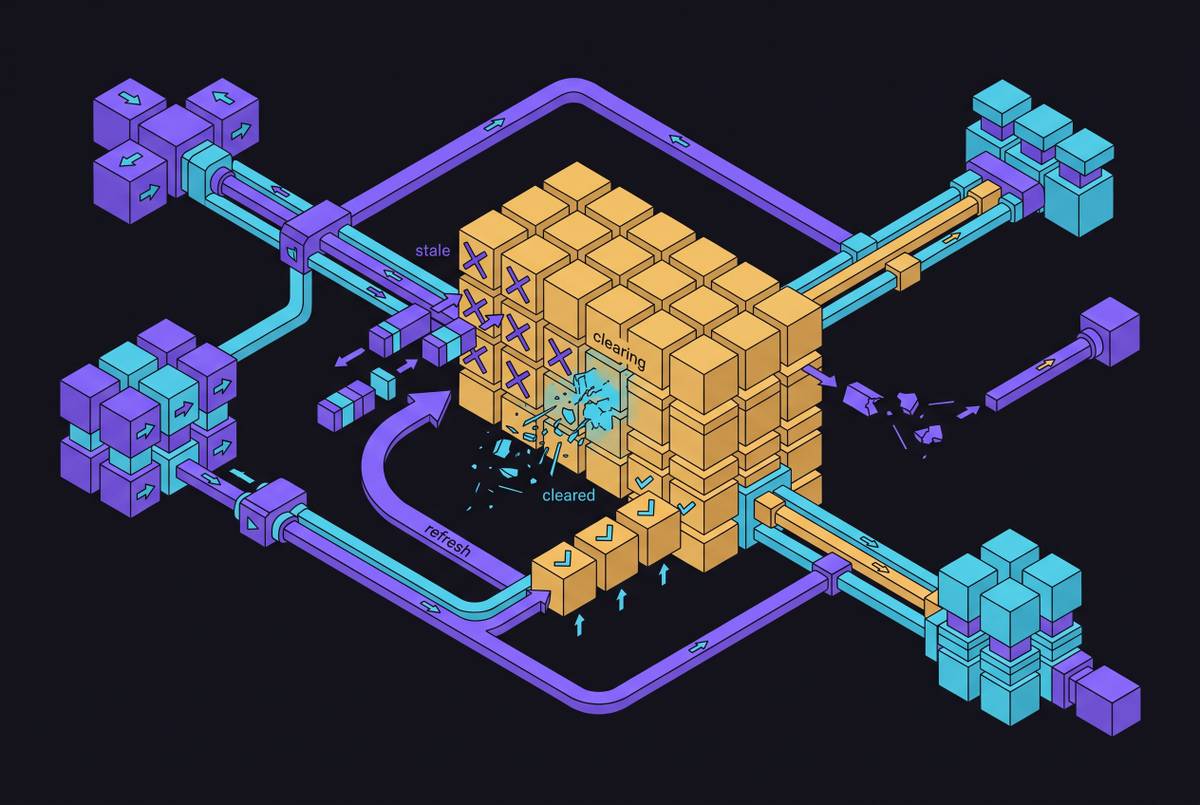
Event-driven retrieval flips that assumption. The agent monitors for specific, pre-classified conditions, and it triggers a web lookup only when one of those conditions is actually met. Retrieval becomes a first-class decision the system makes deliberately rather than a default behavior baked into every loop iteration.
The analogy to event-driven software architecture is close enough to be useful rather than decorative. A message queue doesn't poll constantly for new work; it fires a handler only when a message actually arrives, and it costs nothing while idle. A retrieval trigger works the same way: it sits dormant until a defined signal appears, and only then does the system spend the tokens and the latency budget on a live lookup.
Three properties separate this from scheduled or reactive retrieval. Specificity means the trigger is tied to a named, typed event class, not some generic "new query came in" signal. Proportionality means the depth of the retrieval and the freshness it demands scale with how urgent the underlying event actually is. Observability means every retrieval decision gets logged along with the condition that caused it, so the whole thing can be audited and debugged after the fact rather than treated as a black box.
This isn't a bolt-on feature sitting off to the side of the architecture. In the four-layer production model common in 2026 agent design, event-driven retrieval lives at the seam between the Reasoning Layer, which classifies whether an event warrants a lookup, and the Tool Integration Layer, which actually executes it. That seam is a cross-cutting architectural concern rather than a module you can swap in later. And it deserves parity with model selection for that reason: a state-of-the-art model sitting on top of a retrieval layer that fires on the wrong signal, or on no signal at all, will still produce confidently wrong answers on time-sensitive tasks. The retrieval layer sets the ceiling. The model can't raise it alone.
Classifying the signals that should trigger a web lookup
Not every time-sensitive condition looks the same, and lumping them into one undifferentiated trigger produces the worst of both worlds: over-retrieval on stable facts, under-retrieval on genuinely volatile ones.
Four trigger classes deserve separate treatment. Temporal volatility triggers fire when the agent recognizes that the category of fact it needs, a price, a regulatory status, a personnel change, a live score, decays faster than the model's training data can keep up with, so retrieval happens proactively rather than waiting to be caught out. Contradiction triggers fire when something in the agent's working memory conflicts with a result a tool just returned, which is itself a signal that the internal knowledge base has drifted out of sync with the live web. Epistemic gap triggers fire when the reasoning engine recognizes, explicitly, that it doesn't have enough evidence to proceed with confidence, an honest "I don't know" rather than a guess dressed up as an answer. External event triggers fire when some upstream system, API, or orchestration layer emits a signal that something relevant has actually changed in the world, a market opening, a document being published, a webhook from a source the system is watching.
Getting this taxonomy wrong has a specific, named failure mode in the research literature. Event-driven retrieval, done properly, is one practical corrective to that error, because it forces a system to be explicit about which class of information is being refreshed and why.
The ReAct pattern, reasoning interleaved with acting, is a natural place to host this classification, since the agent is already pausing to reason about whether an action is warranted before it takes one. But that taxonomy has to be written explicitly into the system prompt and the tool definitions themselves. Leaving trigger classification to the model's implicit judgment defeats the purpose; you end up back at reactive-by-default with extra steps. In multi-agent systems built on protocols like MCP, which had passed 110 million monthly downloads by April 2026, a sub-agent dedicated to retrieval can receive a typed event signal from an orchestrator and respond with a properly scoped lookup, turning trigger classification into something closer to a formal contract between agents rather than a loose convention. The category error to avoid is that CoALA and JEPA cognitive architecture frameworks both lack an explicit Knowledge layer with its own persistence semantics (applying cognitive decay to factual claims, or treating facts and experiences with identical update mechanics), as Roynard (arXiv:2604.11364v2, June 2026) notes, with event-driven retrieval offered as one practical corrective.
Designing the retrieval layer to match trigger type to freshness guarantee
Once the trigger classes are named, the design becomes concrete: how fresh does the answer need to be, and how deep should the lookup go, for each one? Freshness and depth should be set per trigger class, not applied as one blanket setting across the whole agent.
Temporal volatility triggers need live web access with essentially no tolerance for cached results. Pre-indexed documents fail this category by definition, since the whole point of the trigger is that the world has moved since the last index ran. Contradiction triggers, by contrast, call for a narrow, targeted re-retrieval of the specific claim that conflicted with working memory, not a broad re-crawl of the whole topic; scoping it tightly keeps cost and latency in check. Epistemic gap triggers often do fine with hybrid retrieval, combining keyword search (BM25) with dense vector search through Reciprocal Rank Fusion, a combination shown to improve accuracy 15 to 30 percent over either method alone on enterprise queries Applied AI Research's Enterprise RAG Architecture briefing. External event triggers need something structurally different again: a listener sitting upstream of the agent, subscribing to a signal rather than polling for one, which changes how the tool interface itself has to be built.
Speed matters regardless of trigger type, because a retrieval that arrives after the agent's planning window has already closed is functionally useless. Part of hitting that number is architectural: AI-native retrieval APIs return clean, structured output built for a model to consume directly, rather than raw HTML that has to be parsed and cleaned after the fact, and in an event-driven system that overhead compounds across every trigger that fires. The broader trend among production grounding services is a move away from handing agents whole documents at all, driven by the plain economics of inference: token costs push toward extracting the most useful signal from the fewest tokens possible. Retrieval infrastructure must deliver results within the agent's planning cycle, and 164ms P95 latency benchmarks from production grounding services, from the Microsoft Web IQ announcement, illustrate what the field considers acceptable for synchronous agentic retrieval (commandline.microsoft.com).
What the retrieval layer needs from web infrastructure to make this work
None of this works if the web API underneath the agent can't hold up its end. Four requirements follow directly from the trigger architecture.
Freshness guarantees come first: the index has to reflect the live web at the moment the trigger fires, not a batch crawl from hours before, because a scheduled scraping pipeline underneath an event-driven agent quietly breaks the entire freshness contract the architecture is built on. Machine-ready output matters just as much: content needs to arrive already filtered, ranked, and shaped for a model to use, since an agent reacting to a live trigger has no latency budget left over for cleaning up raw HTML. Scoped retrieval is the third requirement: the API supports targeted queries tied directly to whatever signal fired, domain filtering, recency windows, and source whitelisting, treated as core functionality rather than optional extras. And predictable latency under load rounds it out, because triggers don't fire on a convenient schedule; they arrive in bursts, at unpredictable times, and the infrastructure has to hold its performance under that pressure, not just in a clean demo environment.
Generic scraping tools tend to fail this contract for a structural reason: they weren't built for the depth, speed, and reliability that an agent running on live triggers actually demands, and they tend to break under real-world load rather than the tidy conditions of a test script. Event-driven retrieval architectures belong entirely in that second camp.
A cautionary tale sits here. Microsoft retired its original Bing Search APIs on August 11, 2025, and redirected developers toward Grounding with Bing Search inside Azure AI Agents, at a materially higher price point and locked into the Azure ecosystem. Nobody using the old API got much warning that the ground would shift underneath them. That's the risk of building a retrieval layer entirely on someone else's terms: pricing changes, endpoints deprecate, output formats shift, and a dependency that seemed stable last quarter can become a liability this quarter. For production agents where retrieval is a first-class architectural decision, owning as much of the data pipeline as possible is the only real hedge against that kind of surprise.
State management and memory design for event-triggered retrieval
Retrieval doesn't end when the lookup returns. What the agent does with that result, and where it stores it, matters just as much as the trigger that caused it to fire.
The same research on cognitive architecture identifies a specific mistake here: conflating knowledge, factual claims that get superseded, with memory, experience that fades the way human recall fades. This is a category error, and it leads systems to apply decay to facts or treat a retrieved web document the same as a conversational turn. A fact retrieved because of a contradiction trigger should carry a timestamp and supersede whatever version was previously stored, full stop, not slowly decay in relevance the way a memory of small talk might.
Episodic memory, which captures specific events along with when they happened, is the right home for content pulled in by an external event trigger. It should be stored with the condition that triggered it, the time it was retrieved, and its source, kept distinct from the general knowledge store rather than folded into it. Caching decisions should follow the same logic. Temporal volatility triggers call for bypassing any cache and hitting the live web every time, but an epistemic gap trigger asking about something genuinely stable can often be served safely from a well-governed cache, provided the invalidation rules track the trigger taxonomy rather than running on a flat, one-size-fits-all timer.
In practice, this means working memory, vector retrieval, and semantic caching function as a layered system rather than one undifferentiated store, a pattern commonly implemented today using Redis alongside vector search, with each retrieval event routed to whichever layer actually matches its type. Agents that persist across multiple sessions depend on this. An agent that forgets what it retrieved last week has no way to notice when this week's answer contradicts it. Episodic memory for retrieval events isn't an optimization; it's a prerequisite for any agent meant to run over a long stretch of time.
Governance, observability, and human-in-the-loop integration for retrieval triggers
Every retrieval event should leave a paper trail: the class of condition that triggered it, the exact query sent, the sources that came back, the timestamp establishing freshness, and whether the result actually changed what the agent planned to do next. Skip that logging and production RAG systems tend to fail quietly, which is worse than failing loudly, because nobody notices until the damage has already compounded.
For actions that are costly or hard to undo, human review stays standard practice: the agent retrieves and reasons on its own, but proposes the action for a person to check, and only executes automatically when the task is genuinely low-risk. For that review to mean anything, the interface has to show the approver the actual evidence the retrieval turned up, so the human can judge whether the retrieved content really justified the action the agent wants to take. Access control belongs at the retrieval layer itself for the same reason, not bolted on afterward at the application layer: a document nobody's allowed to see should never even get scored during retrieval, rather than getting scored and then filtered out of the final response.
Regulators and standards bodies are starting to treat this as core infrastructure rather than a nice-to-have. NIST's AI Agent Standards Initiative, announced in February 2026, named memory, tool design, and orchestration as the points where security and reliability problems tend to cascade through a system, and retrieval trigger design is squarely inside that scope. There's a live use case already forming around compliance: organizations facing strict regulatory obligations are building agents that cross-reference internal documents against public sources and run compliance checks against the live web without a human in the loop at every step. What actually makes that defensible isn't the automation itself; it's the audit trail showing precisely which retrieval triggered which compliance conclusion. RAGAS metrics have become a standard way to evaluate retrieval-augmented systems, and applying them separately per trigger class, rather than as one blended score, is what actually exposes which trigger types are producing the most retrieval errors and need tighter freshness rules.
How to evaluate whether your event-driven retrieval layer is working
A retrieval layer can look healthy in aggregate and still be quietly failing on the one trigger class that actually matters most for a given task. Averages hide exactly this kind of problem. Evaluation has to be broken out by trigger type rather than reported as a single number.
Three dimensions matter for each class. Trigger precision asks what fraction of the retrieval events that fired were actually warranted; a system firing too often on stable facts is quietly inflating token spend and latency, and a well-tuned trigger should have a measurable, low rate of false fires. Freshness coverage asks, specifically for temporal volatility triggers, what fraction of what came back actually postdates the event that caused the lookup in the first place; a trigger that fires correctly but returns cached, outdated content has technically worked and functionally failed at the same time. Answer accuracy delta asks the most direct question of all: does the agent's final answer actually change, and change for the better, when the retrieval fires versus when it doesn't. That comparison is the closest thing to ground truth on whether the whole architecture is earning its cost, so it is the number to return to before any conversation about swapping in a bigger model.