Relevance Ranking Signals for AI Consumers vs. Human Searchers
AI systems need relevance signals built for token extraction, not human clicks.

Search relevance was built to serve human clicks, and that architecture is now the wrong tool for the job it's increasingly being asked to do. AI agents don't click, skim, or bounce, so the metrics that have governed ranking for two decades, click-through rate, dwell time, bounce rate, anchor text diversity, measure a behavior that machine consumers simply don't exhibit. The signal set that actually predicts whether content is useful to an LLM looks nothing like the signal set that predicts whether a human found a result satisfying, and treating them as interchangeable is where most retrieval failures for agentic systems begin.
How AI agents consume web content and what that implies for relevance
An agent doesn't open a page and read it top to bottom. It retrieves fragments, embeds them, and reasons across whatever segments made it into the context window. That's a structurally different act of consumption than a person scrolling a results page, and it changes what "relevant" even means.
Research and summarization tasks represent a major share of agent workloads today; web retrieval is the primary data source for the reasoning that happens downstream, not a side feature bolted onto a chatbot. It's the primary data source for the reasoning that happens downstream. A Gemini Deep Research-class agent might run dozens of queries in sequence and pull in content amounting to hundreds of thousands of tokens before it produces an answer. The unit of consumption there is a dense, multi-source stream of tokens assembled from fragments that were never meant to sit next to each other. It's a dense, multi-source stream of tokens assembled from fragments that were never meant to sit next to each other.
This is the architecture EICTA's April 2026 knowledge-hub piece covers: the memory and data layer retrieves content through RAG, and what the reasoning engine actually sees is the retrieved chunks, not the original page. The page is a container. The chunk is the payload. Any relevance signal that scores the container instead of the payload is scoring the wrong object.
Why engagement proxies mislead retrieval systems designed for LLMs
Click-through rate rewards a headline that matches a query and a result that sits high on the page. Neither of those things reveals whether the underlying prose is dense with verifiable claims or padded with vague filler that reads well but says little. A page can win on a click-through metric purely on the strength of its title tag and still be nearly useless to a model trying to extract a fact.
Dwell time is even more clearly a human artifact. It measures whether a person decided, consciously or not, to keep reading. An LLM doesn't linger. It extracts what it needs from a chunk or it doesn't, and the extraction either happens in milliseconds or fails outright, regardless of how absorbing a human reader would find the prose.
Anchor text diversity carries real meaning for human trust: it tells you that a range of authors, in their own words, thought a page was worth linking to. But that's a social signal about reputation, and it says nothing about whether the sentences on that page are self-contained enough for a model to parse without surrounding context. Bounce rate has the same blind spot from the opposite direction. A page that answers a query in one tightly written paragraph, exactly the kind of content an LLM wants, will often show a high bounce rate, because the human got their answer and left. By that metric, it looks identical to a thin page offering nothing. The signal can't tell the two apart; it measures departure, not value. It's measuring departure.
The signal set that predicts usefulness for LLM reasoning
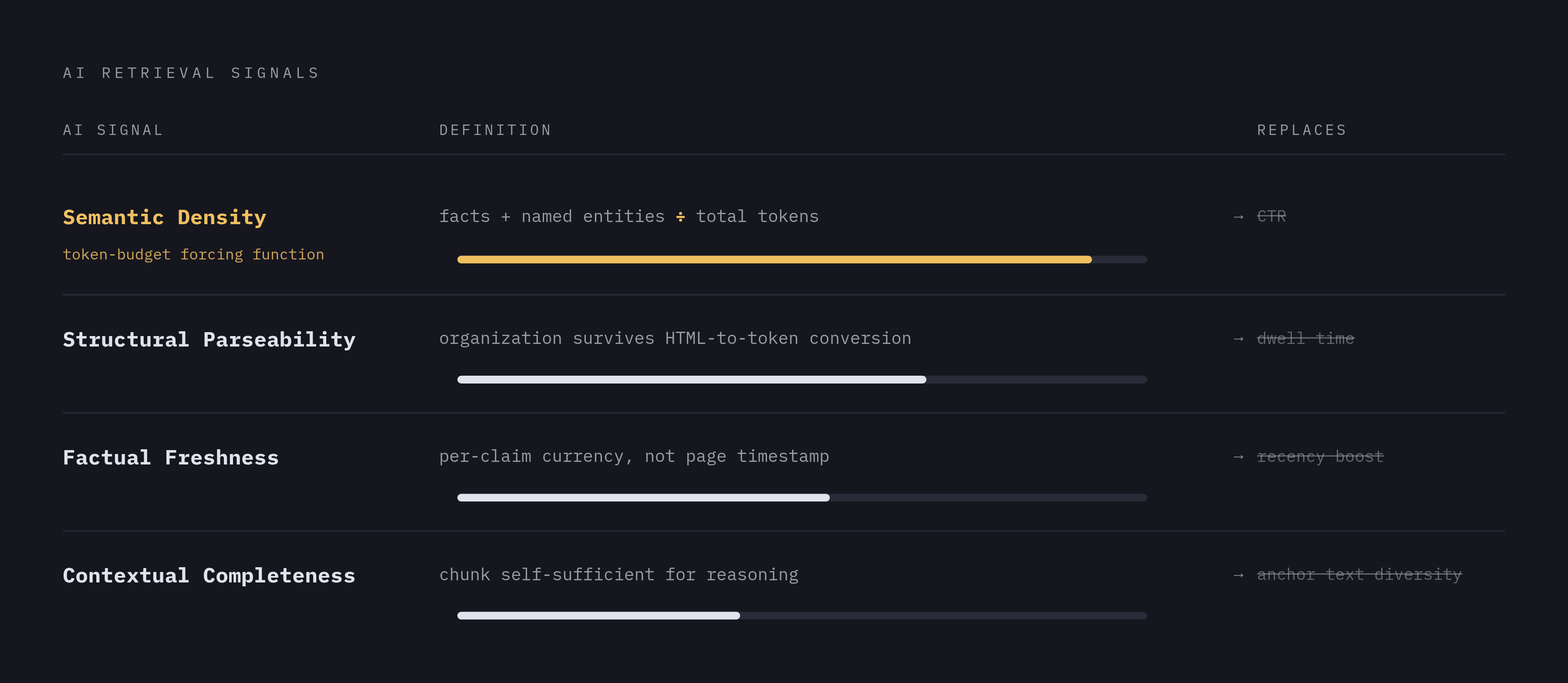
Four dimensions do the work that engagement metrics can't: semantic density, structural parseability, factual freshness, and contextual completeness. Each maps to something specific about how a model actually uses retrieved text, not to how a person browses it.
Semantic density is the ratio of substantive claims, named entities, and verifiable facts to the total token count of a passage. A paragraph full of hedged generalities, "many experts believe," "in some cases," "it is often said," can rank high on engagement and still contribute almost nothing to a model's reasoning, because there's no concrete claim inside it to extract. This matters more than it sounds like it should, because context windows aren't infinite in practice. Reasoning quality can degrade as context length grows, which turns density into a forcing function: under token budget pressure, a chunk that packs more verifiable information per token is worth more to the model, independent of how it would read to a person. This differs from keyword density, an old SEO metric built around term frequency. Semantic density measures information gain, not repetition of a phrase.
Structural parseability is about whether the text's organization survives the trip from HTML to tokens. Bold text, pull quotes, and visual hierarchy help a human's eye scan a page, but none of that formatting is guaranteed to translate into structure a model can use, because the model never sees the rendering, only the text stream. High parseability looks like a clear heading hierarchy that marks topic boundaries, sentences written as complete, self-contained propositions rather than fragments that only make sense next to the sentence before them, and tables or lists that spell out relationships explicitly instead of relying on spacing to imply them. This is also the exact failure point that pushed so many teams toward brittle scrape-parse-chunk-rerank pipelines in the first place: traditional search APIs return short teaser snippets built to earn a click, not to carry a complete idea. Every step a developer bolts on afterward to compensate, the scraping, the parsing, the re-chunking, is effectively a structural parseability tax paid on content that was never designed to be machine-read. And unlike a lot of retrieval quality questions, parseability can be scored before a retrieval pipeline ever runs. It's a property of the content itself, evaluable at index time.
Factual freshness works differently for agents than it does for search users. On a human-facing results page, recency is usually a secondary boost applied after relevance is already scored. For an agent doing time-sensitive reasoning, a model with a training cutoff is depending on retrieval to supply the current state of the world, and a stale page defeats that purpose entirely, not partially. A deeper risk compounds this: as AI-generated content increasingly cites or recycles other AI-generated content, the web's knowledge graph risks a kind of epistemic recursion, where errors and stale claims get laundered through repetition until source provenance becomes the only reliable freshness signal left, a dynamic produced by AI systems training on and citing each other's outputs, visible wherever citation chains can no longer be traced to an original human-verified source. Freshness has to be judged at the level of the individual claim. A page timestamped last week that cites a statistic from three years ago isn't fresh in any way that matters to a reasoning task, even though its metadata says otherwise.
Contextual completeness, the fourth dimension, appears most clearly at the architecture level, and the next section examines it there.
Chunking and retrieval architecture's translation of signal differences into pipeline decisions
In a RAG pipeline, the object being judged for relevance is the chunk. That single fact reshapes what a ranking signal has to do: it has to work at sub-document granularity, and it has to compose sensibly when several chunks from the same source page get pulled into the same context window.
Human-oriented ranking was built to score whole pages. AI-oriented ranking has to score passages, and it has to do so in a way where a document contributing five strong chunks doesn't just flood the context window with redundant restatements of the same fact. The retrieval research on this points to a two-stage design: first-stage lexical retrieval, BM25-class methods that are cheap and fast, followed by a reranking stage that narrows the field. That reranking step is exactly where AI-consumer signals belong. It's the natural point to inject density, parseability, and freshness scoring in place of, or alongside, whatever engagement-derived weighting a legacy system was using.
A few architectural consequences follow from this. Chunking strategy has to preserve contextual completeness: splitting text at semantic boundaries, the edge of an idea or a claim, rather than at an arbitrary token count that might cut a sentence in half or separate a claim from the evidence backing it. Rerankers can be oriented toward signals tied to LLM reasoning utility rather than optimized purely on human click logs. Hybrid retrieval, blending lexical and semantic search, gives a better proxy for density than lexical term frequency alone, since semantic similarity captures meaning rather than word overlap. And authorization-aware filtering, restricting which chunks are even eligible for retrieval, needs to happen before scoring, not after. That's a governance requirement on its face, but it doubles as a signal-quality gate: content that shouldn't be in play never gets the chance to pollute a ranked list.
Context engineering as the discipline that operationalizes these signals
Context engineering asks a narrower and more useful question than traditional query design ever did: given everything available, what specific configuration of context is most likely to produce the behavior you want from the model? That's a different problem than picking the right search terms.
Most agent failures in production are caused by context failures, not model failures. The reasoning capability of the underlying LLM is rarely the bottleneck. What limits the output is what the model was handed to reason over, and how much of that material was actually worth including. Treating the context window as a junk drawer, loading in everything retrieval turned up and hoping the model sorts the signal from the noise on its own, is precisely the failure mode that the four AI-consumer signals exist to prevent.
Each signal maps to a concrete step in the pipeline. Filtering removes chunks that fall below a density threshold before they ever reach the context window, so the model isn't spending attention on padding. Ranking orders what remains so the freshest, most complete chunks are positioned where they are most accessible to the model's reasoning process. Pruning cuts material that would add tokens without adding proportional reasoning value, an unglamorous but critical step given how quickly token budgets fill. Summarization compresses low-density source material down to its factual payload, so a verbose page doesn't eat context budget that a denser one deserves. Context engineering, in other words, is what turns these four abstract signals into a pipeline that actually behaves differently at runtime.
Infrastructure requirements for serving AI-consumer signals at production scale
Serving these signals at scale isn't a matter of adding a new scoring model on top of an existing stack. It requires owning the pipeline end to end: crawl, extract, parse, chunk, score, rank, deliver. Each handoff between components built by different teams, on different assumptions, is a place where signal fidelity quietly degrades.
Snippets returned by traditional search APIs, typically 150 to 300 characters, were built for a human results page, where the goal is to earn a click, not to hand a model something it can reason over. They're structurally too short to carry semantic density or contextual completeness, no matter how the surrounding pipeline tries to compensate. Raw scraping tools that hand back unprocessed HTML push the entire burden of parsing and scoring onto the application layer, and at production request volumes, that burden turns into a latency problem and a reliability problem simultaneously, not just an engineering inconvenience.
None of this matters if the system can't hold up under real load. A retrieval pipeline that returns excellent results on a single demo call and falls apart under concurrent agent traffic hasn't solved the problem, even if its underlying signal design is sound in principle. Production is the test that theory doesn't get to skip.
The practical read for engineering teams rebuilding retrieval for AI consumers
Every team running a retrieval stack should be able to answer one question: which of the ranking signals in that stack were derived from human behavioral data, and which were built specifically to predict LLM reasoning utility? Most teams can't answer it, because most teams inherited a human-search stack and pointed an agent at it without re-examining the assumptions baked into the ranking layer, assumptions that were built for human behavioral data rather than for LLM reasoning utility.
A workable reorientation starts with replacing engagement-proxy rerankers with models supervised on LLM output quality instead of click logs, and auditing chunking strategy against a single test: can a retrieved chunk be reasoned over on its own, or does it quietly depend on context that got left behind at the chunk boundary? Freshness needs to be instrumented at the claim level, not read off a page's publish timestamp. And retrieval quality needs to be measured with frameworks like RAGAS, which evaluate a RAG pipeline across both its retrieval and generation stages, because production RAG systems tend to fail silently. Without that kind of automated evaluation running continuously, a team finds out its signals are misaligned only after user-facing output has already degraded.
That evaluation gap isn't a minor footnote. A large share of RAG implementations never reach production, and retrieval quality problems are consistently cited as a leading cause. Signal misalignment is a retrieval quality issue whether or not a team has the vocabulary to name it that way.
Teams that treat retrieval as a commodity layer, a call to a third-party API or a generic vector store bolted on without scrutiny, and then pour their engineering effort into model selection and prompt tuning instead, are optimizing the part of the system that was rarely the bottleneck to begin with. The model was very likely never the limiting factor. What it was given to work with was.