Prompt Injection via Retrieved Web Content in Agent Pipelines
Attackers hide instructions in web content to hijack AI agent decisions.
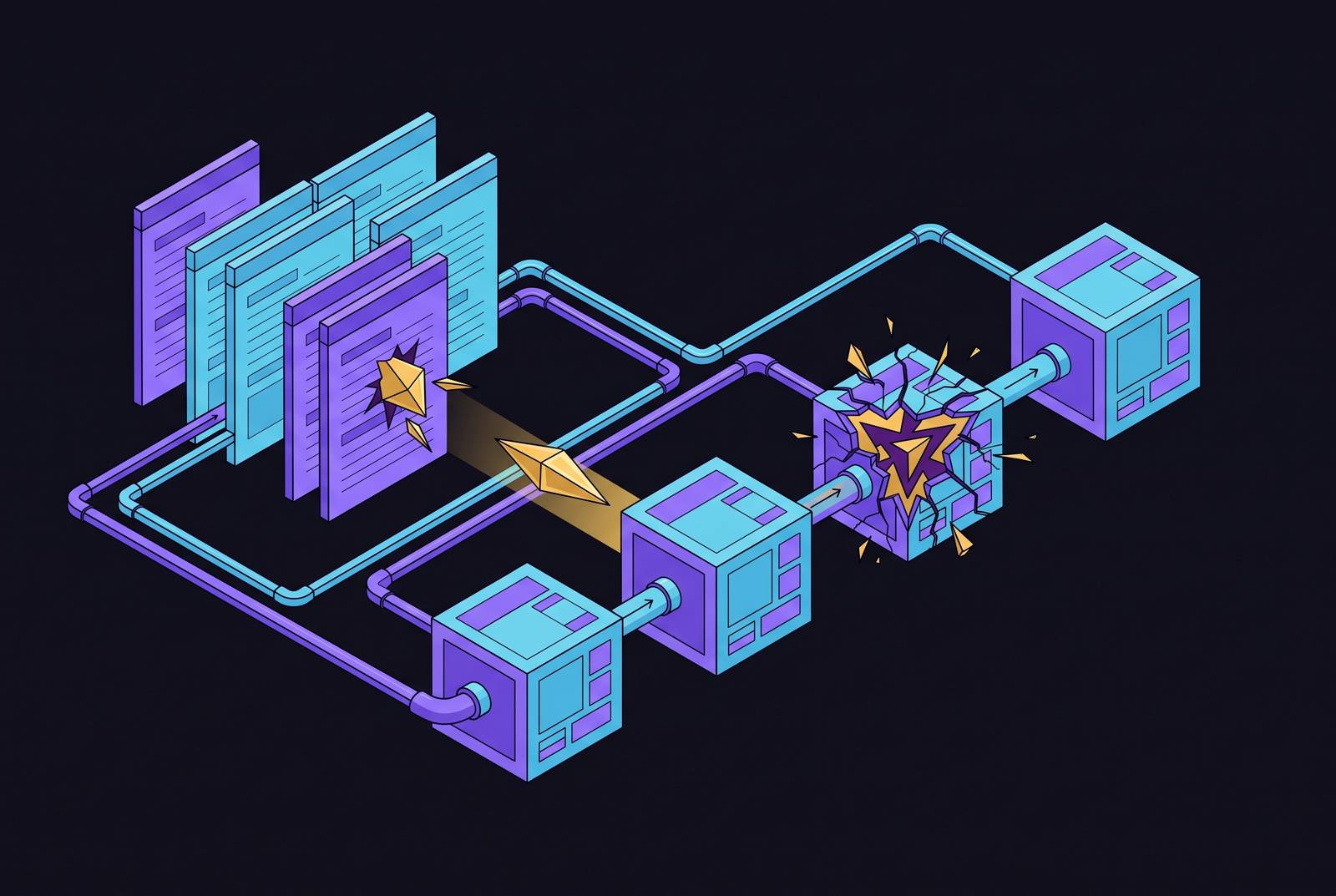
Prompt injection via retrieved web content is an operational threat because external text can redirect an agent’s reasoning and actions. Enterprise AI teams adding live web search must treat retrieval as a security boundary, with controls for provenance, trust, freshness, and external actions. Those properties matter when assessing a SOC 2-aligned web retrieval API, but they do not by themselves establish that a provider meets SOC 2 requirements.
Why LLMs cannot separate instructions from retrieved data
LLMs process system instructions, user input, conversation history, and retrieved content in a single token stream, without a hardware-enforced boundary between trusted instructions and untrusted data. A developer’s system prompt and a retrieved webpage both reach the model as natural-language text. The model therefore has no syntactic mechanism that reliably enforces the distinction between an instruction it should follow and a passage it should examine. This is a structural property of how transformer-based language models process input across products.
Parameterized queries largely prevent SQL injection by separating code from data. Prompt injection has no architectural fix like this because the confusion lies in natural language itself. OWASP ranked prompt injection first in its 2025 Top 10 for Large Language Model Applications. The OWASP GenAI Security Project also added Vector and Embedding Weaknesses, recognizing that retrieval-augmented generation introduces a distinct security surface beyond the model.
How RAG pipelines turn the retrieval layer into an injection surface
RAG makes this structural weakness routinely reachable by automatically inserting external passages into the prompt. A standard retriever ranks candidate passages by embedding similarity and places the top-k results into the context the model uses to answer. That process selects for relevance without establishing authority. When context construction treats those passages as trusted input, text an attacker can reach has a way into the model’s instruction space. The exposure extends through the retrieval corpus, embedding model, vector index, context-construction policy, and external sources.
Direct prompt injection comes through the user’s query, while indirect prompt injection comes through material the agent retrieves. This distinction matters because validation focused on the user’s request does not inspect the instructions hidden in a webpage fetched later. Stored prompt injection leaves malicious instructions in indexed documents or long-term memory, where they remain a threat until retrieval brings them up. The payload can become active long after the original poisoning, without the attacker doing anything else.
The attacker’s burden is correspondingly narrow. One effective payload in one retrievable document can be enough, while the defender must account for every external source the agent can reach. Those sources include emails, webpages, documents, internal wikis, and other agents’ outputs. The legitimate request can be harmless even as the material gathered to carry it out changes how the agent behaves.
What attackers are actually doing to web content agents retrieve
Unit 42 identified visible plaintext, HTML attribute cloaking, and CSS rendering suppression as the top three payload delivery methods in its in-the-wild telemetry. Its detections documented 22 distinct payload engineering techniques. CSS suppression places text off-screen or uses zero-pixel fonts, leaving instructions machine-readable in the DOM while hiding them from a person viewing the page. A visually clean page can therefore carry instructions in its underlying content.
Zscaler ThreatLabz observed attackers embedding payment instructions in JSON-LD schema markup. This takes advantage of how an agent may give structured metadata more weight than free-form HTML. Attackers also use SEO poisoning to move malicious pages into positions a retriever is likely to surface during normal task execution. Protocol-relative URLs, Unicode tag characters, and encoded payloads further obscure malicious content from naive pattern matching.
Unit 42 identified intents including data destruction, denial of service, unauthorized transactions, sensitive information leakage, system prompt leakage, and SEO manipulation. It also recorded its first observed case of AI-based ad review evasion. The common aim is to make attacker-authored content govern a decision that belongs to the user or the system operator.
Documented incidents where injected web content caused real harm
Zscaler ThreatLabz reported a payment-scam campaign in July 2026 that posed as documentation for the fake Python library requests-secure-v2. Hidden indirect prompt injection instructions presented payment to an attacker-controlled account as a routine requirement for acquiring an API key. The site also contained JavaScript to initiate an ETH transfer to a hardcoded wallet address and display a fake API key after completion. The campaign hid a way to divert money in material a development agent could retrieve for a legitimate task. Its documented mechanism does not establish that a victim completed a transfer.
EchoLeak, CVE-2025-32711, carried a CVSS score of 9.3 and enabled zero-click exfiltration from Microsoft 365 Copilot. A crafted email contained a hidden prompt that the agent processed during its normal summarization workflow. No user interaction was required for content to be sent to an attacker-controlled endpoint. GrafanaGhost, made public in April 2026, showed another way in through enterprise content. Researchers found that crafted query parameters could poison Grafana log entries, so its AI assistant would treat text in the entries as instructions when summarizing logs.
Neither the Copilot nor the Grafana case depended on stolen credentials or a traditional software flaw. The exploit was carried by content the agent was designed to process. The Five Eyes intelligence alliance released joint guidance in May 2026 that named prompt injection as a main attack vector against agents. That guidance stated that no single safeguard is sufficient, placing the issue within production security and governance rather than treating it as an isolated model behavior.
Why the retrieval layer is where agent pipelines are most exposed
Security architectures often scrutinize the user query while treating retrieval as an ordinary data pipeline. That leaves externally supplied instructions outside the controls built for human input. The design failure is that the pipeline extends trust to a malicious sentence on the web when assembling the agent’s working context.
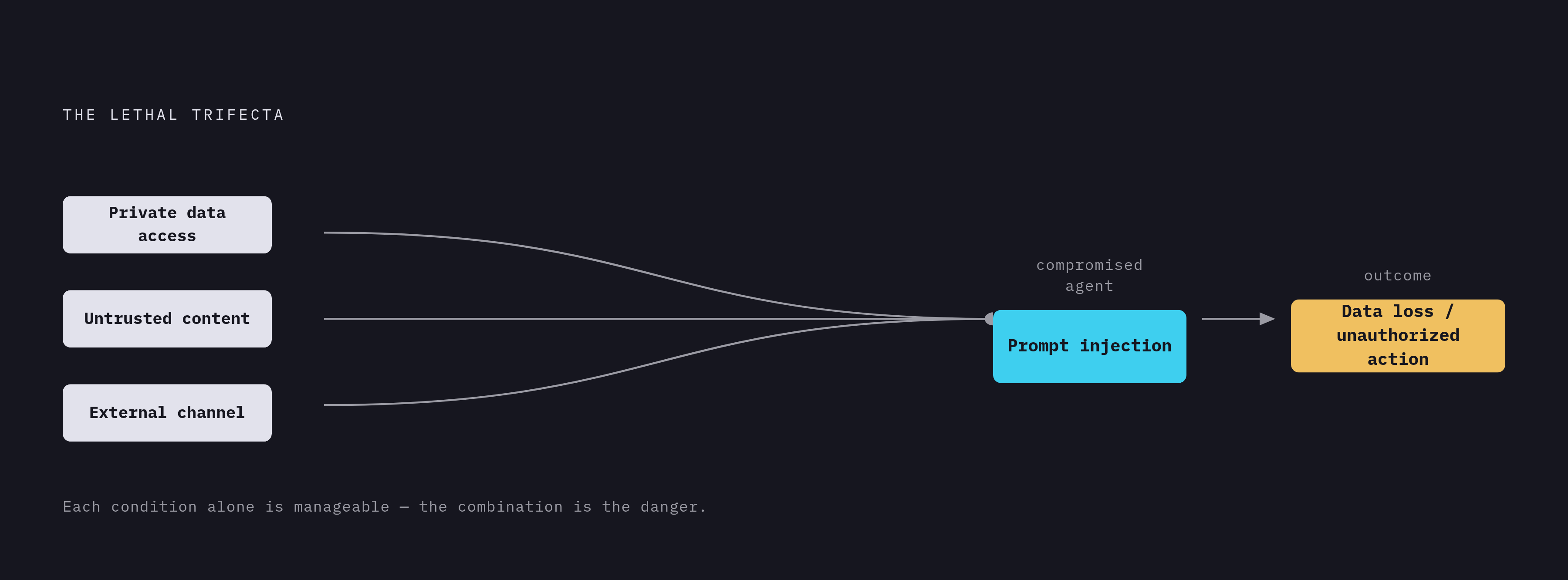
Agent capabilities determine the consequence of that misplaced trust. Browser agents click links and fill forms, coding assistants run shell commands, and CLI agents commit code or post to external services. The Model Context Protocol expands the exposure through integrations that read files, call APIs, query databases, and trigger actions. Across these workflows, the lethal trifecta is concrete, namely access to private data, exposure to untrusted content, and an external communication channel. Together, these capabilities let an agent whose reasoning has been compromised cause data loss.
Conventional controls address only parts of this chain. A firewall can block a malicious connection, but it cannot decide whether a sentence in an allowed document should become an instruction. An access control list can restrict file access without recognizing a poisoned chunk. This makes retrieval a first-class security boundary. Agent-focused infrastructure, including Seltz, which context-engineers and filters content before prompt insertion, addresses the point where external material is selected and framed.
How context engineering at the retrieval layer reduces injection exposure
Context engineering is a security discipline that also improves answer quality. Its scope is the informational environment in which an agent makes decisions. Five useful criteria organize that work, namely relevance, sufficiency, isolation, economy, and provenance. Relevance and sufficiency keep the context tied to the task and give it enough support. Economy cuts out material the task does not need, so the model meets fewer potential injection vectors in a call.
Isolation gives retrieved content clear structural demarcation from instruction context, although that demarcation does not create a hardware-enforced boundary. Provenance gives each chunk an accountable origin through its source, freshness, trust tier, content hash, and ACL reference. Those records allow an incident review to reconstruct the payload that reached the model. Without them, a team may know which source was consulted but lack the exact content needed to explain the agent’s behavior.
Trust tiers set how much validation to apply to first-party verified sources, curated third-party sources, and open-web content. Freshness and content-hash validation check for pages that have changed since indexing when they are retrieved, because a clean copy from the past does not prove a page can be trusted now. When a task really needs both private data and untrusted content, the external communication channel should have a human approval gate. That rule interrupts the lethal trifecta even if filtering fails. Context engineering supplies architectural prevention, while runtime detection and governance cover failures it cannot eliminate.
What the retrieval infrastructure itself must do differently for agent pipelines
These controls require more than a relevance-ranked response from a search service. Traditional SERP APIs return shallow metadata snippets and require a separate extraction layer for full-page grounding. That extraction layer becomes the point where payload-bearing content enters the pipeline. Raw DOM or markdown can retain CSS-suppressed text, off-screen elements, and HTML-comment injection that a human reviewer never sees. Retrieval infrastructure must account for both how an LLM consumes that content and how a browser renders it.
Provenance also depends on control over the path the content takes. Proxy-routed scraping sends raw content through infrastructure the operator does not control end-to-end, so the operator cannot guarantee provenance and content-hash verification along the whole path. Rate limits and latency pressure can encourage caching, but cached content still needs ongoing validation. A wrapper at the final API boundary cannot substitute for control over collection and extraction. Content provenance, trust-tier tagging, freshness validation, and structured output must be properties of the retrieval pipeline itself.
Seltz owns its data pipeline end-to-end, performing the work itself that wrappers delegate to third-party services. That ownership is relevant because it is a prerequisite for enforcing trust tiers, validating content hashes, and maintaining provenance across the pipeline. It is not, by itself, proof that every security control is implemented or that injection cannot succeed. As an infrastructure option, its relevance lies in control over the stages where external content becomes model context. That is a narrower and more useful basis for assessment than a general claim of secure search.
Every query sent to an external API leaves the enterprise’s infrastructure, and the content that comes back has passed through systems the enterprise may not audit. Data ownership is therefore needed for security as well as being a choice made for compliance. For buyers seeking a SOC 2-aligned web retrieval API, the evidence here supports architectural criteria. Seltz’s full-stack approach bears on those criteria without establishing a SOC 2 status.
The governance and monitoring layer that architectural controls alone cannot replace
The Five Eyes joint guidance states, “Strong governance, explicit accountability, rigorous monitoring and human oversight are not optional safeguards but essential prerequisites. Until security practices, evaluation methods and standards mature, organisations should assume that agentic AI systems may behave unexpectedly and plan deployments accordingly, prioritising resilience, reversibility and risk containment over efficiency gains.”
That framing starts from the possibility that prevention will fail. Runtime monitoring must therefore examine actions taken, tools called, and data accessed alongside input content. A successful injection may cause anomalous agent behavior even when its payload escapes detection. Versioned retrieval records and provenance logs make that behavior traceable to the exact material the model received. Without those records, incident responders and compliance auditors cannot reconstruct the relevant context.
Minimum-privilege scoping limits what compromised reasoning can cause by restricting both what an agent can do and what it can read. Human approval gates on irreversible actions, including external communications, financial transactions, and code execution in production, interrupt the path from instruction hijacking to harm. These controls complement retrieval filtering, which remains necessary. The practical design assumption is that some injections will succeed. A resilient agent pipeline is built to prevent malicious text from arriving, contain successful injections, and preserve reversibility.