Private Deployment Architectures for AI Retrieval Components
Enterprises must isolate retrieval components inside the perimeter, not just the model layer.
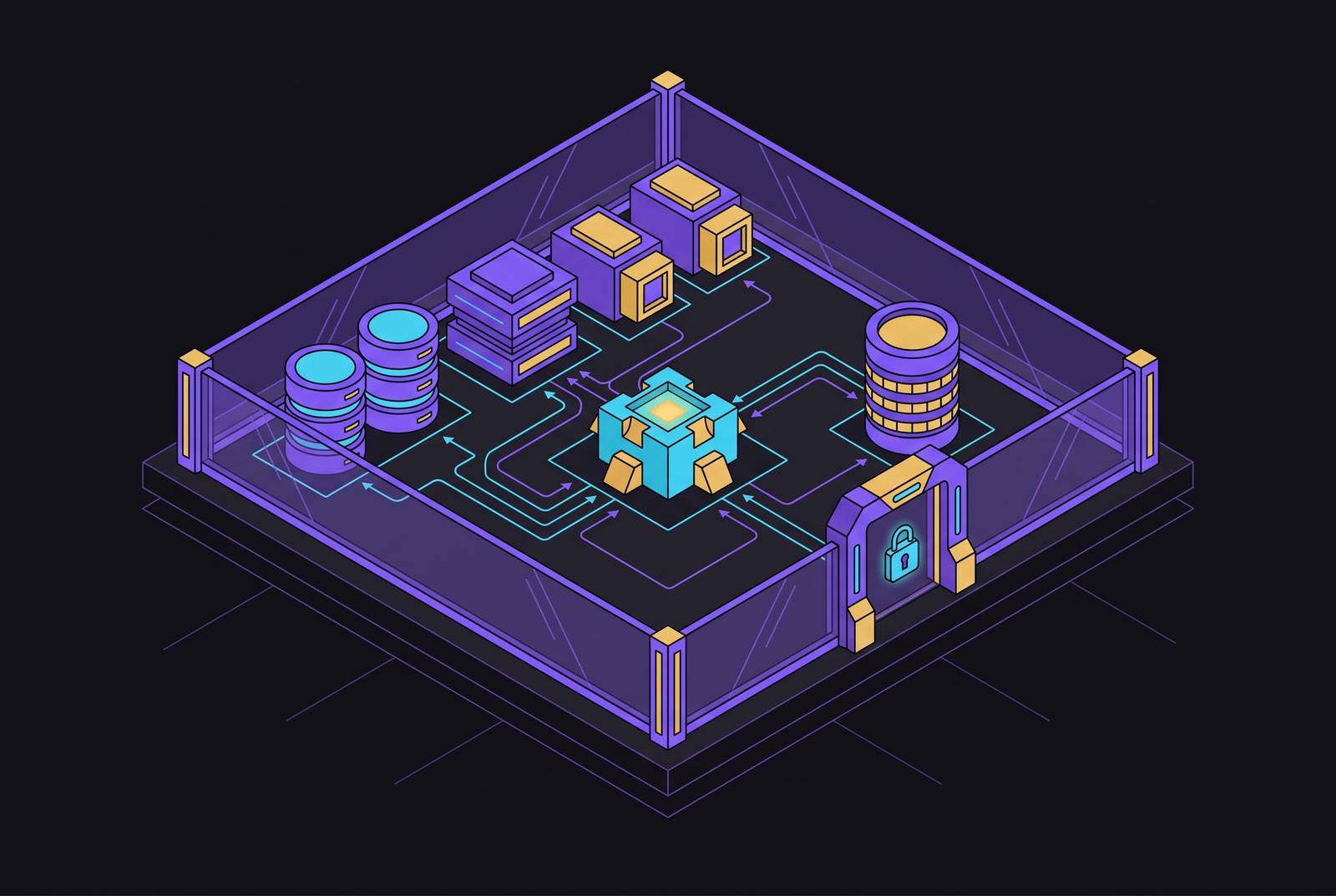
Private AI is a decision about deployment architecture, not a user-facing privacy feature. The distinction determines where every retrieval component physically lives and what guarantees are actually enforceable when an auditor asks hard questions about model weights, access logs, or output reproduction. Enterprises adopt private AI by deploying models and the data that trains them inside a controlled environment: on-premises, private cloud, or a sovereign enclave. On-prem is a cost of market entry, not an architecture preference.
A vendor Data Processing Addendum satisfies a procurement checklist. The practical failure mode is familiar: a team routes AI queries through a cloud provider's regional instance, checks the data residency box, and then cannot answer an auditor's question about who accessed the model weights, what changed in the last model update, or how a specific output can be reproduced for a regulatory inquiry. That failure shapes everything that follows, because it reaches into the retrieval layer specifically, not just the model layer.
Why the retrieval layer is where private AI architectures actually break
Most private AI deployments concentrate on protecting the model layer. The retrieval layer is where sensitive data actually moves at query time, and it is the layer most commonly left outside the intended boundary. The first is where the corpus the AI grounds on stays inside the customer's boundary, covering embeddings, the vector store, retrieval logs, and any decision about reintroducing retrieved content into training. This is the layer that breaks most SaaS AI products for strictly regulated corpora, because the retrieval layer sits exactly where the sensitive data lives, and the vendor's easiest path is to host the vector database.
The other two layers, model inference and orchestration, receive more engineering attention but are less likely to be the actual point of egress. That asymmetry is the trap. Every component that touches a query, the embedding model, the vector store, the reranker, the retrieval logs, and the web knowledge layer, must be evaluated individually for whether it enforces the perimeter or silently breaches it.
The three-layer decomposition of a private retrieval stack
A private retrieval stack is not a single system but three coordinated layers, each with its own privacy boundary requirements and component decisions. The decomposition is what makes the subsequent technical decisions organized rather than encyclopedic. Layer 1 is the corpus and memory layer. It includes the embedding model, the vector database, retrieval logs, and any feedback loop that could reintroduce retrieved content into training. If you host it locally, the semantic index of the entire knowledge base never leaves the encrypted local volume. Tracking precision@k, recall@k, and groundedness gives a measurable signal for retrieval quality that connects directly to answer quality.
Layer 3 is the web knowledge layer, and it creates the hardest boundary problem. LLMs need live web knowledge to stay factually current, but fetching it naively means queries or content cross the perimeter. The other two layers have well-understood private deployment patterns. This one does not, and the rest of this article addresses it in depth.
Infrastructure patterns that determine where data can and cannot flow
The choice of infrastructure pattern is the first and most consequential decision because it determines which retrieval components can even be considered. Air-gapped on-premise running, where model weights, orchestration, and all retrieval sit on physical hardware with no external internet connection, is the highest security level for classified or highly regulated environments, but model updates arrive via physical media or isolated staging with one-way data flow, and updates take weeks, not hours. VPC-isolated deployment puts models inside a Virtual Private Cloud, so you get network isolation while still using cloud hardware. Retrieval components can be deployed within the VPC boundary, but the network path for any external web knowledge fetch must be explicitly architected. Hybrid deployment is the most common pattern: enterprises use public LLMs or APIs for general-purpose tasks, but layer private models or retrieval systems on top for proprietary data, so you need a clear data classification policy with technical enforcement to match.
The defining component of a true private cloud AI deployment is the separation of the control plane from the data plane. Zero-trust network architecture is the operational baseline: separate VPCs or VNets for GPU training clusters and CPU inference endpoints, and inference engines that never have direct database access. Retrieval services in an intermediate zone fetch context and pass sanitized data, keeping the inference layer isolated from raw storage.
The governance layer is not an afterthought. ABAC-based access control on the inference API, dedicated key management for model artifacts and customer data, encryption at rest and in transit, and immutable audit logging of every prompt, completion, and configuration change are infrastructure requirements, not compliance add-ons. Regulators reviewing AI systems expect to see this evidence on request.
Compute and serving requirements that shape private retrieval performance
Private retrieval only works in production if the infrastructure can meet the latency targets that agentic workflows require. If you under-provision, business teams go back to cloud APIs, which defeats the entire architecture. The three reasons enterprises move LLMs in-house cluster around predictability as much as security: data cannot leave the perimeter, costs at scale outrun cloud API budgets, and inference latency must be predictable rather than best-effort. Customer-facing chat demands under 300ms to first token. Agent loops require under 100ms per step.
GPU memory is the dominant constraint for LLM inference. Model weights, KV cache for every concurrent request, and activation overhead must all fit, and running too close to the memory limit produces tail latency degradation before outright failures appear. A regional health system rebuilt a workload that had run on a major LLM API onto a dedicated GPU cluster running a 70B open-weights model. High-performance networking inside an LLM cluster carries two traffic patterns: the east-west fabric for multi-node inference, where a remote direct memory access interconnect is what makes tensor-parallel inference produce stable latency, and the north-south path for storage and retrieval. Most production private deployments standardize on dedicated InfiniBand fabric and separate storage networks rather than running everything over a single Ethernet plane.
Vector store and embedding layer decisions for a private RAG deployment
The vector store and embedding layer are where private RAG pipelines most commonly underperform, not because the components are unavailable for private deployment, but because retrieval quality requires deliberate design decisions that are easy to defer. Generation models such as Ministral 3 8B, successor to the now-retired Mistral 7B, are sufficient for most RAG use cases. Hosting the vector store locally means the semantic index of the entire knowledge base never leaves the encrypted local volume. That is the architectural guarantee that SaaS vector database offerings cannot provide for regulated corpora.
Hybrid retrieval is the production standard. One technique trap is worth flagging. HyDE, Hypothetical Document Embedding, improves recall on vague queries by embedding a hypothetical answer first, but it hurts precision when that hypothetical answer hallucinates and pulls wrong chunks. Retrieval quality measurement should be built into the pipeline from the start. Flagging responses when groundedness falls below a defined threshold and blocking responses when faithfulness drops below a lower threshold targets different failure modes and triggers different remediation paths.
Why SERP APIs and scraping tools fail as the web knowledge layer in a private architecture
The web knowledge layer is where private retrieval architectures face their most structurally intractable problem. The real latency bottleneck for AI search pipelines is not the SERP API request itself. It is the round-trip latency of converting unstructured web content into LLM-ready context after the response arrives.
Scraping tools face structural reliability problems at production scale. Regional prices, availability, and content render by IP location. The pipeline complexity consequence is significant. The question is not whether it can be built but whether it is the right use of the team's engineering capacity, and whether it can be kept current at production scale without becoming the dominant operational burden.
What an LLM-native web knowledge layer looks like and where it sits in the private architecture
An LLM-native web knowledge layer is architecturally distinct from a SERP API or scraper. It is designed to produce machine-ready, context-engineered content that an AI can reason over directly, rather than raw web output that requires additional processing. The defining differences are threefold. That is the step that disappears from the enterprise's operational surface when the right layer is used.
Agentic retrieval patterns change the requirements further. That is the evolution from traditional single-query RAG patterns. The web knowledge layer must support this: parallel execution, structured responses with grounding data, and citations are not optional features but requirements for production agentic workflows.
The web knowledge layer presents a particular tension for private deployments. Enterprises need live, current information to ground their AI systems, but routing queries through external search APIs or generic web content providers breaches the data sovereignty perimeter. Purpose-built web knowledge infrastructure, designed specifically for AI agents operating within controlled boundaries, can deliver fresh, context-engineered content without forcing a choice between freshness and data ownership. It delivers context-engineered, machine-ready web content, selected, filtered, ranked, and shaped for AI reasoning, rather than raw SERP output or unprocessed scraped content, and it is designed for the depth, speed, and reliability that autonomous agents and production LLM systems require.
How context engineering governs what actually reaches the LLM in a private pipeline
Retrieval architecture determines what content is available. Context engineering determines what the LLM actually reasons over, and the gap between those two is where production AI systems fail even when the retrieval layer is correctly built. Context engineering is about deciding what goes into an agent's context window. At AI Engineer Europe 2026, Elastic's Leonie Monigatti observed that this work represents the dominant share of what agentic search actually involves. The agent's reasoning is only as good as what is fed into it, and stale or poorly filtered context produces confident-sounding wrong answers.
The filtering and ranking pipeline for a private deployment has a clear sequence. Fast, fresh, citable web search is what separates production agents from demos. The context engineering layer must distinguish between a document retrieved from the internal corpus and a live web result, and apply freshness weighting accordingly.
A reference architecture for private AI retrieval that reaches live web knowledge without breaching the perimeter
A private AI retrieval architecture that satisfies both data sovereignty requirements and the freshness needs of production LLM systems must be designed as a layered system in which each layer enforces the perimeter independently, not as a single monolithic boundary. The layered structure is what makes the whole thing work. Layer 1, the corpus and memory layer, sits fully inside the perimeter. Hybrid retrieval, BM25 plus dense vectors via Reciprocal Rank Fusion, operates over this private corpus. Layer 2, the retrieval and ranking layer, operates in a controlled intermediate zone, analogous to the retrieval service zone in a zero-trust network design. All context passes through this intermediate layer.
Layer 3, the web knowledge layer, sits at the controlled egress point. For VPC-isolated and hybrid deployments, the web knowledge API lives in the intermediate zone, receives the query, fetches and processes web content, and returns machine-ready, structured context. General-purpose search APIs return shallow snippets or ranked links for human browsing, but infrastructure designed specifically for LLM reasoning, such as Seltz's approach to context-engineered retrieval, can deliver machine-ready content shaped for depth and context without breaching the enterprise perimeter. The architectural requirement is that the web knowledge layer must deliver content that is already filtered, ranked, and shaped for AI reasoning, not raw SERP output that requires an additional processing pipeline inside the perimeter.
The governance layer spans all three. It includes attribute-based access control on the inference API, dedicated key management for model artifacts and customer data, encryption at rest and in transit at every layer boundary, and immutable audit logging of every prompt, completion, and configuration change, assembled continuously, not reconstructed after an audit request. The orchestration layer directs compute and jobs through a one-way tunnel, and data, query logs, and model artifacts never traverse that tunnel in the outbound direction. The content is fetched, cleaned, and passed inward, but raw queries and raw web responses never traverse the internal network.
Where private retrieval architectures break under real production load
A correctly designed private retrieval architecture still fails in production if the operational layer does not account for the specific ways retrieval systems degrade under real workloads. The latency trap is the first. Under-provisioning for the concurrent inference load pushes tail latency above the thresholds that agentic workflows require, and business teams respond by reverting to cloud APIs, which breaches the perimeter the architecture was built to enforce.
The model refresh lag is the second. A lag of two to four quarters between the on-premise fleet and the public model frontier is common, and for agentic workloads that depend on the latest tool-use and long-context capabilities, this lag can erode the system's usefulness faster than the sovereignty benefit is realized. If the platform team that owns this work is already the organizational bottleneck, adding the LLM platform workload is a strategic mistake even when the compliance case points to it.
The retrieval quality drift problem compounds the others. Continuous monitoring is not optional for a production system. For organizations whose compliance framework permits encrypted egress with audited boundaries, a hybrid pattern, private corpus and ranking inside the perimeter, with a purpose-built web knowledge layer at the controlled egress point, delivers the freshness and depth that production LLM systems require without the full operational burden of a fully air-gapped stack.