Third-Party Data Pipeline Risk in Enterprise AI Stacks
Data flowing through third-party RAG components bypasses traditional security controls.
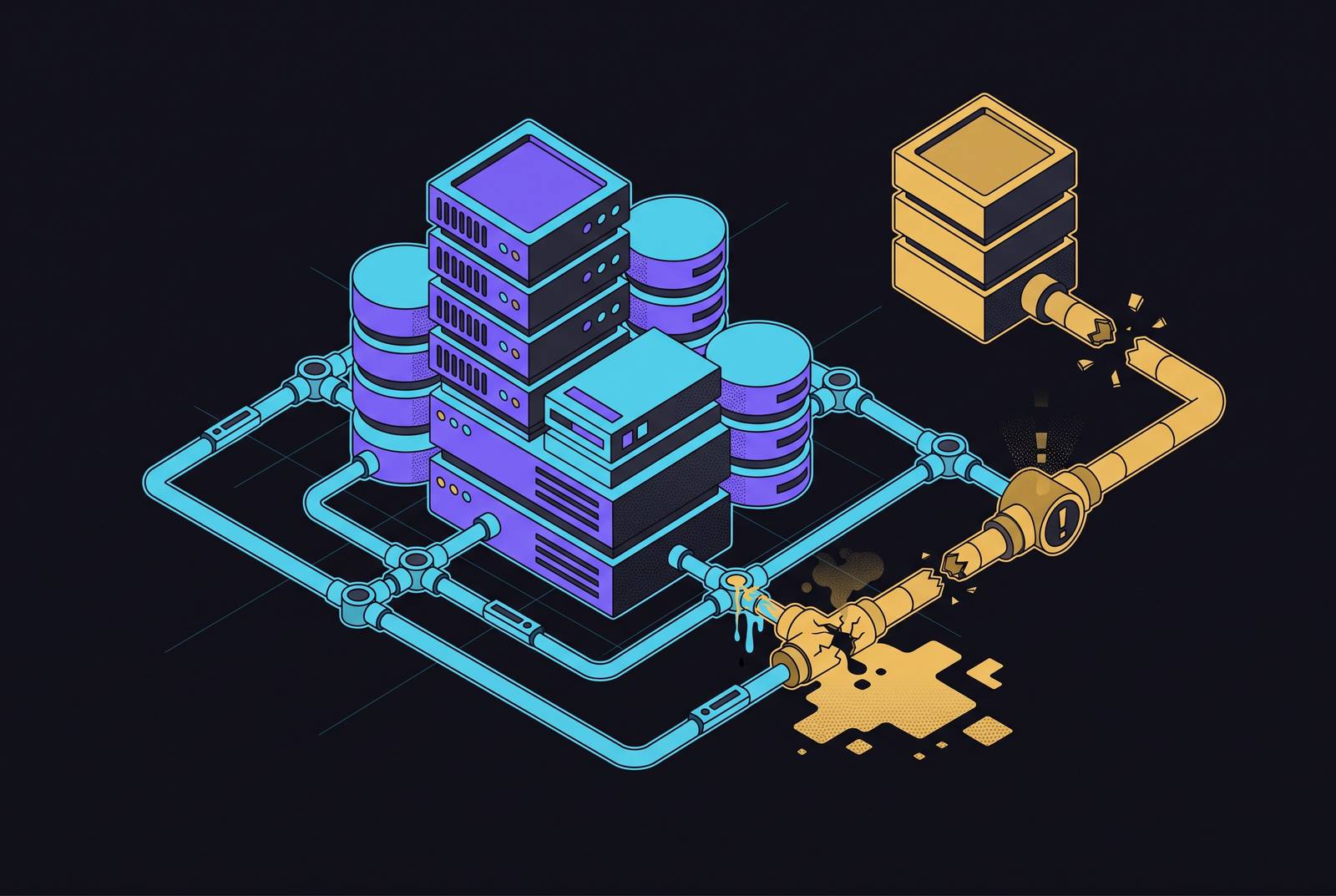
Enterprise AI has moved past standalone language models. Retrieval-augmented generation, where a system pulls in outside documents and live content before generating an answer, is now the dominant way enterprises deploy AI, and that shift has quietly relocated the system's greatest exposure from the model to the pipeline that feeds it. A RAG system is not a chatbot with a bigger vocabulary. A typical enterprise AI deployment now runs more than a dozen separate components across ingestion, embedding, retrieval, and generation, and every one of them is a place something can go wrong. Traditional application security was built to guard the front end and the database behind it, but it has no eyes on the semantic retrieval layer, where embeddings, metadata filters, and context windows quietly decide what the model actually sees. A failure anywhere along that chain, not just inside the model itself, can put the wrong content in front of the LLM, and the damage carries forward into every answer the system produces afterward.
Third-party components trusted by default in enterprise RAG stacks
Most enterprise RAG stacks are built out of parts the organization did not make. A weakness in any single one of these parts can compromise the whole pipeline's security even when the organization's own code is written with care, because the stack is only as strong as its weakest link. These components tend to get wired in as if they were safe infrastructure, the digital equivalent of plumbing, rather than treated as data processors handling the same sensitive material the model and application layer are built to protect. The outcome is a kind of trust nobody actually signed off on: internal documents, customer records, financial data, and source code all pass through services the organization neither built nor runs nor can fully inspect. Each component in this chain, from embedding APIs to retrieval services, is a live pathway: proprietary content flows through systems outside the organization's walls the moment you make a query, and it never just sits idle until called. Purpose-built infrastructure such as Seltz, which owns its data pipeline end-to-end rather than wrapping someone else's service, shows that this kind of ownership is a structural requirement for production RAG systems. This is a different category of risk from the old concern about third-party software. A vulnerable library sits in a sandbox until it's called. A retrieval dependency is a live channel, and it carries an organization's proprietary content across every query.
The six specific mechanisms through which third-party pipeline components introduce systemic risk
Third-party components do more than add operational overhead.
The first is indirect prompt injection through retrieved content. An attacker hides instructions inside a document, a web page, a support ticket, an uploaded file, that the RAG system later retrieves and folds into the model's context. The model follows those instructions because it has no reliable way to tell system instructions, user prompts, and retrieved content apart. Filtering the user's own query does nothing here, because the malicious instruction arrives through the retrieval pathway, and most filters never inspect that channel.
The second is poisoning of the knowledge base itself. Bad or manipulated content gets into the index through compromised uploads, ingestion pipelines nobody reviewed, or external sources, and once it's indexed, the model treats it as trusted fact. External retrieval services, including web search APIs pulling in live content, are where this risk runs highest, because the source material sits entirely outside the organization's control.
The third is authorization drift inside the vector store. A document restricted to the legal team in SharePoint can end up as an embedding in a shared vector index, retrievable by anyone whose query happens to be semantically close enough. A majority of enterprise AI systems running RAG have been found to carry cross-tenant data leakage vulnerabilities.
The fourth is agent over-permissioning. Agentic systems don't stop at retrieving content, they act on it, calling APIs, writing to databases, sending messages, so a prompt injection that reaches the agent layer functions as something closer to a remote command. CVE-2025-6514, a flaw in an OAuth proxy used with MCP, exposed hundreds of thousands of downloads before it was patched, a supply-chain weakness sitting between agents and the services they call. Microsoft disclosed two further Semantic Kernel vulnerabilities, CVE-2026-26030 and CVE-2026-25592, where unsafe handling between model-controlled data and agent tools could lead to remote code execution or arbitrary file writes.
The fifth is memory poisoning in systems that persist state across sessions. An adversary plants false or malicious information in an agent's long-term memory, and unlike a prompt injection that dies with the session, poisoned memory sticks around. The agent can recall it days or weeks later, and the compromise survives across interaction boundaries in a way that's hard to detect or trace back after the fact.
The sixth is query-time exfiltration through third-party model providers. Queries routinely carry sensitive material, customer names, financial figures, source code, personal data, and once that content is sent to a third-party embedding or model provider and used for training, it has effectively left the organization with no record of the fact. Embedding services, SaaS connectors, and managed vector stores each bring their own vendor, residency, and subprocessor risk, and proving otherwise requires vendor assessment, contract controls, data-residency review, and evidence of encryption and deletion capability.
The web retrieval layer as a third-party dependency
Web-grounded retrieval concentrates more pipeline risk than any other third-party dependency, because the content entering the model's context at query time comes from outside the organization entirely, and provenance, freshness, and the possibility of deliberate manipulation all sit beyond what internal governance can reach. Conventional SERP APIs and scraping tools were built for human-driven SEO monitoring, not for feeding an AI's reasoning. Adversarial content filtering, retrieval-time authorization, and formatting a model can actually digest were never part of their design brief. Traditional scraping infrastructure introduces its own reliability failures that compound the security risk: availability that comes and goes, rate limits that kick in under agent-scale concurrent requests, and parsers that break the moment source HTML changes, all of which create unpredictable gaps in what reaches the model. The implicit trust baked into most third-party RAG stacks assumes orchestration frameworks, embedding APIs, and retrieval services behave as neutral plumbing rather than as active processors of proprietary content at query time. For retrieval specifically, the gap between a general-purpose search wrapper and a web knowledge API built with context engineering for AI reasoning is a material decision: the former hands back shallow results open to injection, the latter filters, ranks, and shapes content with reasoning fidelity built in as an engineering requirement, not an afterthought. The real question for an AI team is what trust level, what filtering, and what provenance metadata travels with each chunk into the model's context, not only what a retrieval API returns. A retrieval layer that can't answer that is not a neutral utility; it's an input channel nobody has audited.
The RAG pipeline as a shadow data processor
An unsecured RAG pipeline behaves like a shadow data-processing system. It touches regulated information, shapes decisions, and routes sensitive content through third-party services, all without the control maturity enterprises apply to any other system handling that same data. In a governance, risk, and compliance context, that pipeline accesses regulated information and influences outcomes, but it sits outside the oversight given to core enterprise applications. A RAG system handling sensitive data deserves the same treatment as any other enterprise system that touches it: identity and access management, least privilege, zero trust, telemetry, data loss prevention, retention governance, and audit evidence, all applied with the same rigor.
The gap is concrete. A bank indexing internal policy manuals, an insurer retrieving customer claims, a healthcare provider connecting a clinical-notes assistant, a legal team searching confidential contracts: each one is routing regulated content through a pipeline whose subprocessors may never have made it into the organization's vendor register. Traditional vendor risk management, built around questionnaires, SOC 2 report reviews, and contract negotiation, was designed for software vendors, not for live data pipelines processing sensitive content at inference time across several subprocessors at once. Proving compliance for a single RAG pipeline means producing vendor assessments, contract controls, data-residency reviews, encryption verification, and deletion-capability evidence, and doing it for every third-party component in the chain, including embedding providers, vector stores, and retrieval APIs.
Retrieval events often aren't correlated with IAM, DLP, EDR, XDR, CSPM, or SOC monitoring at all, so neither the security team nor the audit function can say with confidence what was retrieved, on whose behalf, or what actually reached the model. None of these trip an alert under legacy monitoring frameworks, so they can run for months before anyone notices.
Pipeline ownership and the security controls third-party assembly cannot provide
Closing this attack surface means enforcing security controls at every stage of the data pathway, ingestion, embedding, retrieval, and generation, and that's only realistic when an organization owns or governs the pipeline end to end rather than inheriting trust from a set of assembled components.
At ingestion, this means source allow-listing, content validation before anything gets indexed, and write-once storage that blocks retroactive poisoning, enforced at the point of entry rather than assumed from wherever the content came from. You need to treat external sources, including web APIs and connected SaaS systems, as untrusted input that requires validation, not as data providers that operate in good faith by default.
Authorization has to happen before retrieval, never after. The LLM should never be the last line of access control, because if the vector database doesn't enforce document-level permissions on its own, the model can end up handed content the user was never supposed to see. Vector databases need to be treated as sensitive data stores in their own right: encrypted, logged, subject to retention rules, auditable, not just a technical cache sitting quietly in the background.
Scanning and redacting output before it reaches the user closes the gap at the other end, at generation.
What enters the model's context window is the direct cause of what the model does next, so filtering, ranking, deduplication, and compression of retrieved content aren't performance tuning, they're security controls that decide what instructions and data the model ultimately acts on. An external retrieval layer that hands over unfiltered, unranked, unverified content to the context window is an uncontrolled input straight into the model's reasoning. Third-party retrieval services make this worse precisely because they operate as black boxes: the enterprise has no way to see how content gets filtered, ranked, or shaped before it lands in the LLM's context. If you build retrieval infrastructure around data ownership and transparency, so the filtering logic and ranking decisions are auditable and under the organization's own control, retrieval turns from a trust liability into an actual security checkpoint.
Agent permissions need to be scoped to the minimum required for a given task and pulled back the moment it's done. Broad standing permissions make implementation easier, but they also guarantee that a successful injection causes the most damage possible.
None of this works without telemetry. Query, retrieval, denial, source, and output logs need to be generated and correlated with IAM and DLP systems, because a retrieval event that isn't logged can't be audited, and unaudited retrieval can't satisfy the evidence regulated industries require. An organization that owns its pipeline can produce that evidence on demand. One assembled from third-party black boxes, often, cannot.
The web retrieval layer is where this argument about ownership has the most practical weight, precisely because it's the component most often treated as a commodity, swapped in and out without a second thought.
The retrieval API's role in concentrating or distributing pipeline risk
The retrieval API's architecture decides whether web content reaches the model's context as structured, filtered, provenance-carrying input, or as unverified noise an attacker can exploit, which makes the design of that API a direct determinant of how secure the whole pipeline is. An API that hands back raw HTML, ads, SERP features, and unfiltered third-party content delivers every risk described above, injection, poisoning, and noise, straight into the context window with nothing standing in the way. A retrieval API built for AI from the ground up, one that owns its data pipeline end to end, selecting, filtering, ranking, and structuring content before it ever reaches the model, applies these controls at the infrastructure layer instead of leaving them to application code bolted on after the fact.
The questions that matter here go beyond query throughput or snippet quality. Does the API filter and rank content for a model's reasoning, or for a human skimming a search results page? Does it carry provenance metadata with each result? Can it hold up under agent-scale concurrency without falling over? Can the organization audit what it returned and when?
Seltz is built to answer those specific questions. As a web search API purpose-built for AI agents and RAG pipelines, it owns its full data pipeline rather than wrapping someone else's service, and it delivers context-engineered, machine-ready content shaped for how a model actually reasons, with enterprise-grade security alignment and production-scale reliability built in from the start. Pipeline ownership, at the retrieval layer as much as anywhere else in the stack, is a security property you should demand before you buy.