Audit Logging and Retrieval Traceability in Regulated AI Systems
Closing the gap between decision logs and source traceability in regulated AI systems.

In regulated AI systems, a complete decision log and a traceable answer are not the same thing. Most teams build the first and believe they have the second. The gap between them is where audit failures happen, and it widens with every stage a retrieval pipeline adds between a user's question and the model's reply. This article charts that gap and what it takes to close it.
Why a complete decision log is not the same as a traceable answer
A decision log records that a model acted. It captures the timestamp, the model version, the input hash, the output hash, and the name of the human reviewer who signed off. What it does not record is whether the answer was grounded in anything real. A log can be flawless on its own terms and still sit on top of a retrieval step nobody can reconstruct after the fact. It answers what happened. It does not answer whether any of what happened was trustworthy.
Source traceability asks a different and harder question than logging does. It demands to know which specific retrieved content produced this output, from which source, retrieved at what moment, and under whose authorization. That is not a richer version of the decision log. It is a different artifact entirely. The audit trail versus traceability distinction is precisely where compliance work on regulated AI products tends to stall, because the checklist reads like a finish line when it is really only the first one.
Teams that have built solid decision logs have done real work. They have instrumented model calls, configured retention, and wired human review into the pipeline. But a decision log only proves that a system ran. An auditor asking where a specific answer came from is not asking whether the system ran. That question requires the retrieval layer to have been treated as a governance boundary, not an implementation detail.
What regulators and frameworks actually require when they say "traceability"
The regulatory language of 2026 is specific enough that "we have logs" is no longer a defensible answer on its own. Most telling is a single phrase in Article 12 itself: the logs must identify the reference database used. That means the retrieval source, not just the model version.
The enforcement calendar makes the obligation immediate. For any financial institution, hospital, or insurer operating in the EU, Article 12 is no longer aspirational. Industry retention floors compound the obligation. SOX requires at least 366 days of operational logs and seven years of audit work papers. HIPAA requires six years. PCI DSS v4.0 requires 12 months with three months immediately available.
The same convergence appears in other jurisdictions. In February 2026, COSO published "Achieving Effective Internal Control Over Generative AI," requiring a complete audit trail capturing prompts, inputs, outputs, model and configuration versions, and evidence of human review, sufficient to reconstruct what the AI acted on. The following month, the SEC announced a dedicated SOX enforcement group, and AI-touched controls are squarely in scope. The OECD AI Principles make traceability a component of accountability under Principle 1.5, requiring records of datasets, processes, and decisions across the AI lifecycle. Across every major jurisdiction, the requirement converges on the same underlying demand: the retrieval step must be reconstructable, not just the output.
The NIST AI RMF aligns transparency with enterprise risk management and recommends continuous validation across workflows. Sirion's 2026 traceability standards state the requirement plainly: trace logs under compliant frameworks must retain a complete reconstruction path from data input to decision output. That path is what a decision log, however complete, does not provide.
The most common compliance gap: service account attribution and the missing retrieval record
The most common compliance failure is not a missing log field. It is that the retrieval event itself is never recorded as an attributable, auditable act. The 2026 audit trail checklist identifies individual user attribution as the hardest and most commonly missed requirement in enterprise AI deployments, and service account attribution is the most common way it fails. AI accesses regulated data under a service account or API key, and no log records which individual directed the access. HIPAA's unique user identification rule, GDPR's accountability principle, and SOX all demand individual attribution that service account logging cannot provide.
A second gap is quieter: confidence scores recorded in place of reasoning. A score is not a source reference. A team that set a 90-day log rotation before August 2026 is now out of compliance with Article 12's six-month minimum, and the fix requires rebuilding a retention architecture, not changing a setting.
The fourth gap is the least visible and the most consequential. The retrieval query itself is not logged. Teams record the user prompt and the model output, but not the query issued to the vector store, the chunks returned, their source document IDs, or their version timestamps. Without those fields, it is impossible to reconstruct what the model was grounded on. The log is complete in form and empty in substance for traceability purposes. These gaps are being surfaced in examination, not just in theory.
Why the Fragmented Trace Problem is structural, not a configuration oversight
Current logging infrastructure was designed to answer a different question than the one regulators are now asking. It was built to answer "what went wrong?" not "what grounded this answer?" Those are architecturally distinct questions, and the systems that answer the first do not automatically answer the second. ML frameworks log model inference metadata. Policy engines record rule evaluation paths. Infrastructure observability platforms capture system health and data lineage. These layers operate independently, with no mandatory shared decision point binding ML execution to authorization and governance.
The Decision Trace Schema paper names this the Fragmented Trace Problem. MLflow tracks model metadata, ONNX Runtime logs inference, OPA records policy evaluation, OpenTelemetry and OpenLineage capture observability and lineage. None covers all four layers at once. The practical consequence is that a team can have excellent observability tooling and still be unable to produce a governance-grade trace. A unified trace requires fields that span query, retrieval, authorization, context assembly, and generation.
What a complete retrieval trace must capture at each stage of a RAG pipeline
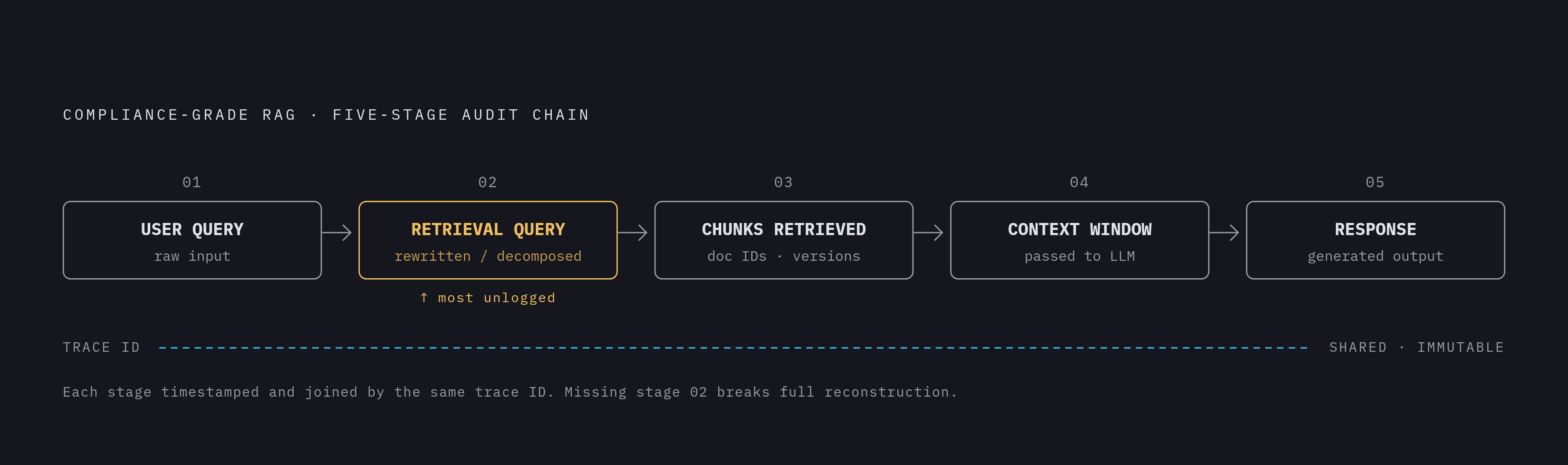
A traceable RAG pipeline requires a structured, immutable record at every stage from query to generation, not just at the output boundary. The complete record includes five components. The original user query. The retrieval query issued to the vector store, which may differ from the user query after decomposition or rewriting. The specific document chunks returned, with source document IDs and version timestamps. The full context window passed to the LLM. And the generated response. All of it must be timestamped and retrievable on demand. Each stage must share a deterministic trace identifier so the retrieval event, the model call, and the output can be joined into a single reconstruction.
Query-level authorization is a critical and commonly missed field. Robust pipelines apply pre-filtering at ingestion, blocking unauthorized data from ever being indexed, alongside post-filtering at retrieval, verifying that authorization remains valid at the exact moment of access. This dual control is what minimizes cross-context data leaks. Human oversight decisions also belong in the same trace. Approvals, rejections, and overrides must appear alongside the retrieval and generation events, not in a separate system, so that the reconstruction path from data input to decision output is unbroken. For RAG pipelines, this record must capture not just that content was fetched, but which sources responded, what was returned, and when. Seltz, as a web knowledge API designed for LLM reasoning, emits that data as a first-class audit event, sparing teams the work of retrofitting traceability after deployment.
The Decision Trace Schema paper offers the most actionable idea here: a tiered evidence strategy. Not every call needs a full trace. High-risk decisions do. Government procurement requires controlled data residency in logging environments.
Why upstream provenance deficits in training data and model supply chains propagate into retrieval traces
A team can instrument its RAG pipeline perfectly and still fail an audit if the indexed content itself has no verifiable provenance chain. RAG pipelines that index content derived from upstream sources inherit those sources' provenance deficits. The trace can reach the document chunk, but it cannot reach further back to confirm the chunk's own lineage. The model supply chain compounds the problem. Fine-tuned models show meaningful rates of license drift, meaning the terms governing a model's training data can change somewhere down the chain without the deployer knowing. That matters directly when a regulator asks about the reference database used.
The implication is that retrieval traceability is not only a pipeline instrumentation problem. Traceability architecture must specify what provenance attestations are required of content sources before they are indexed. The engineering response is cryptographic. Signing ingestion runs and snapshot manifests with a hardware-backed key and publishing the public key in a transparency log allows auditors to verify signatures offline. That extends the provenance chain backward from the chunk to the ingestion event. The data supply chain is acquiring the tools the software supply chain already relies on.
For live retrieval, the provenance question sharpens. Seltz is an example of a web retrieval platform built for regulated AI teams that logs retrieval events with full attribution and timing metadata, closing that specific gap. The principle is broader than any single vendor: the retrieval layer must be governed as part of the content supply chain, not treated as an external lookup.
How the web retrieval layer determines whether real-time grounding is auditable or opaque
Real-time web retrieval solves the staleness problem and introduces a distinct auditability problem. Static training data cannot substitute for live, factual, time-sensitive information. But a web page retrieved today may not exist tomorrow in the same form. The audit record must capture the content as retrieved, not just the URL, because the URL alone cannot reconstruct what the model was grounded on.
The design of the search API layer determines whether reconstruction is possible at all. Traditional SERP APIs return titles, URLs, and snippets in raw JSON. Each query-response pair must be captured with a shared trace identifier linking it to the downstream generation step.
Vendor coupling carries its own compliance risk. For regulated environments, portability of the retrieval record is a requirement, not a preference. The architectural difference between an API designed for human-facing search and one designed as a traceable retrieval layer in a governed AI system is whether that metadata exists at all. The web retrieval layer should be treated as a first-class component of the audit trail, not an external dependency that sits outside the trace.
Agentic pipelines and why multi-step retrieval makes traceability exponentially harder
In agentic systems, the unit of audit is not a single retrieval-generation pair but an extended action chain, and existing logging architectures were not designed for that unit. Agents execute tool calls, delegate to subagents, and take actions in the real world. The audit trail must reconstruct the full decision and action chain that produced an outcome, not merely a model output. The 2026 Singapore Consensus treats auditability as a design principle co-equal with least privilege and traceable identity. Its companion report on agentic risk management specifies that each agent in a multi-agent system must have a traceable identity, and that audit logs must be legible enough to support human oversight and intervention.
Context engineering makes the problem concrete. Managing the entire information environment for an agent includes provenance as a core quality criterion. What was loaded into the context window, from which source, at what timestamp, is precisely what audit logging must capture. A compliance-grade trace must capture not just what was retrieved, but what was surfaced in the model's effective attention window. A trace identifier that propagates across all agent hops is the minimum architectural requirement. The exponential difficulty comes from combinatorics: each additional hop multiplies the points where the trace can break, and a single missing identifier anywhere in the chain renders the whole chain unreconstructable.
Engineering retrieval traceability from the start rather than retrofitting it
Retrieval traceability is an order of magnitude cheaper to design in than to retrofit, and the architectural decisions made in early pipeline design determine whether a trace is reconstructable later. The first design decision is a shared trace identifier from the first call. Assign a deterministic, immutable trace ID at the moment of the user request and propagate it through every retrieval query, chunk retrieval, context assembly, model call, and output. This is the structural prerequisite for joining logs across layers, and retrofitting it after the fact means rewriting every service in the path.
The second decision is to log the retrieval layer as a first-class governance component. Record the retrieval query, not just the user prompt, along with the chunks returned, their source document IDs and version timestamps, and the authorization check that governed access. These fields are what EU AI Act Article 12's "reference database" requirement maps to in practice, combined with COSO's demand for a complete reconstruction path from input to decision. Seltz is built around that requirement rather than adapted to it.
The remaining decisions follow from these two. Apply query-level authorization as a dual control, with pre-filtering at ingestion and post-filtering at retrieval, so authorization is enforced at the moment of access, not only at indexing time. Treat human oversight decisions as trace events, with approvals, rejections, and overrides in the same immutable record as retrieval and generation.
The closing point is about durability. The distinction between a decision log and a traceable answer is not going away. The systems that close it will be the ones that last.