Conflicting Source Reconciliation in Multi-Document Grounding
Language models need to know which type of source conflict they're facing to resolve it correctly.

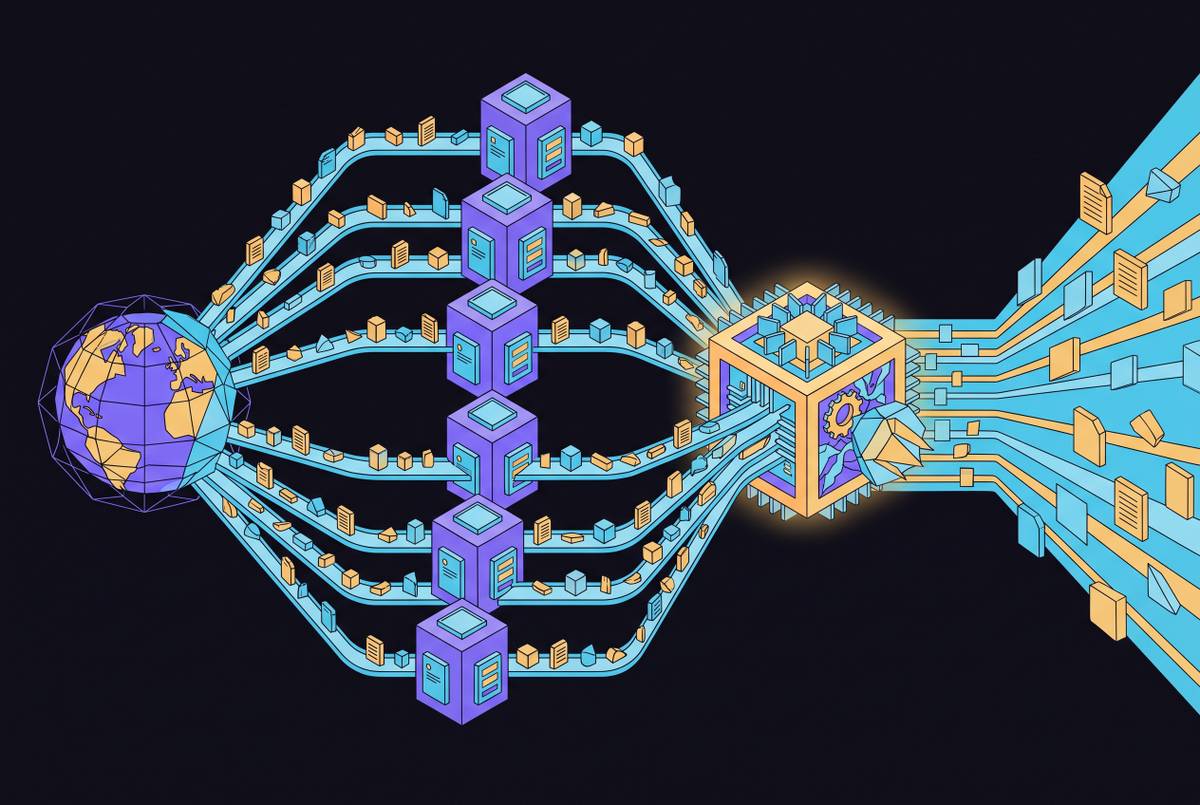
Multi-document grounding works by handing a language model several retrieved passages and asking it to answer from them. The trouble is that those passages routinely contradict each other, and nothing in a standard retrieval-augmented generation pipeline tells the model what to do about it.
Why multi-document grounding creates a conflict problem
A retrieval-augmented generation system pulls relevant passages from an index and inserts them into a prompt so the model can answer from evidence alongside memory. The design rests on an assumption that rarely holds up once a system runs against real content: that the retrieved passages agree with one another. In practice, a single query can return a statement that was true last year and one that is true now, two near-identical claims that differ in one important number, a handful of contradictory snippets pulled from different corners of the web, and sources whose authority depends entirely on when they were written, who wrote them, or which jurisdiction they apply to. None of this is unusual. It is what retrieval looks like at scale.
A pipeline built only to rank passages by relevance has no way to notice that two of its top results disagree. When that happens, the generation stage is left to improvise. It might pick one source arbitrarily and present it as settled fact. It might blend two incompatible claims into an answer that sounds coherent but asserts something neither source actually said. It might even invent a citation to smooth over a gap it has no real way to close. None of these are edge cases introduced by bad luck in retrieval. They are the predictable output of a system that was never given a way to detect disagreement.
The stakes rise sharply depending on where this happens. In healthcare, law, public policy, finance, scientific search, and organizational knowledge management, a system that quietly stitches together conflicting claims is producing a liability. A dosage figure drawn from an outdated guideline, a legal threshold that varies by state but gets presented as universal, a financial rule that changed last quarter and got averaged in with the old one: these are not formatting problems. They are the reason a conflict taxonomy has to come before any resolution strategy gets designed.
Treating all source conflicts as one problem produces resolution strategies that fail on most conflict types
Once it's clear that conflicting sources are a routine output of retrieval rather than a rare failure, the next question is whether one resolution method can handle all of them. It can't, and the reason is structural rather than a matter of degree. Research on conflict detection in search-augmented language models has established that assuming the conflict type is known ahead of time is usually unrealistic, and that applying one fixed method across different kinds of conflict produces worse outcomes than tailoring the response to the conflict actually present.
Consider what happens when a system defaults to always trusting its highest-ranked source. That rule works fine when the conflict is a freshness problem: an outdated claim loses to a newer one, and ranking by recency gets the right answer most of the time. The same rule falls apart on a question where opinions genuinely differ, because no single source is authoritative on a contested or value-laden matter. Surfacing the range of positions is the correct behavior there, not picking a winner.
The opposite default fails just as predictably. A system that always surfaces disagreement, regardless of how serious it is, becomes unusable in production the moment the conflict is trivial, a near-duplicate passage phrased slightly differently, or already resolvable by checking which source carries more institutional weight. Flagging every minor variation as a conflict buries the genuine ones in noise. And approaches built to select a single correct answer run into a separate wall in settings of genuine ambiguity, where conflict is expected and more than one answer is legitimately valid at once.
Benchmarks built specifically to test this, including CRAG, ConflictBank, and ConflictQA, make the diagnosis explicit: retrieval-augmented systems struggle with evidence that changes over time, with sources that disagree with each other, and with conflicts between what a model retrieves and what it already believes. The common thread across these benchmarks is that the systems aren't failing because they're blind to conflict. They fail because they can't tell which kind of conflict they're looking at, and without that classification, no single resolution rule will cover the range of cases retrieval actually produces.
The four conflict classes
Different research groups carve up this problem differently. ConflictRAG names three inter-document conflict types: factual, temporal, and opinion. DRAGged into Conflicts proposes a five-category scheme that includes no conflict, complementary information, conflicting opinions, outdated information, and misinformation. The groupings differ, but a practitioner building a system needs something organized around what can actually be detected and what response each detection calls for. Four classes cover the ground that matters.
Freshness conflicts arise when sources were each accurate at different points in time, and the current state of the world has moved past one or more of them. The signature is distinctive: sources agree on the kind of claim being made but disagree on the value, a rate, a policy figure, a product version, and that disagreement tracks publication or update dates. This class is most consequential in domains that move fast, current events, medicine, active scientific questions, where the gap between what a model learned during training and what is true right now can be wide and consequential.
Authority mismatches look different. Here, sources that are each current make incompatible claims because they carry unequal credibility, expertise, or institutional standing. The signature is a disagreement that maps onto source type rather than source date: a peer-reviewed study versus a blog summarizing it, a regulatory filing versus a news article paraphrasing it. Not every retrieved passage deserves equal epistemic weight, and resolving this class means modeling that variance rather than treating all retrieved text as interchangeable. This is a genuinely separate problem from freshness: both sources can be equally current, and the conflict still exists because one carries more weight than the other for the question being asked.
Near-duplicate divergence is the quietest of the four and the easiest to miss. Multiple passages describe what looks like the same underlying claim, but a small difference changes the meaning: a number that shifted slightly, a qualifier added or dropped, a scope condition narrowed or widened. The surface similarity between the passages is high enough that naive deduplication or clustering treats them as the same claim repeated, so the small delta between them gets lost. NightFeats, a system recognized at NeurIPS 2025 for its approach to this problem, handles it through atomic fact extraction paired with bounded contradiction reconciliation applied before any resolution step runs, because overlapping content and real contradiction aren't mutually exclusive. A system has to check for contradiction even among passages that look like corroboration.
Opinion spread is the fourth class, and it behaves unlike the other three in one important way: the conflict is not a problem to be solved. It arises on contested or value-laden questions where multiple sources hold genuinely different, internally coherent positions, and none of them is simply wrong. Recency doesn't resolve it. Authority doesn't resolve it. The correct response is to present the range of positions. Collapsing that plurality into one synthesized answer, the opposite failure from the freshness case, misrepresents what the actual state of knowledge looks like.
A fifth conflict class that cuts across all four: parametric-retrieved knowledge inconsistency
The model's own internal knowledge, learned during training, causes a second kind of disagreement affecting all four classes: it may agree with one retrieved source and disagree with another, and that agreement can point the system toward the right answer or lead it badly astray depending on which source happens to be correct.
This kind of conflict occurs when retrieved evidence disagrees with what the model already believes internally, and the result can be ambiguous or flatly wrong output even when the retrieval step itself did its job well. Much of RAG system design assumes that external retrieved evidence should override a model's internal knowledge as a matter of course. That assumption doesn't hold up. If the retrieval step returns a passage that's been poisoned, or one that's simply mistaken, deferring to it without question makes the model's output less reliable than relying on its own training would have been.
The CoRe-MMRAG framework gives this problem a name, Parametric-Retrieved Knowledge Inconsistency, and treats it as its own diagnosable failure mode separate from the four classes above. Its proposed pipeline runs in four stages: the model first answers using only its internal, parametric knowledge; it then selects the most relevant multimodal evidence from what's been retrieved; it generates a separate answer grounded in that external evidence; and finally it integrates the two answers, weighing both on their merits. That last step matters because it refuses the easy shortcut of always trusting retrieval or always trusting memory.
What this means for the four-class taxonomy is that parametric knowledge functions as a fifth source, one that's always present whether or not anyone asked for it, and its authority has to be judged differently depending on which conflict class it's weighing in on. For a freshness conflict, parametric knowledge can be a liability, since the model may have learned an outdated value during training and recall it with full confidence. For an authority mismatch, it can function as a tiebreaker if the model's training drew on credible sources. For opinion spread, it's dangerous in a different way: the model may have absorbed one side of a contested question as settled fact during training, and treating that internal belief as an arbiter would flatten a legitimate disagreement into a false certainty. A system that can't locate its own parametric knowledge relative to the conflict in front of it cannot correctly classify that conflict, and classification has to happen before any resolution step runs.
Resolution strategies matched to conflict classes
The five-part map, four conflict classes plus the parametric layer, only earns its keep if each class routes to a different concrete action. Treating the map as a taxonomy to admire rather than a set of decisions to make defeats the purpose.
Freshness conflicts call for recency-weighted retrieval and timestamp-aware ranking. The fix lives on the retrieval side: surface the most recent authoritative source on a given fact and push older claims about the same fact down or out. This is why a retrieval index needs to be kept continuously updated. A model's training data, frozen at some cutoff date, cannot substitute for live, time-sensitive retrieval, and the update cadence of the index needs to match how fast the underlying domain actually changes.
Authority mismatches call for source reliability estimation and weighted evidence fusion. This means assigning credibility weights to retrieved passages based on source type, domain expertise, and institutional provenance before generation ever sees the evidence, not picking whichever source ranked highest for relevance and not blending every source as if they carried equal weight. A highly reliable source that's a bit older can still outrank a less reliable one that's more recent, particularly in a domain where facts don't shift quickly. That's a different calculation from recency weighting, and conflating the two produces the wrong answer in both directions.
Near-duplicate divergence calls for atomic fact extraction paired with severity-tiered contradiction handling. The design move that matters here is classifying the divergence before deciding how to respond to it. A minor phrasing difference calls for simple fact weighting. A material factual divergence calls for a fresh retrieval pass aimed at resolving it, not a generation-stage attempt to synthesize two numbers that can't both be right. Applying the same response to every level of divergence wastes time on the trivial cases and under-reacts to the serious ones.
Opinion spread calls for perspective enumeration with the uncertainty stated outright rather than smoothed over. The right response to a genuine difference of opinion is to present the range of views, because the task here is generative. EvidentialRAG's approach, treating retrieved sources as probabilistic evidence rather than as fixed, settled context and exposing disagreement instead of suppressing it, fits this class specifically: abstaining from a single answer, or stating the uncertainty outright, is the correct output when the underlying disagreement is real and not resolvable by better evidence. Mistaking opinion spread for an authority mismatch is a common design error, because opinion spread doesn't go away once a more credible source is found. Both sources can be equally credible and still disagree.
Parametric-retrieved conflicts call for staged arbitration that weighs both sources on their merits. Micro-Act's self-reasoning framework handles this by having the model adaptively break each knowledge source down into fine-grained comparisons through a hierarchical action space, rather than setting the two sources side by side and picking one. The arbitration itself should depend on which conflict class is in play: for a freshness conflict, retrieved evidence should generally win over the model's internal knowledge; for opinion spread, the model's internal knowledge is just one position among several, not a referee.
Conflict detection as a prerequisite: how a system identifies which class it is facing
None of these resolution strategies work if the system applying them can't first tell which conflict class it's facing. A system that misclassifies a freshness conflict as an authority mismatch will weight the wrong signal and land on the wrong answer about as often as it lands on the right one. DRAGged into Conflicts treats detection, the step of identifying whether a conflict exists and what kind it is, as something that has to happen before any resolution logic runs at all, not as a nice-to-have layered on top of a working pipeline.
Each conflict class needs its own detection signal, and the signals don't transfer across classes. Freshness conflicts are detectable from document metadata: publication date, last-modified timestamp, version markers, provided the retrieval pipeline actually preserves that metadata and carries it through to the point where a decision gets made, rather than stripping it out during indexing for the sake of a cleaner embedding. Authority mismatches need source-level credibility signals, domain provenance, document type, institutional markers, encoded when the document is first indexed rather than guessed at when the model is generating an answer and has no good way to look it up. Near-duplicate divergence needs atomic fact extraction and clustering at a finer grain than the sentence or passage level, because surface similarity between two documents is exactly the signal that misleads a system into treating genuine contradiction as agreement.
Get the detection step wrong, and the most carefully matched resolution strategy in the world never gets the chance to run on the right conflict. The practical order is fixed: classify first, resolve second, and build the pipeline so that order can't be skipped.
Sources
- NightFeats @ MMU-RAGent NeurIPS 2025: A Context-Optimized Multi-Agent RAG System for the Text-to-Text Track
- EvidentialRAG: Quantifying and Mitigating Information Conflict in Multi-Source Retrieval-Augmented Generation via Evidential Deep Learning
- DRAGged into Conflicts: Detecting and Addressing Conflicting Sources in Search-Augmented LLMs
- Micro-Act: Mitigating Knowledge Conflict in LLM-based RAG via Actionable Self-Reasoning
- ConflictRAG: Detecting and Resolving Knowledge Conflicts in Retrieval-Augmented Generation