Live Index Freshness Requirements for Production RAG Grounding Pipelines
Production RAG systems need architecture that syncs updates across retrieval, vectors, and cache.
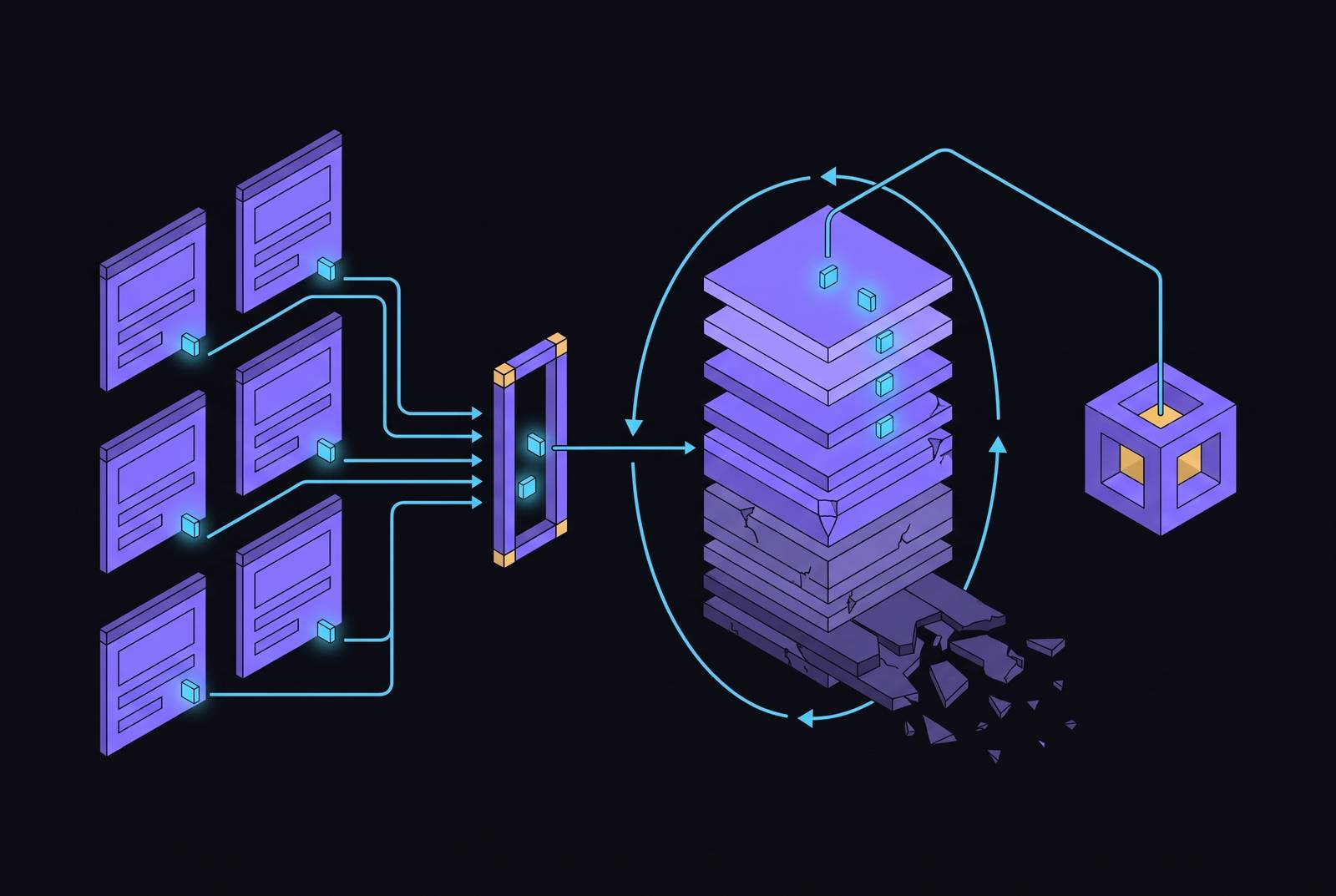
Real-time web knowledge for production LLM grounding requires a synchronization contract between retrieval, the vector index, metadata, and cache. Giving a deployed model live web access is not enough if its answers still draw on stale chunks or cached results. Production freshness depends on architecture that makes updates, deletions, and permission changes retrievable within a defined delay, with provenance attached.
Why freshness is a synchronization contract, not a monitoring add-on
Teams often respond to stale answers by monitoring ingestion throughput and adding alerts. Those measures show where things go wrong but do not fix the synchronization path. A retrieval service can look healthy even when its source data, vectors, metadata, and cache hold different versions of the same document. The structural requirement is a contract defining how a change crosses those boundaries and when every retrieval-facing component must reflect it. Monitoring can then test that commitment.
The resulting answer failure is easy to misdiagnose. A model may give a confident, well-cited response that accurately describes an earlier state of the world. That is temporally displaced grounding. An agent asked whether a company changed its CEO could answer from an index that was accurate months ago, although the leadership changed last week. Larger context windows do not remove this problem because a large context window is not a live database. If a knowledge base updates hourly, retrieval at query time remains the path for exposing those updates to the model.
The three staleness vectors that operate simultaneously in every pipeline
Ingestion lag begins when a source changes but the indexing pipeline sees the change late or not at all. Infrequent polling, silent webhook failures, backed-up change-data capture streams, and weak SaaS change signals can all create this gap. Throughput alone does not reveal the delay. The corrective mechanism is reliable change detection and propagation, measured from source update to retrievable answer.
Delete propagation failure has a different cause. A document disappears at its source, but no corresponding event removes it from retrieval. For example, deleting a document in Confluence can leave cached chunk IDs active if the metadata index never marks them inactive. The fix requires source-deletion events, tombstones, and cache invalidation wired into synchronization.
Embedding drift can happen even when the source text stays the same. A new embedding model, revised chunking rules, or altered parsing can make existing vectors incompatible with current retrieval behavior. Version metadata and selective rebuilds address this gap by identifying which embeddings need replacement. Caching compounds all three because a retrieval result or answer can remain stale after the index has been corrected.
How ingestion architecture determines which freshness SLA is even achievable
Polling, webhooks, and change-data capture establish different limits on achievable freshness. Polling is the simplest pattern, but detection waits on the poll interval. It is sufficient for internal knowledge bases where hourly lag is acceptable and for low-volatility archives. A batch schedule cannot satisfy a shorter freshness commitment through downstream tuning. The source change must first become visible to the pipeline.
Webhooks reduce that detection delay by making ingestion event-driven. They also require explicit delivery confirmation and fallback polling because network interruptions or source-side misconfiguration can cause silent failures. For customer support or live-pricing contexts that need updates within minutes, webhook-driven incremental indexing with a polling fallback fits the requirement.
Change-data capture tracks INSERT, UPDATE, and DELETE operations in relational databases, but unstructured sources lack the same native schema. To detect when a file changes, the pipeline must instead use signals such as content hashes, modified timestamps, or version-control commit history. That substitution adds operational work and can leave weaker change signals to reconcile. Moving from nightly batch to CDC-style processing can bring daily cycles down to sub-minute freshness, but it makes the pipeline much harder to run. The trade-off is justified when outdated pricing, superseded policies, or other stale content creates measurable business risk.
Incremental indexing and document versioning as the mechanism for safe partial updates
Full re-indexing is too blunt to serve as the primary production freshness mechanism. It consumes substantial compute and may cause application downtime. Small knowledge bases can accommodate rebuilds during dormant periods, but larger pipelines need updates confined to changed documents, new additions, and deletions. Partial updates require explicit bookkeeping to remain safe. Otherwise, the pipeline cannot distinguish a harmless metadata edit from a change that invalidates existing vectors.
The versioning schema supplies that distinction for every chunk. A source ID links it to the authoritative source it came from, and a content checksum shows whether the text changed. The chunk schema version and embedding model version reveal incompatibility caused by pipeline changes. A scrape timestamp and source URL establish provenance for freshness scoring and auditable citation. Together, these fields replace the “scrape once, embed, forget” approach with tracked, versioned chunks.
Update decisions follow directly from those records. Metadata-only changes can be patched in place, while changed text with an unchanged model and schema requires re-embedding the affected chunks. A model or schema change instead triggers a selective rebuild. Content criticality and diff size should govern re-embedding policy, so a minor formatting correction in a low-stakes archive does not receive the same treatment as a revised policy page. The version record also makes those decisions auditable.
Tombstones, delete propagation, and stale-cache invalidation as first-class pipeline events
A permission revocation exposes the danger of treating removal as cleanup. When a user loses access, answers grounded in the restricted document must stop within the time set by the revocation commitment, even if the next routine content refresh is due later. That requirement makes deletion a first-class synchronization event. An ingestion pipeline that handles only new and changed documents leaves removed content available for retrieval unless it also has a path to remove it.
A tombstone records that a source document is deleted and propagates that state through the retrieval system. Its path must mark chunk IDs inactive in the vector index, update the metadata index, and invalidate cache entries keyed to those chunks. Deletion is incomplete until those retrieval-facing changes take effect. Without propagation, the model can continue citing content the organization deliberately removed.
Cache invalidation must therefore run in step with index updates and tombstones, with its schedule tied to those events. A stale answer cache can negate otherwise successful removal upstream. Permission changes also require access-control metadata to be enforced before or during vector search. This defines the enforcement boundary for the synchronization event. Content freshness and authorization freshness may use the same infrastructure, but they can allow different delays.
What a freshness SLA actually specifies and how to measure it in production
A freshness SLA defines the maximum delay between a source change and that change becoming retrievable. A refresh schedule is not the same commitment. “We refresh daily” describes an activity, while “no source change takes more than X minutes to become retrievable” defines an outcome that can be tested. High-risk policies, pricing, and permissions need commitments measured in minutes, and a 60-second revocation target is a tough requirement for permission changes to meet. Support may need hourly or near-real-time freshness, while archives that rarely change can wait for daily or weekly rebuilds.
Freshness lag measures source-update-to-retrievable-answer time and directly exposes ingestion delay. Sync success rate measures the share of change events that made it through propagation and shows where webhook or CDC delivery failed. Tombstone backlog counts deletion events still awaiting propagation. Cache invalidation misses identify retrievals served from stale cache after an index update, while recovery time after failed jobs measures how long the pipeline takes to return to its SLA. Together, these measures reveal where synchronization stalls.
Embedding drift needs a version-aware interpretation of those measurements. Source-update lag alone cannot show a model or chunk-schema change because the text may have stayed the same. The versioning contract sets out which selective rebuild must be checked for completion. Observability now has a precise role to perform. Brief lag can be tolerable when failure is bounded, detectable, and recoverable, but it must remain visible against the stated commitment rather than disappear inside a healthy throughput chart.
Why the freshness contract breaks when the web retrieval layer is not built for it
Live web grounding extends the contract beyond the internal pipeline to content acquisition. Traditional SERP APIs return ranked URLs and short snippets, leaving the application to fetch, parse, clean, and chunk each result. Each extra step adds latency and one more place where things can fail. Scraping tools face bot detection, JavaScript rendering, and structural changes that can yield empty or malformed chunks despite apparently successful ingestion. Internal versioning cannot repair content that never arrived correctly.
Publication date, scrape timestamp, content hash, and source authority signal serve different purposes in evaluating a result. Without those signals, the pipeline lacks the basis for freshness scoring or down-weighting stale passages. An indexed passage needs more than a URL. Its provenance must let the retrieval system tell when content was just acquired but the information in it is old.
Web search APIs built for AI pipelines return pre-extracted passages with source URLs and publication dates that are ready to go into prompts. This moves extraction and part of provenance capture into the infrastructure layer rather than leaving every application to assemble them. The selection criteria remain passage readiness, available timestamps and hashes, and latency and reliability commitments. These criteria matter especially for agents because a ranked URL list still leaves them with a second acquisition step before they can ground an answer.
The security and compliance dimensions of the freshness contract in enterprise deployments
Freshness is part of compliance when retrieval serves policies, pricing, or legal documents that fall under regulations. An accurately cited but superseded policy is not made safe by its citation. The contract must define how quickly the current version replaces it and how quickly deleted or restricted content stops being available. Content updates, deletions, and permission changes therefore need explicit freshness commitments. Their consequences differ even when they travel through the same pipeline.
Authorization must still be enforced at the retrieval boundary. A vector index without enforced access-control metadata can retrieve internal escalation procedures for a customer-facing query. A post-retrieval check is a fragile substitute because the wrong document has already crossed that boundary and may have entered context. Permission propagation must keep the state used before or during search up to date. For agentic systems, that state must reflect the human user's scope rather than treat the agent as an elevated credential.
External web retrieval adds a separate governance constraint. Every query sent to an external API leaves the organization's infrastructure, which creates privacy considerations for sensitive or regulated content. The acquisition design must account for that exposure as well as freshness. This supports retrieval infrastructure that keeps data under enterprise control where the deployment requires it. A lower-latency answer is not an adequate trade if obtaining it violates the data-governance conditions of the system.
Designing the synchronization contract before adding observability
The design starts at the source boundary. Each source needs a sync mechanism, a fallback when it fails, and an achievable freshness limit that the downstream pipeline can honor. The document versioning schema then defines which fields travel with every chunk and which changes trigger a metadata patch or re-embedding. The delete propagation path must reach the vector index, metadata index, and cache, with a distinct commitment for permission revocation. Cache invalidation rules must tie affected keys to those events and relate cache lifetimes to the content's SLA tier.
Re-embedding policy follows from that versioned update path. It distinguishes selective rebuilds caused by model or chunking changes from re-embedding an affected chunk after a text edit. Content-category SLAs then express the maximum allowed lag as testable commitments. For live web sources, those commitments extend to the retrieval API's provenance fields, latency, and reliability.
Only then does observability have a defined target. Instrumentation measures the gaps the contract names instead of discovering unintended behavior and forcing the team to reconstruct its causes. The practical action is to write the synchronization contract first, then monitor whether the pipeline honors it.