Grounding Architecture Tradeoffs When AI Agents Depend on Live Web Retrieval
Design passage-level retrieval to manage latency, freshness, and context costs together.
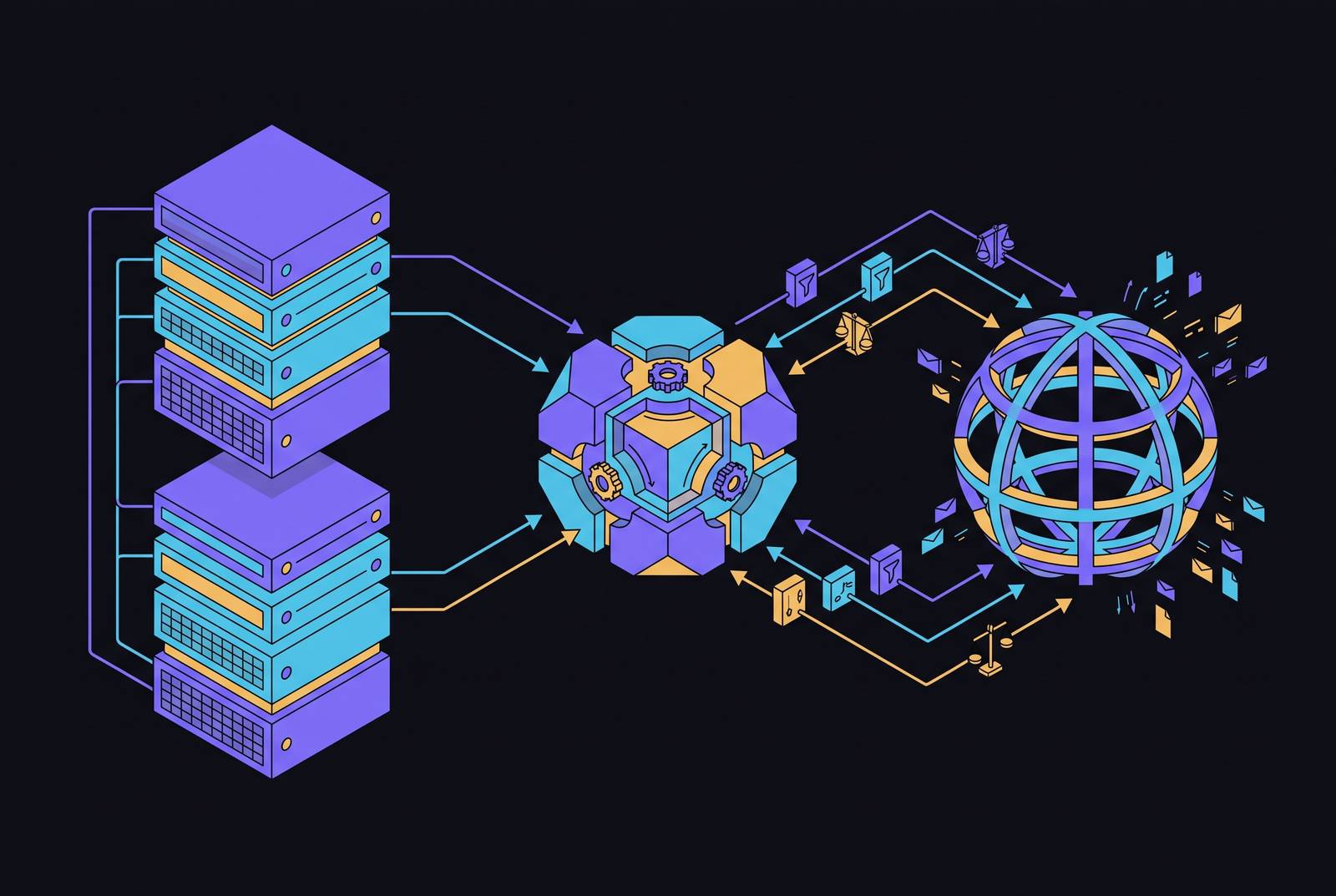
A web search API for AI agents and RAG pipelines needs to deliver usable evidence. The strongest fit depends on passage-level retrieval, freshness controls, provenance, and latency across the complete reasoning workflow. Grounding architecture succeeds when these capabilities are designed together, because retrieval choices propagate into context quality, GPU memory demand, operational control, and security.
Why the web's existing delivery infrastructure fails AI agents
Search services return URLs and ranked snippets, while content delivery networks cache URL-addressed objects. Neither abstraction knows which passage an agent needs for its next reasoning step. Peichun Hua and Yunming Xiao’s Semantics Delivery Network paper identifies this mismatch between document delivery and agent consumption. Language models need short, semantically coherent chunks selected for downstream utility, rather than full documents ranked by generic relevance. The delivery unit and reasoning unit do not align.
The SemDN research shows that page-first retrieval processes two to three orders of magnitude more content than agents actually consume. This overhead comes from how content is delivered, rather than from a single flaw in how the system was built. An agent must work through content laid out for a person visiting a page to get the smaller amount of evidence it needs for its task.
Agentic workloads amplify the problem because retrieval is repeated. Agents retrieve, reason over evidence, adapt their questions, and retrieve again within tight latency budgets. A path designed around a single human page load therefore imposes its overhead across successive reasoning turns. Meanwhile, LLM-generated content is flooding the web corpus and worsening its signal-to-noise ratio.
What it means to shift the unit of retrieval from documents to passages
Retrieval granularity determines how much irrelevant material reaches the model. Microsoft’s Web IQ announcement states the design principle directly. “Models do not need documents, they need information and documents are often a poor proxy for that”. Passage-level retrieval concentrates useful signal. Its objective is fewer tokens, better answers, and lower cost per call.
The SemDN research finds that delivering chunks gives better answers per context token. Every token sent to a language model adds cost and latency, so document content the model does not need costs especially much when agents make repeated calls. The same research identifies task-local chunk reuse that URL caches cannot see. A passage-level index can spot when the same evidence is needed again without fetching the document again.
Passage extraction does introduce a cost and a risk. Preprocessing takes time, and cutting a passage out of the text around it can remove context it needs. When extraction happens at index time, however, its latency is incurred once. Full-document injection skips the choice of what to extract but adds more to the model’s input on every call. The architectural choice is therefore where to perform selection.
The latency-freshness tradeoff and where it bites hardest
Web IQ’s architecture documentation describes orchestration latency as “not just user-visible but structurally significant”. With fast retrieval, an agent can afford multiple reasoning steps, while slow retrieval forces it to compress its work into a single attempt. Faster evidence delivery therefore changes the reasoning workflow available to the system. It does not simply make the same answer appear sooner. Yet reusing an earlier result to save time can undermine tasks whose answers depend on recent changes.
Web IQ illustrates this constraint with a support agent seeking a vendor advisory published this morning and a research assistant locating a recently updated regulation. Stale evidence cannot substitute for the requested information. Semantic similarity alone does not resolve the problem because superseded facts can closely match a current query. The model may then reason coherently from outdated evidence. The resulting error is a grounded hallucination.
FreshCache research proposes risk-constrained semantic caching around whether a prior result can safely be reused. Recency sensitivity becomes part of that decision. Stable factual queries can tolerate cache hits, while time-sensitive queries cannot rely on reuse that sacrifices freshness. A production pipeline consequently needs query-class-aware caching policies. Otherwise, it spends latency unnecessarily on stable questions or compromises freshness on changing ones.
How retrieval depth choices propagate into context window and GPU memory pressure
Deeper retrieval makes the prompt longer because RAG puts what it retrieves inside the model’s context. That expansion reaches beyond the retrieval service. As context grows, the key-value cache, or KV cache, can surpass model weights as the dominant consumer of GPU memory. Long contexts combined with meaningful batch sizes can make this cache a substantial practical constraint. Retrieval depth thus influences which hardware can support the deployment.
This constraint changes the economics of repeated retrieval. Each additional reasoning turn can add both evidence and latency, so agentic RAG costs do not necessarily grow linearly with the number of steps. Repeated retrieval also incurs the memory cost of supporting the resulting context. A retrieval service can return more evidence while making the overall deployment harder to run. Measuring search quality on its own leaves out that effect.
Hybrid dense retrieval with BM25 and a reranker adds a moderate reranking cost while retaining a linear pipeline. GraphRAG supports multi-hop reasoning but introduces substantially higher indexing cost through LLM-based entity extraction and adds graph-traversal latency to queries. It can store its knowledge graph as Parquet files beside a vector store without a dedicated graph database. For simple factual lookups, those extra steps add cost even though the task has no need for multi-hop reasoning.
Context engineering as the discipline that determines what retrieval depth actually buys
More retrieved material helps only when the context is shaped for the task. Selection and filtering determine what enters the prompt through relevance scoring, recency weighting, and salience thresholds. Compression and distillation then reduce its size through extractive summaries, abstractive summaries, or distilled facts. These operations determine what retrieval depth actually buys. Without them, additional evidence can become additional noise.
Semantic similarity is not the same as task utility. A chunk can resemble the query while contributing no fact needed to complete the task. Resham Joshi’s Eywa architecture paper also cites failures in long-context models that depend on where evidence sits, including trouble using relevant evidence in the middle of an input. That limitation makes context assembly a design constraint. Maximizing the amount retrieved cannot compensate for evidence the answer model fails to use.
Eywa implements a bounded, deterministic multi-route read path with zero LLM calls inside retrieval. It returns retrieved context separately from answer instructions and preserves provenance so failures can be diagnosed by layer. This separation makes retrieval behavior distinguishable from answer-model behavior. Context engineering therefore belongs in the architecture. Deep retrieval without reranking or compression can produce more expensive wrong answers as noise compounds across the reasoning chain.
Pipeline ownership versus third-party convenience and what each choice forecloses
The build-or-integrate decision determines which parts of that chain a team can control. Third-party services take less time to integrate and less engineering work upfront. That convenience is a real architectural benefit. However, assembling multiple APIs, MCP servers, and data sources also adds coordination work, latency, and operational complexity. Web IQ’s documentation presents its end-to-end design as a replacement for this patchwork.
Web IQ describes a full-stack approach spanning crawling, indexing, embedding, retrieval, and evidence assembly. Its architecture treats networking, data placement, and execution paths as design variables, with a DiskANN retrieval fabric optimized around latency constraints. By contrast, SERP-style APIs that return only short metadata snippets leave evidence preparation to the consuming pipeline. Production synthesis then requires additional URL fetching, JavaScript execution, boilerplate removal, and structured-text extraction. Each step adds latency and another place where something can go wrong.
Freshness exposes a further limit on delegated control. A third-party index can return a newly published advisory only after it has discovered and indexed that advisory, while the consuming team cannot control crawl frequency or prioritization. Robin Dey and Panyanon Viradecha’s Infrastructure for the Agentic Web gap analysis identifies observability and memory among 62 missing infrastructure capabilities across agent platforms. Teams cannot directly instrument pipeline internals they do not control. As reliability and throughput requirements grow, freshness gaps, opaque failures, and lack of data ownership can constrain what the integrated system can guarantee.
Security threats that only exist when agents retrieve from untrusted web content
Live web retrieval lets adversaries place instructions in material an agent encounters as evidence. The model processes that material in the same token stream as trusted instructions, user input, and conversation history. There is no hardware-enforced boundary between those categories. An instruction disguised as retrieved data therefore cannot be reliably distinguished from a legitimate instruction through model safety training alone. Opening retrieval to the web changes who can supply content to that stream.
Google’s Security blog and Forcepoint X-Labs published concurrent analyses in late April 2026 documenting evidence of adversaries experimenting with hidden web instructions aimed at agents, coding assistants, and enterprise copilots. Aim Security disclosed EchoLeak, CVE-2025-32711, in June 2025. With a CVSS score of 9.3, it was the first documented zero-click prompt injection exploit to achieve concrete data exfiltration against a production AI system, targeting Microsoft 365 Copilot. CVE-2025-53773 showed that prompt injection hidden in pull request descriptions could allow remote code execution, with a CVSS score of 7.8.
A privileged LLM processes only trusted user queries and generates a structured plan. A quarantined LLM handles external material but cannot modify that plan. The boundary belongs at the data-access layer. Reliance on vendor model defenses and policy documents alone does not provide this separation for agents with access to mail, code, payments, and file shares.
Provenance becomes a security primitive within that design. A pipeline needs to know where content comes from to enforce the intended trust boundary. Eywa illustrates the supporting evidence discipline by storing immutable source evidence before derived facts become canonical. Every canonical fact remains linked to its evidence, and retrieved context stays separate from answer instructions.
How the tradeoffs compound across the full pipeline and what production-grade grounding requires
A document-versus-passage decision reaches far beyond the search response. It changes context size, which changes KV cache pressure and the need for reranking and compression. Those operations consume part of the latency budget available for each reasoning step. The time left determines how many turns the agent can afford and whether it can still carry out multi-hop tasks. A locally attractive component can therefore constrain the workflow it was intended to improve.
Ownership and security tighten those dependencies further. A team using an external crawl and index has no direct lever when a time-sensitive query returns superseded information. That gap calls for an infrastructure change. Likewise, P-LLM/Q-LLM separation depends on provenance generated during retrieval. A pipeline that omitted source tracking cannot adopt that boundary without redesigning its evidence path.
The Agentverse gap analysis places these dependencies in a wider infrastructure progression, from ephemeral key-value storage to a full Agent Memory Cloud, from keyword-based discovery to a semantic, trust-weighted Agent DNS, and from single-instance hosting to agent-native orchestration at Kubernetes scale. Eywa’s benchmark results provide a complementary example at the memory and retrieval layer. Its high accuracy on LoCoMo, LongMemEval-S, and BEAM under a frozen retrieval configuration demonstrates strong performance across diverse tasks within a coherent, provenance-grounded architecture.
The engineering implication is to evaluate a web search API as part of the entire grounding path. Passage-level indexing, freshness controls, provenance tracking, end-to-end pipeline ownership, and latency guarantees address connected constraints. Their value depends on how they work together. Production-grade grounding requires an architecture designed around that propagation before load exposes dependencies a demonstration can conceal.